Sweep Picking Note Count Calculator
Estimate total notes, picked strokes, string crossings, and practice time for arpeggio sweeps.
| Shape | Common sweep span | Typical note layout | Calculator adjustment |
|---|---|---|---|
| Major triad | 3 to 5 strings | Mostly one note per string with a doubled top string | Adds no extension notes |
| Minor triad | 3 to 5 strings | Similar picking count to major with a different fretting shape | Adds no extension notes |
| Diminished 7 | 4 to 6 strings | Symmetrical movement often looped through inversions | Adds 1 extension note per pass |
| Major 7 | 4 to 6 strings | Extended arpeggio with a wider top-string target | Adds 1 extension note per pass |
| Minor 7 | 4 to 6 strings | Extended arpeggio often used in fusion lines | Adds 1 extension note per pass |
| Add9 spread | 5 to 6 strings | One extra color tone makes the pass longer | Adds 2 extension notes per pass |
| Tempo | Sixteenth notes | Triplet sixteenths | Thirty-second notes |
|---|---|---|---|
| 60 BPM | 4 notes/sec | 6 notes/sec | 8 notes/sec |
| 90 BPM | 6 notes/sec | 9 notes/sec | 12 notes/sec |
| 120 BPM | 8 notes/sec | 12 notes/sec | 16 notes/sec |
| 160 BPM | 10.7 notes/sec | 16 notes/sec | 21.3 notes/sec |
| Direction choice | Best fit | Crossing feel | Counting note |
|---|---|---|---|
| Downstroke lead, ascending | Low-to-high arpeggio bursts | Natural rake toward thinner strings | One crossing for each string change |
| Upstroke lead, descending | High-to-low return figures | Natural rake toward thicker strings | One crossing for each string change |
| Return sweep | Continuous up-and-back loops | Crossings double unless reset | Apex repeat changes note count |
| Alternate reset | Short licks with a gap between reps | Cleaner start, more idle motion | Rest time matters in the total |
| Preset | Strings | Shape | Practice target |
|---|---|---|---|
| 3-String Major Triad | 3 | Major triad | Clean entry and exit strokes |
| 5-String Major 7 | 5 | Major 7 extension | Longer arpeggio contour |
| 6-String Diminished 7 | 6 | Diminished 7 | Symmetrical sweep endurance |
| Legato Top-String Sweep | 5 | Minor 7 extension | Picked versus slurred note control |
Sweep picking seems tricky to begin with. You watch as some guitarist picks from string to string in a continuous gesture and it sounds like magic. So then you grab your guitar and attempt that run. Instead of it sounding magical, you hear three notes at once. The sound is muddled, and your pick heads for the ceiling.
It’s not usually talent. It’s almost always physics. You must keep precise rhythm while your picking hand move across one string and your fretting hand jumps positions on the next. This gap in coordination are where most player give up.
How to Learn Sweep Picking Easily
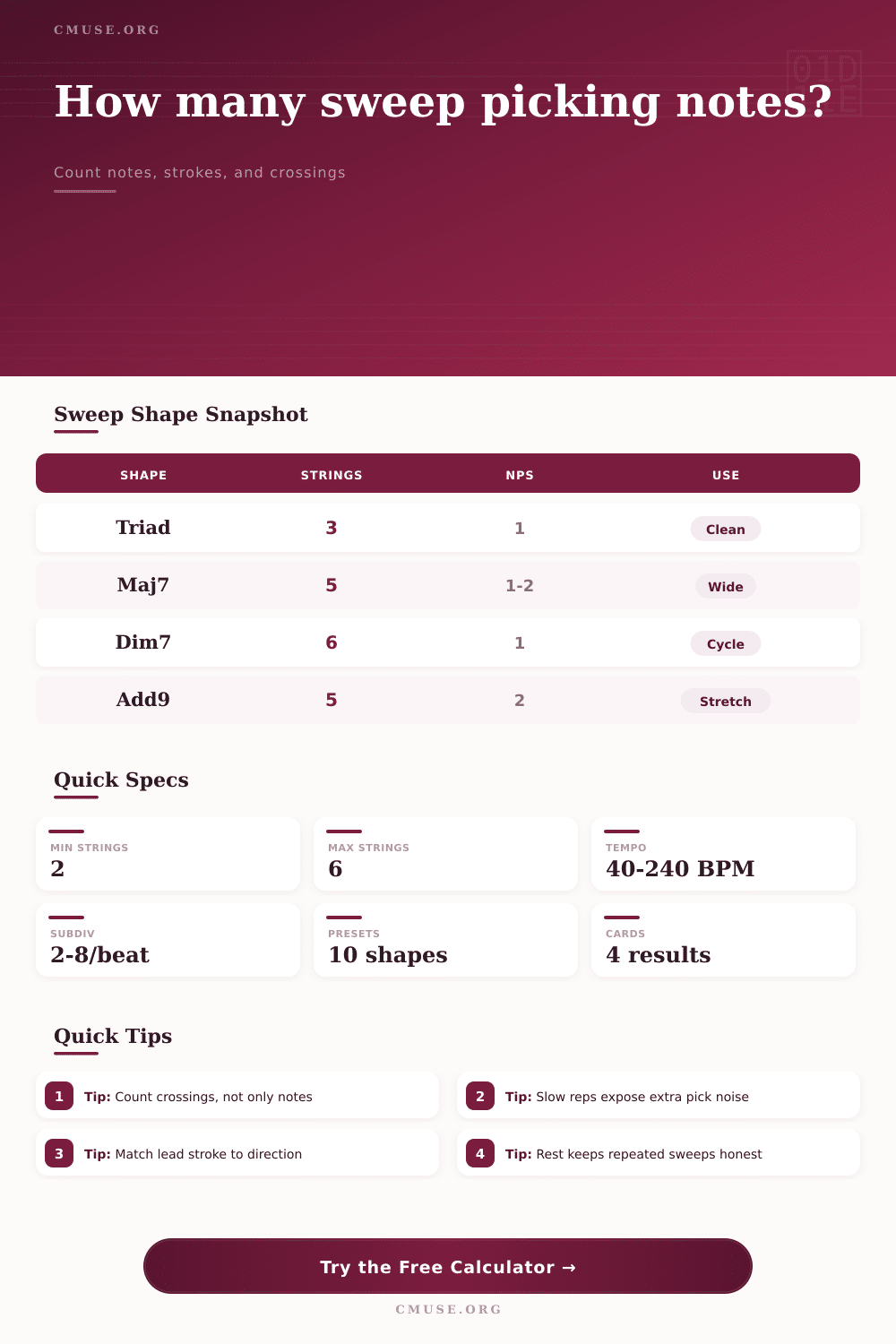
That’s what that calculator does for you. It measures the gap between what you think is hard (guess) and what realy is hard (data). You put in the info. How many strings, what arpeggio shape, the desired tempo, and get an exact number of string crossing and pick strokes you’re about to commit to.
Why does this matter? Because sweep picking fall apart at these transition points. Most often, the notes themselves is easy to finger. Where they go wrong is at the exact instant when the pick leaves one string and strikes the next. Count them and know their rhythm. Then, you will begin to treat the technique less as a mystery and more than a mechanical issue with a solution.
Starting out on too many strings or going too quickly are other common mistakes that most beginner guitarist make. They try to conquer the six-string diminished run before they have mastered the three-string major triad. This tool lets you separate those variable. Selecting a basic three-string major shape with the tempo set at a leisurely sixty beats per minute forces you to concentrate on the mechanics of the stroke instead of the end result.
Then as you introduce additional strings or raise the subdivisions to sixteenth notes the math begin to reveal just how much faster you need to pick. Even keeping the tempo the same, moving from quarter notes to thirty-second notes puts four times the demand on your picking hand. That’s where people go wrong. They assume it’s all about the BPM, when in fact switching up the subdivision often represent a larger leap in difficulty.
There’s a small extra use for articulation regarding accuracy and stamina. By using the calculator you can account for legato techniques such as pulling or hammering a note instead of picking it. On paper this may appear as a short cut but it alter the whole feeling of the sweep. Developing pure picking creates muscle memory through the forearm and wrist.
To get accurate results when using legato, the timing between your fretting fingers and hand must be exact. If you hammer on too soon, you end up with two notes. Too late, and you hit an open string. The articulation setting will show you how many strokes comes from your pick versus how many come from your finger strength. This can be key when developing a well-balanced technique that doesn’t overwork one area of the body at the expense of another.
Finally, don’t neglect the “rest” portion of your dry run. Although it may seem like cheating, a brief pause between reps allows you to begin each new sweep with renewed intention. Fatigue can cause sloppy form if we continuously loop without pausing. You should of practiced this more too. This rest period is built into the tool so you have a good idea about how long a practice session will realistically last. Avoid overestimating what’s achievable during one sitting, then map out chunks of work that makes sense.
At its heart then, sweep picking isn’t so much about how fast as it is about control. Precision for volume. Each crossing has to be purposeful. Cleanly placed every single time.
The trick is to break it down into time, strokes, and note counts. That way there’s no intimidation factor. It becomes just a series of little things to do again and again each one becoming part of a smooth whole. Begin slowly. Count the number of crossings. Let your ears follow the math and let the muscle memory start. Magic happens once you get the mechanics.