Sweep Length Calculator
Estimate logarithmic sine-sweep duration, low-frequency cycles, capture time, and response-tail allowance for room, loudspeaker, subwoofer, and PA measurement sessions.
Load a real measurement target, then adjust the frequency span and cycle requirement. Longer sweeps spend more time at the bottom octave, improving repeatability where rooms and subwoofers are hardest to measure.
Formula basis: logarithmic sweep duration is estimated from the requested cycles at the start frequency, then scaled by octave span and measurement priority. Capture time adds pre-roll, fade pad, IR tail, and repeats.
Sweep Breakdown
| Measurement target | Frequency span | Cycle target | Suggested sweep | Useful when |
|---|---|---|---|---|
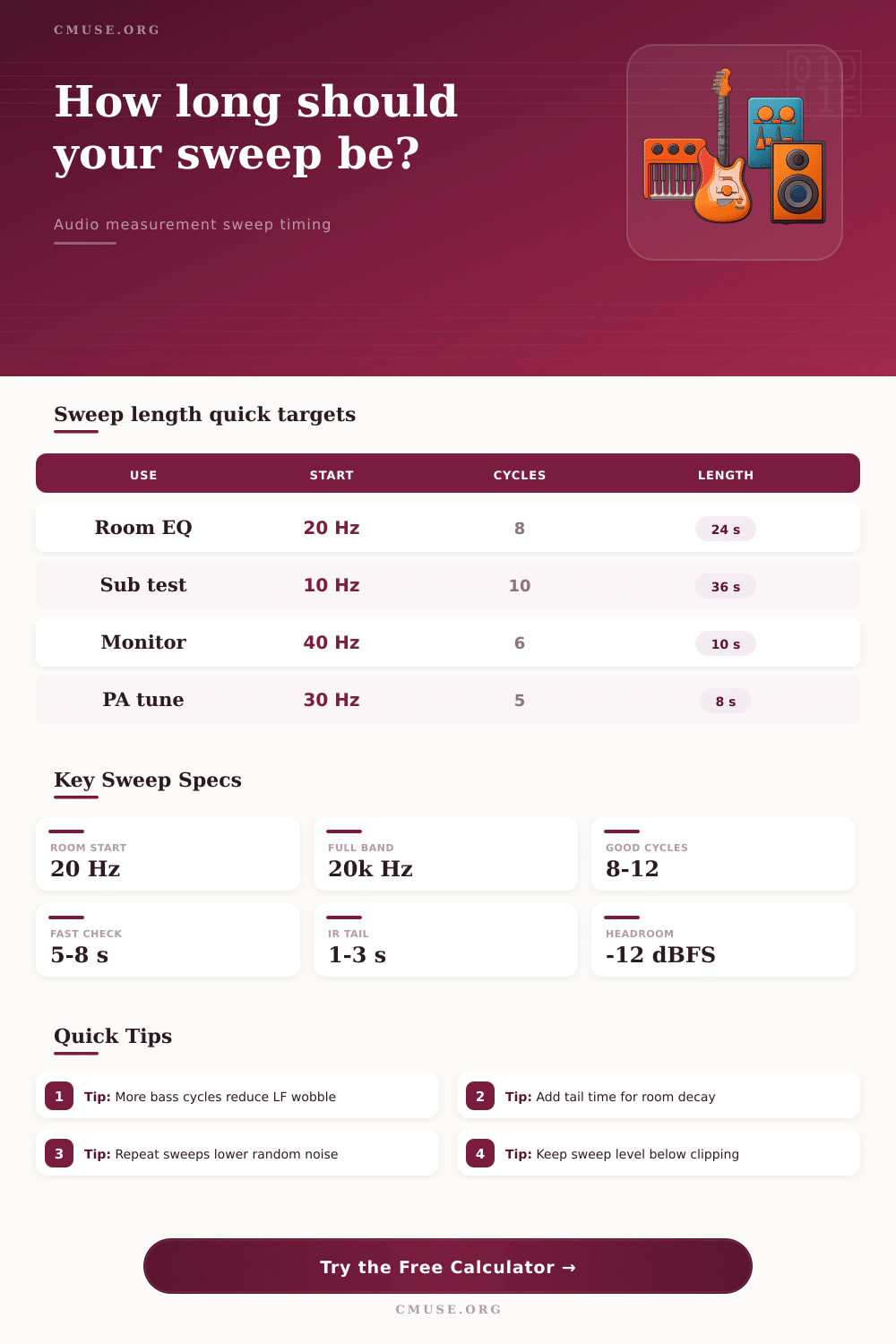
| Fast speaker check | 80 Hz to 20 kHz | 4 to 6 cycles | 3 to 6 seconds | Confirming wiring, polarity, and broad response shape. |
| Monitor or small room | 40 Hz to 20 kHz | 6 to 8 cycles | 8 to 14 seconds | Nearfield monitors where deep bass is limited. |
| Full-range room EQ | 20 Hz to 20 kHz | 8 to 12 cycles | 18 to 32 seconds | Room correction, modal checks, and repeatable bass traces. |
| Subwoofer extension | 10 Hz to 200 Hz | 10 to 16 cycles | 30 to 60 seconds | Low-noise subwoofer tuning and infrasonic rolloff checks. |
| Large-room IR | 20 Hz to 20 kHz | 12 to 20 cycles | 45 to 90 seconds | Long decay capture with better signal-to-noise ratio. |
| Space or system | Pre-roll | IR tail | Why it helps |
|---|---|---|---|
| Loopback or electronics | 0.1 to 0.5 s | 0.1 to 0.3 s | Leaves room for interface latency without wasting file length. |
| Headphone fixture | 0.5 s | 0.3 to 0.8 s | Captures fixture settling and short acoustic reflections. |
| Studio control room | 0.5 to 1 s | 1 to 2 s | Allows early reflections and low-frequency decay to settle. |
| Live room or hall | 1 to 2 s | 3 to 8 s | Preserves long reverberant tails for impulse-response work. |
| Outdoor PA tuning | 1 s | 1 to 3 s | Gives operator and DSP latency a clean capture margin. |
| Method | Strength | Watch point | Best sweep length choice |
|---|---|---|---|
| Log sine sweep | High dynamic range and separates harmonic distortion. | Needs enough low-frequency time for stable bass. | Use this calculator with 8 or more LF cycles. |
| Linear sine sweep | Simple frequency ramp and predictable time per Hz. | Spends too little relative time in bass octaves. | Use longer durations for full-range acoustic work. |
| Stepped sine | Very accurate at selected frequencies. | Slow when many points are required. | Set dwell time per frequency instead of one sweep length. |
| Pink noise RTA | Continuous display for live adjustments. | Less precise phase and impulse-response information. | Average longer instead of extending a sweep. |
| Project | Frequency span | Main result | Secondary result |
|---|---|---|---|
| Desktop monitor voicing | 60 Hz to 20 kHz | 6 to 10 s sweep | 0.5 to 1 s tail |
| Home theater correction | 15 Hz to 20 kHz | 24 to 40 s sweep | 2 to 4 s tail |
| Subwoofer placement | 10 Hz to 300 Hz | 30 to 55 s sweep | 2 to 3 repeats |
| Stage PA verification | 30 Hz to 18 kHz | 6 to 12 s sweep | 1 to 2 s tail |
| Auditorium impulse response | 20 Hz to 20 kHz | 45 to 90 s sweep | 5 to 8 s tail |
When this occurs, you pressed record too early in the recording or did not let the room finish fading before stopping the recording.
How long you run depends on length of your sweep. If the sweep are too short, all you’ll hear is initial impulse of the room with no time to let the lower frequencies ring out and decay back to nothing. It slowly sweeps through frequency in a logarithmic sine sweep, spending more time at the lower frequencies.
Tips for Better Sound Measurements
Why does this matter? Because room acoustics and human hearing aren’t uniform. Once you have entered your cycle requirements and frequency span, the pages calculator do the rest of the math for you.
If you rush the low end it will appear as if bass response is noisy and erratic. Room resonances require multiple cycles before they stabilize, and subwoofer mode do too. Nothing can be seen about standing waves with a half-second signal at twenty hertz. Eight full cycles show all that there is to know.
Patience versus precision is the trade-off. For example, verifying polarity takes just a few seconds; a quick sweep might also check if a speaker is on but it will butcher any attempt at equalization. Subwoofer tests take longer than tests done with nearfield monitors. See reference table on the page.
How about measuring your home theater system that extends down to fifteen hertz? You want long enough times to be accurate AND repeatable. Running it once and getting a different curve for the bass indicate the sweep wasn’t long enough to minimize any random noise.
If you neglect pre-roll silence, you ruin good data. Your audio interface take some amount of time (latency) to process what’s going on, and you want to let it do its job without chopping start of waveform. Then there’s the issue of letting the sweep complete so you have enough tail capture following the sweep conclusion. Chopping away when the room is still ringing will chop away the impulse response and ruin the ability to calculate reverberation time and analyze decay. For a large auditorium, this could be several seconds; for a headphone fixture in an anechoic chamber it might be just milliseconds.
When it’s in the audible range, file size depend more on sample rate than measurement quality. If your application involves ultrasonic distortion products, running at one hundred and ninety-two kilohertz cleans things up. For routine use, stick with eighty-eight or forty-eight kilohertz.
Sweeps don’t have to be super-long, but do make several; that is where the real value lies. Averaging two moderate passes usually beats one long-hour drone as intermittent noise (such as distant traffic or HVAC hum) gets cancelled.
People make technical things too complicated. Physical environment: They do that, but forget the actual room. A bad input to the mic get clipped and there’s nothing digital can do about that. Noisy measurement? Nothing digital can help. Be conservative with your levels. Give yourself extra space in your gain structure.
Let the tool determine timing. Get it right on duration and the traces will smooth out and the modes will settle. You’ll hear the room for what it really is, not just its first impulse.
It would of been easier if you used better equipment, but you should of checked things first.