🔊 Subwoofer Tuning Frequency Calculator
Calculate your port tuning frequency (Fb), port length, and enclosure response characteristics.
| Port Length (in) | Port Length (cm) | Tuning Freq (Hz) | Application |
|---|---|---|---|
| 4 in | 10.2 cm | ~55 Hz | High Impact / SPL |
| 6 in | 15.2 cm | ~47 Hz | Car Audio Daily |
| 8 in | 20.3 cm | ~41 Hz | Car Audio SQ |
| 10 in | 25.4 cm | ~36 Hz | Music / HT Blend |
| 12 in | 30.5 cm | ~32 Hz | Home Theater |
| 16 in | 40.6 cm | ~27 Hz | Deep HT / Cinema |
| 20 in | 50.8 cm | ~22 Hz | Infrasonic / Cinema |
| 24 in | 61.0 cm | ~19 Hz | Extreme Low Extension |
| Sub Size | Sealed (cu ft) | Ported (cu ft) | Ported (liters) |
|---|---|---|---|
| 8 inch | 0.35–0.60 | 0.60–1.0 | 17–28 L |
| 10 inch | 0.50–1.0 | 1.0–1.75 | 28–50 L |
| 12 inch | 0.75–1.5 | 1.5–2.5 | 42–71 L |
| 15 inch | 1.5–2.5 | 2.5–5.0 | 71–142 L |
| 18 inch | 2.5–4.0 | 4.0–8.0 | 113–227 L |
| 21 inch | 4.0–7.0 | 7.0–14.0 | 198–396 L |
| Qtc Value | Alignment Name | –3 dB Point | Characteristic |
|---|---|---|---|
| 0.5 | Butterworth (B2) | Moderate roll-off | Smoothest low-freq, less boom |
| 0.577 | Quasi-Butterworth | Near-ideal flat | Low distortion, natural |
| 0.707 | Chebyshev (-3dB) | Best extension | Most popular, balanced |
| 1.0 | Critically Damped | Highest Fc | Fast transient, less deep |
| 1.2+ | Over-damped | Boosted midbass | Boomy, not recommended |
| Sub Size | Min Port Dia (in) | Recommended Dia (in) | Max Power (W RMS) |
|---|---|---|---|
| 8" | 2.0 | 2.5–3.0 | 150–300 W |
| 10" | 3.0 | 3.0–4.0 | 300–600 W |
| 12" | 3.5 | 4.0–5.0 | 500–1000 W |
| 15" | 4.0 | 5.0–6.0 | 800–2000 W |
| 18" | 5.0 | 6.0–8.0 | 1500–3000 W |
| 21" | 6.0 | 8.0–10.0 | 2000–5000 W |
The right setup of the frequency for your subwoofer affects directly the tuning of your box. One calls it Fb, simply the tuning frequency of the ported box itself. Here is the point: only Fb does not show how low your subwoofer truly will go.
Based on the kind of speaker with that you work and the volume of your box, that Fb can sit even eight or more below than the F3.
How to Set Your Subwoofer Tuning Frequency
A calculator for Subwoofer Tuning Frequency takes three main data: the size of the box, the resistance of the speaker and the tuning frequency of the speaker, the last point is what you should target. For what does that tool serve? Well, if you manage to set it right, a well done box strongly reduces distortion in the low notes.
So you will have cleaner and tight bass, when the ported space matches the tuning depth of it.
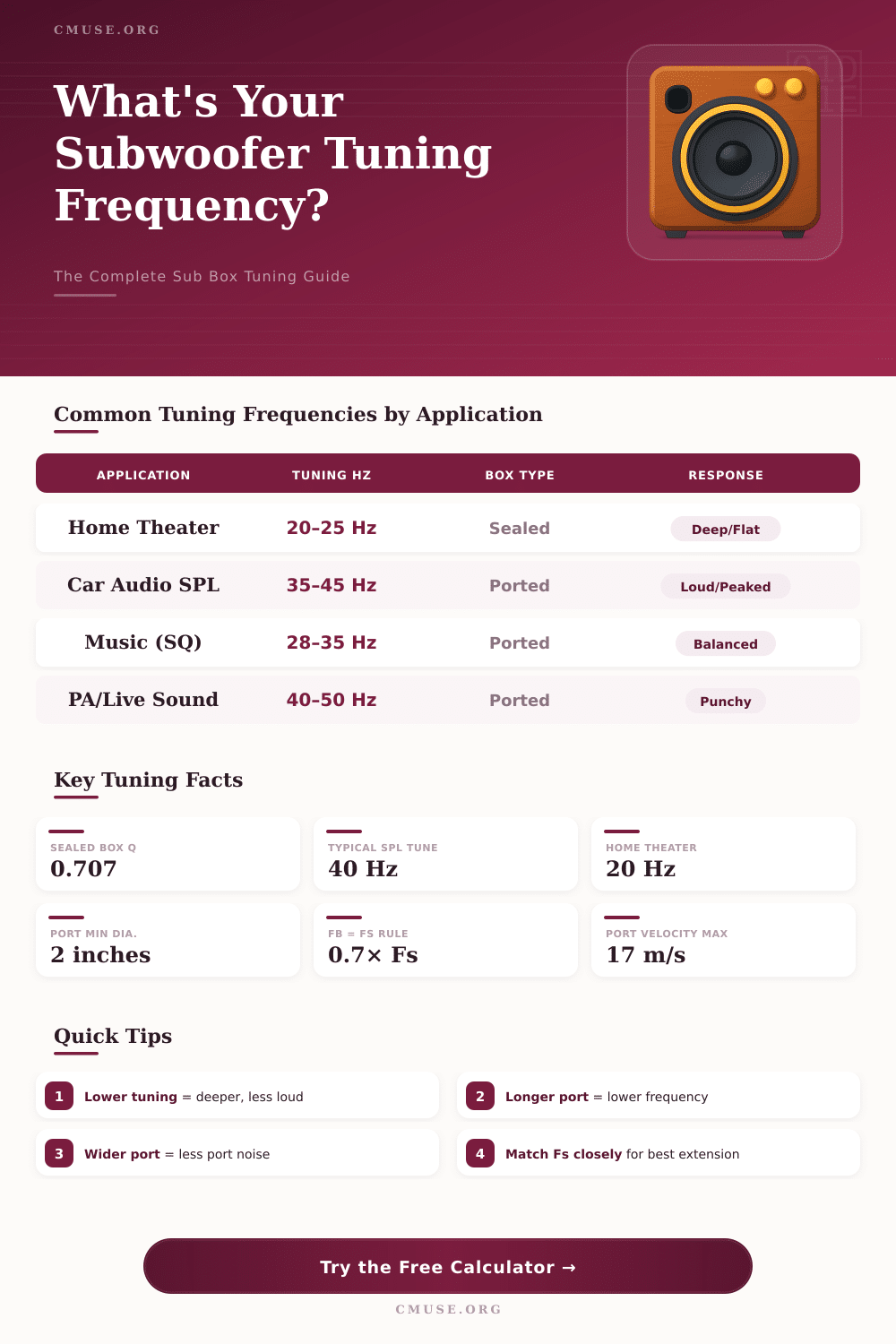
If you search balance between good sound and strong output by means of ported box, something between 30 and 35 Hz commonly works well. Want only pure SPL? Then raise the setting more upward.
Favour smoothness in the quality? Lower it. Around 33 Hz seems a good center for many cases.
Other aspect, the majority of common ported subwoofer boxes come set between 39 and 42 Hz.
About 32 Hz is reliable for many good subwoofers. Smaller speakers, say 8- or 10-inch (mostly like something higher), around 34 to 36 Hz, because those frequencies sound natural for small units. Big ones, like an 18-inch subwoofer, can handle settings down too 26 or 28 Hz without too much problems.
The Q of the speaker matters a lot for deciding where to set. Speakers with low Q start to roll sooner, so setting more highly helps to fight the drop. Also there is Fs, the free-air tuning frequency, it depends on the stiffness of the cone and limits how deeply the speaker goes.
Your subwoofer can play under its Fs, yes, but distortion usually comes soon.
Every car has its own sound character and needs different settings. One car will sound well at 32 Hz, while another shines at 40 Hz. Testing the sound in various cars helps to find what truly works in those surroundings.
For home cinema on the other hand, you can set to 15 Hz, 20 Hz or even 30 Hz to reach truly deep frequencies. Some favour 16 to 20 Hz for that mighty low blow.
A subsonic filter is not optional (it protects). Lay it at around 80 percent of your Subwoofer Tuning Frequency. So if you set to 35 Hz, the subsonic filter stands around 28 Hz.
If you lay settings as high as 60 Hz, you go past what a real subwoofer should do, so you need a solid high pass filter for safety. At that level, a lot of the real deep bass disappears anyhow.
The crossover frequency also matters, and 80 Hz is the usual, that is also the suggestion of THX. Crossover simply splits the low from the high, sending the lows to your subwoofer and the highs to your tweeter. Smaller boxes, around 1.25 to 1.5 cubic feet, sound better set at 60 to 65 Hz.
Bigger boxes in therange of 1.75 to 2.25 cubic feet work better at 50 to 60 Hz.