Subwoofer Cone Area Calculator
Calculate piston area, equivalent round diameter, and swept volume for one subwoofer or a full multi-driver low-frequency system.
🔊 Quick Presets
🎚 Subwoofer Inputs
📊 Cone Area Landmarks
📏 Typical Subwoofer Sd Reference
| Nominal Size | Typical Effective Diameter | Typical Sd | Area vs 12 in |
|---|---|---|---|
| 6.5 in compact | 5.3 in / 13.5 cm | 143 cm² / 22.2 in² | 0.27x |
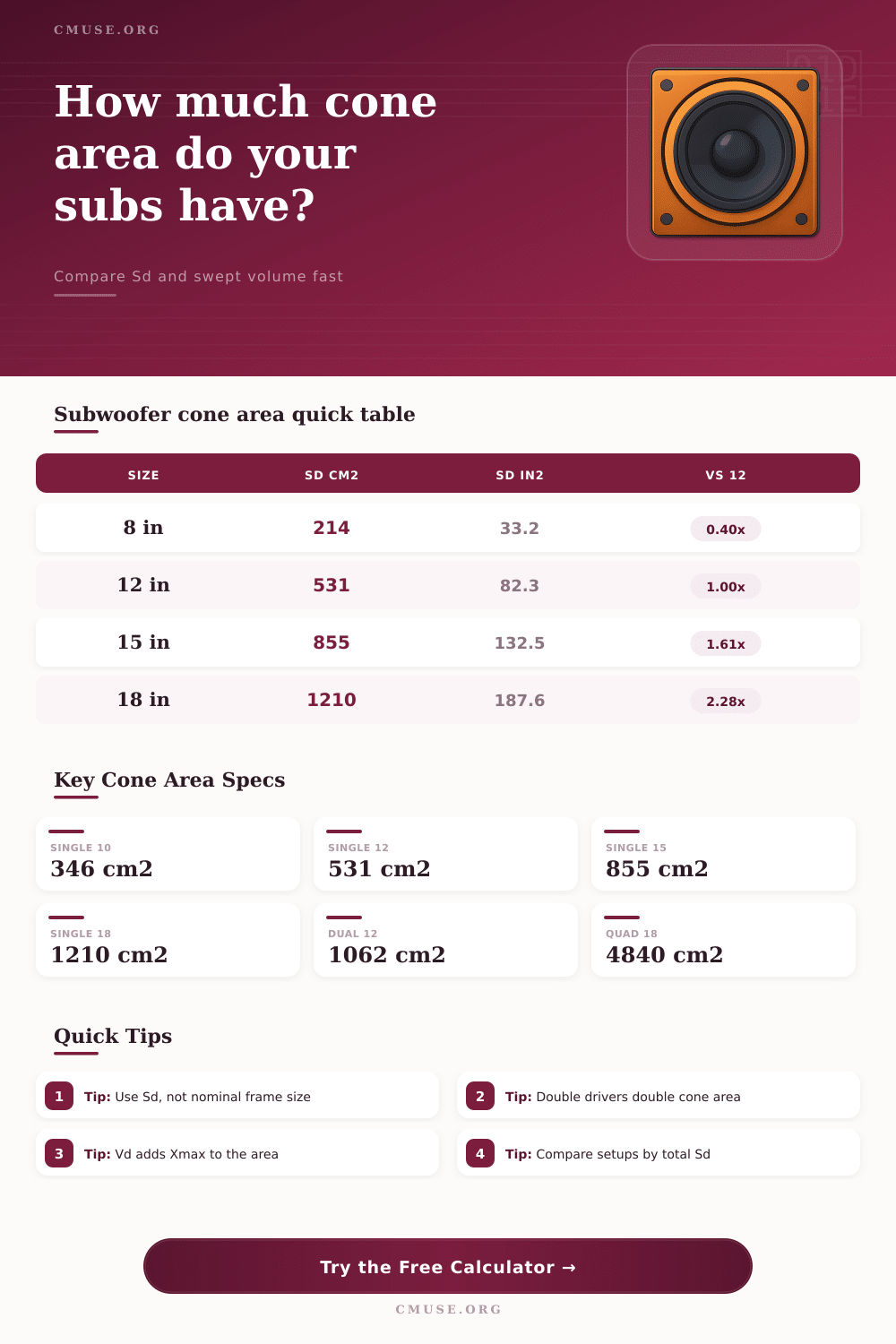
| 8 in subwoofer | 6.5 in / 16.5 cm | 214 cm² / 33.2 in² | 0.40x |
| 10 in subwoofer | 8.25 in / 21.0 cm | 346 cm² / 53.6 in² | 0.65x |
| 12 in subwoofer | 10.2 in / 25.9 cm | 531 cm² / 82.3 in² | 1.00x |
| 13.5 in subwoofer | 11.6 in / 29.5 cm | 684 cm² / 106.0 in² | 1.29x |
| 15 in subwoofer | 13.1 in / 33.4 cm | 855 cm² / 132.5 in² | 1.61x |
| 18 in subwoofer | 15.4 in / 39.3 cm | 1210 cm² / 187.6 in² | 2.28x |
| 21 in subwoofer | 18.1 in / 46.0 cm | 1660 cm² / 257.3 in² | 3.13x |
📦 Driver Count Scaling
| Driver Size | Single Driver | Dual Drivers | Quad Drivers |
|---|---|---|---|
| 10 in subwoofers | 346 cm² / 53.6 in² | 692 cm² / 107.3 in² | 1384 cm² / 214.5 in² |
| 12 in subwoofers | 531 cm² / 82.3 in² | 1062 cm² / 164.6 in² | 2124 cm² / 329.2 in² |
| 15 in subwoofers | 855 cm² / 132.5 in² | 1710 cm² / 265.1 in² | 3420 cm² / 530.1 in² |
| 18 in subwoofers | 1210 cm² / 187.6 in² | 2420 cm² / 375.1 in² | 4840 cm² / 750.3 in² |
| 21 in subwoofers | 1660 cm² / 257.3 in² | 3320 cm² / 514.6 in² | 6640 cm² / 1029.2 in² |
💨 Swept Volume Examples
| Setup | 10 mm Xmax | 15 mm Xmax | 20 mm Xmax |
|---|---|---|---|
| Single 10 in, 346 cm² | 0.35 L / 21.1 in³ | 0.52 L / 31.7 in³ | 0.69 L / 42.2 in³ |
| Single 12 in, 531 cm² | 0.53 L / 32.4 in³ | 0.80 L / 48.6 in³ | 1.06 L / 64.8 in³ |
| Single 15 in, 855 cm² | 0.86 L / 52.2 in³ | 1.28 L / 78.3 in³ | 1.71 L / 104.4 in³ |
| Single 18 in, 1210 cm² | 1.21 L / 73.8 in³ | 1.82 L / 110.7 in³ | 2.42 L / 147.7 in³ |
| Dual 18 in, 2420 cm² | 2.42 L / 147.7 in³ | 3.63 L / 221.5 in³ | 4.84 L / 295.3 in³ |
🎶 Spec Comparison Grid
| System Type | Typical Cone Area | Equivalent Diameter | Useful Comparison |
|---|---|---|---|
| Nearfield single 8 in | 214 cm² / 33.2 in² | 6.5 in / 16.5 cm | 0.40 of one 12 in |
| Compact dual 10 in | 692 cm² / 107.3 in² | 11.7 in / 29.7 cm | 1.30 single 12 in drivers |
| Music dual 12 in | 1062 cm² / 164.6 in² | 14.5 in / 36.8 cm | 2.00 single 12 in drivers |
| Theater single 15 in | 855 cm² / 132.5 in² | 13.1 in / 33.4 cm | 1.61 single 12 in drivers |
| Club quad 18 in | 4840 cm² / 750.3 in² | 30.9 in / 78.5 cm | 9.11 single 12 in drivers |
🎯 Practical Reading Table
| Reading | What It Means | Best Use | Watch Point |
|---|---|---|---|
| Total Sd | All active cone area added together | Comparing driver count and size | Use the same Sd method for every setup |
| Equivalent diameter | One round piston with the same area | Visualizing arrays and stacked subs | It is not the cabinet width |
| Vd | Cone area multiplied by one-way Xmax | Comparing low-frequency displacement | Xmax definitions vary by maker |
| Reference multiplier | Total area divided by one chosen size | Fast A/B system comparisons | Area is not sensitivity or tuning |
When you are choosing subwoofers for your speaker system, you may look at a nominal size of the subwoofer as the determining factor for what subwoofers to purchase. However, the nominal size of the subwoofer are not the amount of air that the subwoofer can move. The frame and suspension of the subwoofer take up part of a total size of the subwoofer.
Another measurement of the subwoofer determines the amount of air that a subwoofer can move: the Sd. The Sd is the measurement of the true surface area of the cone of the subwoofer and the active part of the surround of the subwoofer. If you want to compare subwoofers from different makes and models, you must use the Sd as the measurement to use for making your comparison.
How to Find a Subwoofer’s Sd
You can calculate the Sd of a subwoofer by plugging the specifications of the subwoofer into a calculator. Using a calculator to compute the Sd of the subwoofer save subwoofer system designers from having to use geometry formulas to determine the Sd. By calculating the Sd of the subwoofer, designers have a concrete number that they can use to make there design decision.
Furthermore, calculating the Sd becomes necesary if you are comparing a few different subwoofers. For example, you may wonder if it is better to use one large subwoofer for your system or a few smaller subwoofers. The answer to that question become clear when you calculate the Sd of each of the subwoofers that you are considering for purchase.
Two twelve-inch subwoofers will have the same total cone area as one subwoofer with a diameter of twenty inches; however, they do not necessarily have the same amount of volume output. The concept of using the equivalent diameter of the subwoofers can help you to understand the Sd of each of your subwoofers and how they compares to each other. The Sd is only one part of the equation used to model the movement of air by subwoofers.
Another component of the equation is the swept volume of the subwoofers, or the Vd. The Vd calculation depends upon the Xmax of the subwoofers. The Xmax is the distance that the cone of a subwoofer can move linear in one direction.
You calculate the Vd of a subwoofer by plugging the Sd and Xmax values into a formula; a subwoofer with a large Sd but a small Xmax will move less air than a subwoofer that has a small Sd but a large Xmax. Thus, there is a trade-off between these two value for subwoofers. A long-throw subwoofer can have the same Vd as a larger subwoofer with a smaller Xmax.
When you are calculating the Sd of a subwoofer, there are steps that you must take to ensure that you are using the correct source of the value that you will plug into your calculator. If available, the best source of the Sd of the subwoofer is the official data sheet for that model of subwoofer. If there is no data sheet for the subwoofer, you will have to calculate the Sd yourself.
To calculate the Sd, you will measure the effective diameter of the subwoofers cone and half of its surround. Many people will measure the outer metal frame of the subwoofer. However, this is incorrect.
The metal frame is not a part of the area that effectively move air. Thus, if people measure this portion of the subwoofer, they will overestimate the Sd of the subwoofer. Using such a measurement will result in an incorrect calculation.
Another method of comparing subwoofers is to use a reference multiplier. For instance, you can use a reference multiplier to compare all of the subwoofers that you are considering to a baseline of a single twelve-inch subwoofer. Using the reference multiplier, you can determine if the other subwoofer configurations will move more air than the baseline twelve-inch subwoofer.
This reference multiplier will provide a ratio that will tell you if the new configuration of subwoofers will provide a 1.5x or a 2x movement of air as the baseline twelve-inch subwoofers. Creating a subwoofer system requires that you manage how much air move from the subwoofers. Thus, creating a subwoofer system is similar to build a pump for a room.
Regardless of whether you are using four eighteen-inch subwoofers or two ten-inch subwoofers, the physics of the air movement are the same. To build a good subwoofer system, you have to ensure that there is enough Sd and enough Xmax to reach the desired volume in the room where the speakers will be placed. You also cant stress the equipment unduly.
Once you stop looking at the frame size of the subwoofers and start looking at the Sd of each of them, you will have a better understanding of what to create and how to design your speakers effective. The Sd is the scientific measurement of the amount of air that a subwoofer can move.