Subwoofer Box Calculator
Calculate gross and net enclosure volume for sealed or ported subwoofer builds.
🎵 Presets
📏 Inputs
📊 Reference Grid
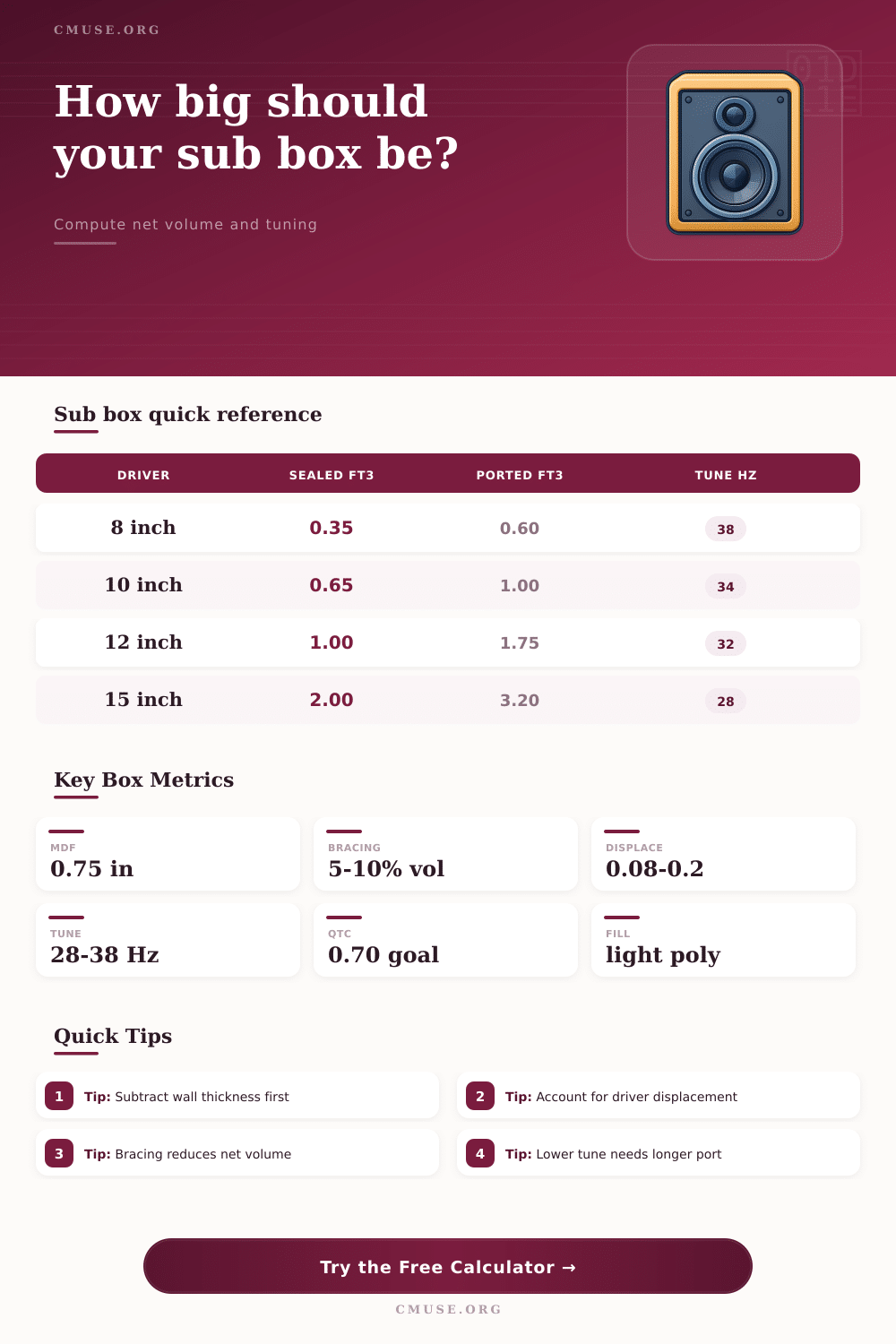
| Driver | Sealed | Ported | Tune |
|---|---|---|---|
| 8 inch | 0.30-0.45 | 0.55-0.80 | 36-42 Hz |
| 10 inch | 0.50-0.80 | 0.90-1.30 | 32-38 Hz |
| 12 inch | 0.90-1.30 | 1.50-2.00 | 28-34 Hz |
| 15 inch | 1.80-2.50 | 2.80-4.00 | 24-30 Hz |
| Project | Outer Size | Net ft3 | Type |
|---|---|---|---|
| Compact Trunk | 20x14x12 | 0.92 | Sealed |
| Daily Setup | 24x16x14 | 1.58 | Ported |
| SPL Build | 30x18x16 | 2.79 | Ported |
| Home Theater | 28x20x18 | 3.22 | Sealed |
Subwoofer box is not simply some tin, in that you put the driver. It forms acoustic circuit that works with the attributes of the driver and the acoustic attributes of your room. The size and arrangement of the box directly shapes the low tones, from the force and accuracy to the impact and the power without danger.
Each subwoofer driver has ideal dimensions for its box. If it is too little, problems happen: the bass will not sound very loud, the frequency response fails, some notes project while others disappear in the sound bigger boxes usually give better results.
How a Subwoofer Box Affects Bass Sound
Here happens the hard part: if the box is more than 50% smaller than specifications of the driver, important consequences follow. The resonance frequency rises, deep basses disappear, the tone fails, efficiency falls and distortion grows, plus bigger mechanical stress on the driver, especially at ported designs. When space lacks in the room, the best solution is swap to other driver apt for smaller box or use active DSP to protect the driver and reach the wanted answre.
The two mainstream kinds of subwoofer boxes are sealed and ported, that are genuinely different. Sealed box is simple: only airtight tin with the driver on the interior. The back wave never mingles with the front, so you get the purest and precise deep sound, nearest to the intention of the author.
Such designs also handle more power, because the air compacts in finite space. Ported boxes operate otherwise: they are efficient and issue much volume in the set frequency, but after that they twist. You must double the size compared to sealed version.
Want your bass strike strongly with maximum force? Choose ported.
Good news: on-line there are free calculators for subwoofer boxes. They are basic 3D-programs for plan boxes. The tools lead you through ported and sealed designs for good deep bass, and they auto count the volume of the box and the length of the port.
Building home-made box is entirely possible, if you want that. Many step-by-step guides help to build speaker either subwoofer boxes. Some use 3/4 inch birch plywood for ported versions, while others do thick triple systems for big power.
Or simply buy ready box done for your particular driver, or hire it to professional.
Subwoofer boxes come in all sizes for cars, trucks, jeeps, whatever you drive. From 8 inch until 12 inch and bigger. Upper models handle 600 watts until 1500 watts or more without problems.
Many are done in United States with real craft and custom options. Professional subwoofer boxes offer bandpass, vented and sealed variants, each optimized for good sound. Box apt to your vehicle and speakers can entirely alter your deep experience.