Student Progress Hours Calculator
Estimate the focused practice hours, lesson rhythm, retention work, and calendar time needed to reach a specific music milestone.
Progress hour estimate
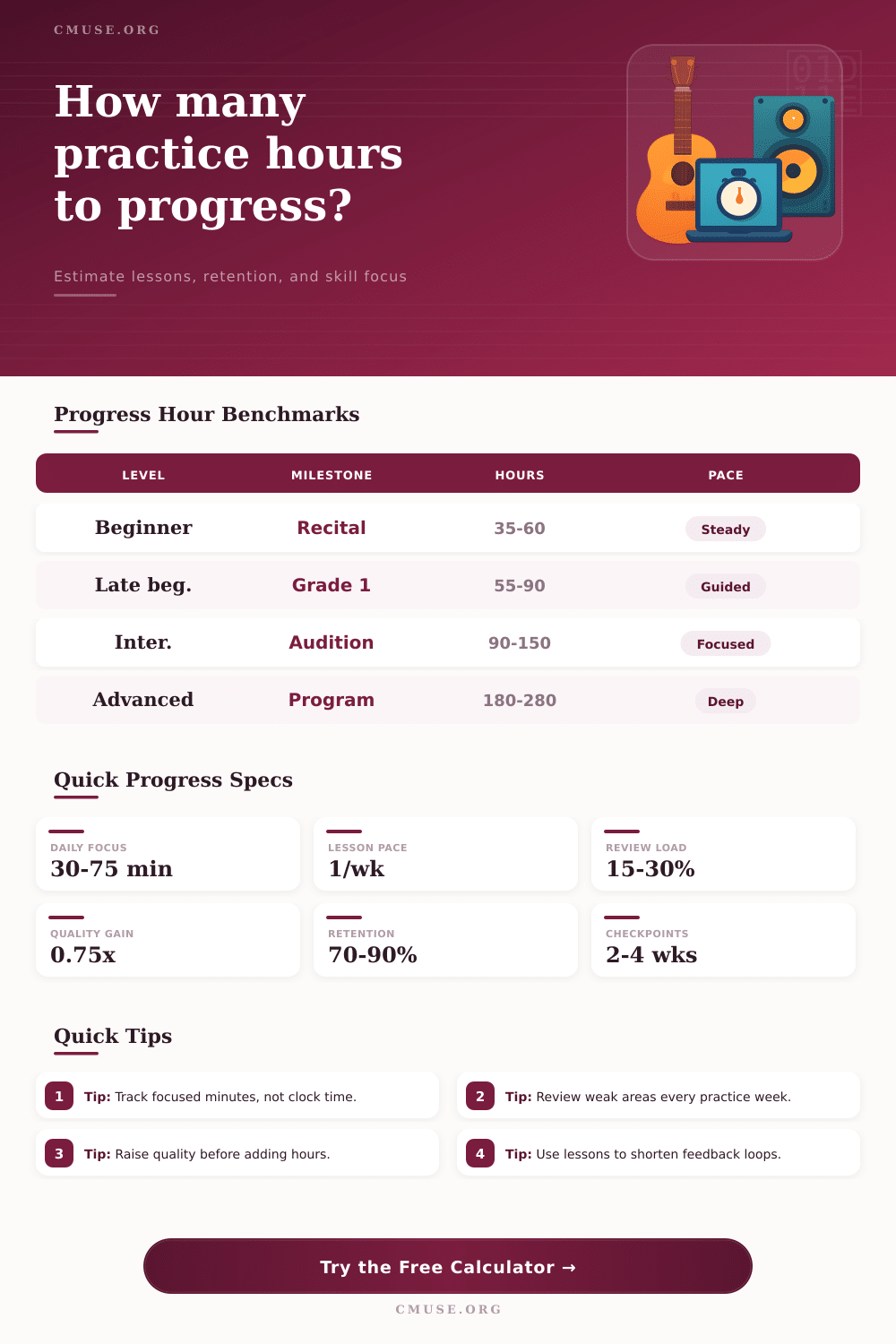
Level and milestone hour bands
| Current level | Typical milestone | Focused hours | What changes the estimate |
|---|---|---|---|
| New student | First short recital piece | 35-70 | Reading basics, steady posture, simple rhythm control |
| Beginner | Grade 1 or equivalent unit | 45-95 | Hand position, tone consistency, memorized patterns |
| Late beginner | School ensemble entry | 60-120 | Counting independence, sight-reading, ensemble awareness |
| Intermediate | Audition or graded exam | 85-170 | Tempo stability, expressive control, technical cleanup |
| Late intermediate | Improvisation or program polish | 120-230 | Style, memory, theory links, reliable performance recovery |
| Advanced | Short polished performance program | 180-320 | Nuance, endurance, interpretation, high-retention review |
Practice quality multipliers
| Practice style | Multiplier | Best use | Progress signal |
|---|---|---|---|
| Casual run-throughs | 1.30x | Maintenance or enjoyment sessions | Comfort improves before accuracy |
| Mixed focus | 1.12x | Students still learning how to practice | Some goals are clear, some time drifts |
| Structured goals | 1.00x | Most lesson-based study plans | Tempo, notes, rhythm, and review are tracked |
| Deliberate correction | 0.82x | Auditions, exams, and focused skill repair | Errors are isolated, slowed, repeated, and retested |
Lesson frequency and feedback effect
| Lesson rhythm | Multiplier | Coaching advantage | Watch point |
|---|---|---|---|
| No regular lessons | 1.18x | Flexible self-study | Wrong technique may stay hidden longer |
| Monthly lesson | 1.08x | Periodic direction setting | Keep written checkpoints between sessions |
| Every 2 weeks | 1.00x | Good balance for independent students | Bring focused questions to each lesson |
| Weekly lesson | 0.92x | Short feedback loop | Practice still needs review days |
| Twice weekly coaching | 0.86x | Fast correction for near-term goals | Avoid overload by narrowing the target |
Skill area weighting guide
| Skill area | Added load | Typical evidence | Useful checkpoint |
|---|---|---|---|
| Technique | +12% | Clean shifts, relaxed motion, even tone | Can repeat slowly without tension |
| Repertoire | +16% | Piece sections connect at target tempo | Can start from several cue points |
| Sight reading | +10% | New material stays moving with pulse | Two passes show visible improvement |
| Ear training | +8% | Intervals, tuning, and memory improve | Can sing or identify target patterns |
| Rhythm | +10% | Subdivision and rests remain stable | Metronome test holds for three repeats |
| Theory / analysis | +7% | Form, harmony, or scale choices guide practice | Can explain why a passage works |
After entering your goals and level, student progress hours calculator predicts time frame for yourself, removing the guesswork of estimating when you might have mastered a given work. It’s quality over quantity that make all the difference here, and the tool relies heavily on accuracy of your input. Better to play a passage through deliberately correcting mistake, even if it’s only two times, then to play through it ten times just to get comfortabley with it. If you opt for more casual run-throughs, the calculator extend your timeline. Use practice style that reflects what you actualy do.
Secondly, there’s retention load. This is a huge factor in how fast you will go. Most people practice until they can recall something for five minutes or so. Then they’re onto next thing. By following week, they’ve forgotten half of it. Maintenance is a component of the work, and that’s why the calculator saves up time each week for review. If your retention is low, you’ll end up spending precious time unlearning previous errors as well as attempting to get new skill. If you are under deadline for an audition, you can’t afford debt like that.
How to Use the Calculator
How do you know if you are developing poor technique? It’s harder to spot during easy pieces different than difficult ones. If you play something easy with improper form, you might not even notice until you ramp up the challenge and encounter a solid wall of wrongness. Regular lessons will help nix any poor technique before it has time to take root. The shorter time between practice and correction will also reduce error that set in over time. An instructor can see problems you don’t. This reduces the number of hour you think you need because there is constant feedback. It is a fair trade for quicker results.
The skill area are weighted, and this has a bigger impact on players than they might think. For example, adding ear training or sight-reading skills increases your mental effort as it require more of your attention. If you attempt to develop a solid grounding in music theory while improving your repertoire then you’ll probably take longer. The calculator takes account off this additional complexity and allows you to see what’s possible within any particular month.
By planning how many hours you’ll practice, you know how much time it will take which keeps you realistic, protects against burning out trying to meet unrealistic deadlines and avoids the lull of assuming too much progress is being made every day. A good way to think about this: if you’re going to accomplish something big (anything big), you need a gameplan. When you break it all down and put it into numbers then it’s about following a plan versus hoping to get inspired. You should of had one.
The second you pull up, the clock is ticking. So measure what matters.