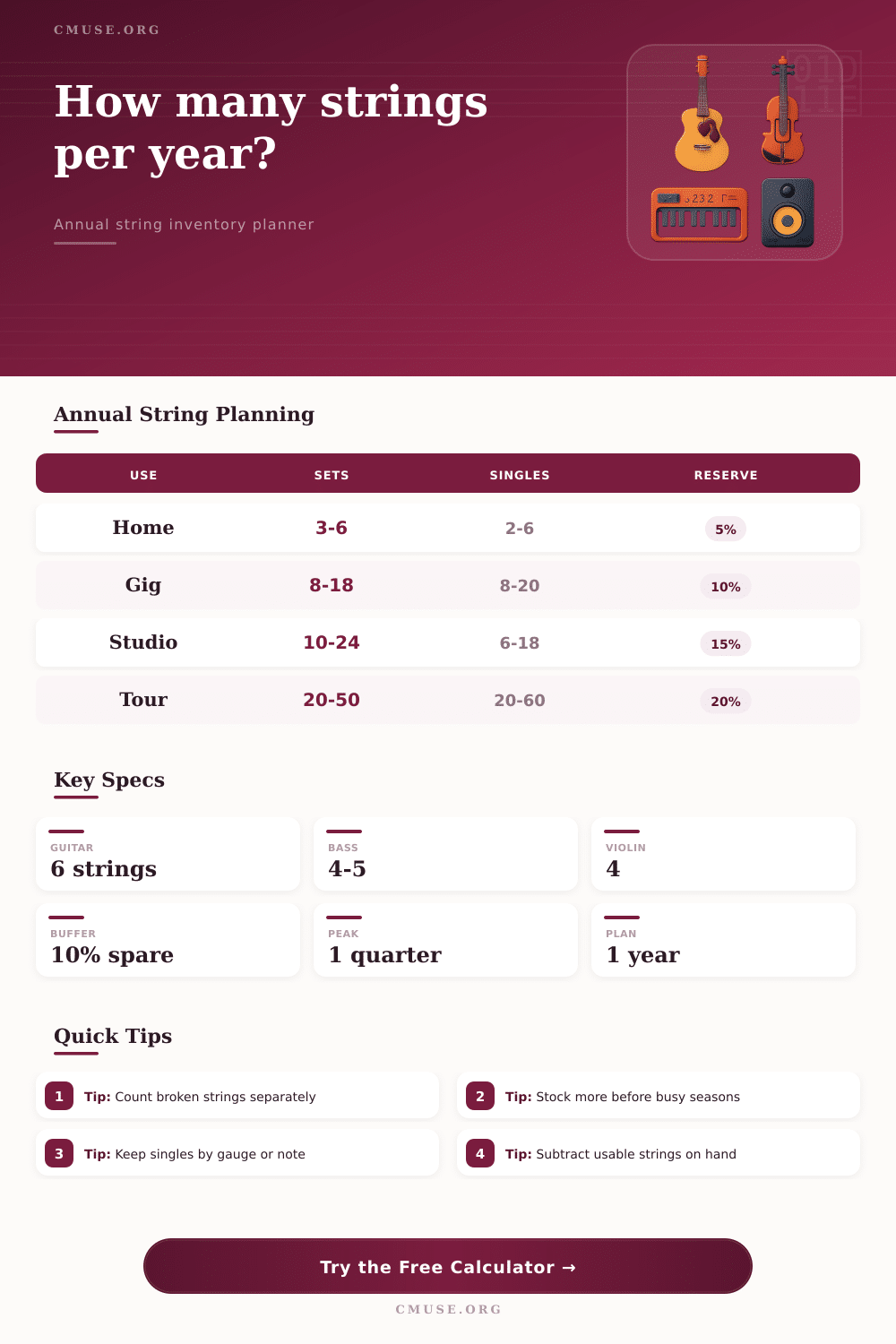
Strings Needed per Year Calculator
Estimate annual full sets, individual replacement strings, emergency spares, seasonal peaks, and restock cost for one instrument or a whole working rig.
| Instrument family | Strings per set | Typical annual changes | Single-string planning note |
|---|---|---|---|
| Electric guitar | 6 | 6 to 24 sets per active instrument | Plain 1st and 2nd strings often need extra singles. |
| Steel-string acoustic | 6 | 4 to 16 sets per active instrument | Uncoated bronze sets age faster with sweat and humidity. |
| Classical guitar | 6 | 3 to 12 sets per active instrument | Trebles and basses may be replaced on different schedules. |
| Electric bass | 4 or 5 | 2 to 10 sets per active instrument | Singles are useful for extended-range gauges and emergency breaks. |
| Violin or viola | 4 | 2 to 8 sets per active instrument | E and A strings usually deserve the largest single-string reserve. |
| Cello | 4 | 1 to 6 sets per active instrument | Track singles carefully because one string can dominate restock cost. |
| Mandolin | 8 | 4 to 12 sets per active instrument | Course pairs should be counted as individual strings for spares. |
| Ukulele | 4 | 2 to 8 sets per active instrument | Nylon and fluorocarbon stretch-in time matters before performances. |
| Usage pattern | Gig add-on | Studio add-on | Inventory implication |
|---|---|---|---|
| Home practice only | 0% to 4% per event | 0% to 2% per session | Base changes drive most annual set demand. |
| Weekend performer | 6% to 10% per show | 3% to 6% per session | Keep a month of singles ready before each run. |
| Studio-focused player | 4% to 8% per show | 7% to 14% per session | Fresh-tone sessions increase complete set changes. |
| Touring or theater pit | 12% to 18% per show | 5% to 10% per session | Peak-season stock should arrive before rehearsals. |
| Seasonal setting | Multiplier | Best for | Restock timing |
|---|---|---|---|
| Quiet year | 90% | Practice-led years, fewer performances, light session work | Restock twice a year after checking old packets. |
| Balanced year | 100% | Steady lessons, rehearsals, church, local shows, casual studio days | Restock quarterly and keep singles visible. |
| Busy summer or semester | 115% | School terms, wedding season, summer shows, recital cycles | Order peak sets one month before the run. |
| Festival, tour, or holiday peak | 130% | Dense calendars with back-to-back gigs or recording deadlines | Front-load sets and common breakage singles. |
| Compressed peak season | 150% | Short tours, cruises, theater runs, intense content schedules | Carry more spares than normal monthly math suggests. |
| Restock item | Count from calculator | Use it for | Inventory check |
|---|---|---|---|
| Full sets | Annual changes, event wear, seasonal multiplier, buffer | Complete restringing and tone resets | Subtract sealed, correct-gauge sets already available. |
| Individual strings | Planned singles, breakage, event emergency allowance, buffer | Broken strings and note-specific replacements | Sort by gauge, note, scale, and instrument family. |
| Peak-quarter reserve | Portion of annual need concentrated into the busiest season | Festivals, school terms, tour legs, holiday services | Keep this stock separate from everyday practice supplies. |
| Current inventory | Sets and singles on hand | Reducing the buy list without undercounting total usage | Ignore corroded, opened, wrong-scale, or wrong-gauge packets. |
If you’ve been on stage with the house lights down and reached into the string packet in your gig bag only to find it’s empty, then you’re familiar with that sinking feeling. It’s one of the worst nightmares for a player. Luck aside, the answer lie in both better planning and better logistics.
For most of us, replacing strings has become a reactive chore versus part of supply chain. We wait until our strings is broken or dull. Then we make an emergency run to a closed music shop or gas station and settle for whatever gauge they has in stock.
Why You Should Plan Your String Stock Early
If you plan out your inventory once a year, it changes from a cause of stress into something that doesn’t even register as an expense. Plug in your current stock levels and the number of times per year that you play. The calculator above will then spit out how many sets you need to last until the end of the tour season so you don’t have to guess how many sets will actualy survive.
Because broken strings aren’t necessarily a full set issue, they’re two very different problems with two very different solutions. A full set change affect maintenance and tone. If something goes flat or the intonation starts to drift, it is time for a full set change. Replacing a single string is about survival. The high E on your electric guitar snap during a solo. The A string on your violin loses tension after a long rehearsal.
Buying twenty sets of strings isn’t going to help if you have zero loose spares for emergencies. That is a problem that cause more missed notes than just not having enough supplies.
Then think about the rate of string wear in the studio as opposed to live performance. Onstage there’s more physical aggression, humidity variations and sweat that increase metal fatigue. To account for this, the tool allow you to enter how much wear per gig. Intense bluegrass? Hard rock? Your strings will degrade quicker then if you were just playing fingerstyle acoustic at home.
Studio sessions follow their own rules, as well. They require fresh tone for each take which means an engineer is making full changes even if the strings remain intact. Why? Because they’re engineers. That makes sense, but it also means buying ten extra sets may not really help when you really need 30 separate high-E strings that break during tracking.
Another factor most musicians don’t consider until it bites their bank account: seasonality. Sure, you may do 40 gigs during three months and zero during winter. If you split your yearly budget over 12 months then you’ll be broke by July. That’s why there’s a seasonal multiplier on the calculator. It focuses your estimates on the busier quarters so you can make purchases before the rush.
Get your gear in time to try it on at home. This way you know you have the right brand and gauge to get you through. You can avoid making last-minute choices that ruin your sound. Order six weeks before your tour.
Inventory management is easy to use, but it requires discipline. First of all, know what’s in your possession. Tell this tool how much you currently have on hand so it will remove your current inventory from your “want list.” This prevents you from making duplicate purchases while overlooking important omissions.
Preserve corrosion inhibitors by keeping sets sealed in plastic. Put each string into a bag labeled by gauge and instrument so you can find them easy when needed. If one breaks during a show, you won’t waste time digging through several different packets hoping to find the proper thickness.
And this keeps your budget in line: Once you stop reacting, you know how much you’re going to be spending every year. Use the estimated cost feature as a limit and then put away some money each month knowing it’ll be there when you need to make that large purchase. It evens out the cost of playing at full throttle and eliminates wasted strings (because you haven’t been stockpiling them all until they go bad).
Perfection is not required; only reliability is needed. No plan accounts for spilled drinks or snapped strings. However, knowing approximately what your instrument will endure allows you to expect the inevitable and have appropriate strings in bag prior to walking onto stage. After all, you want to be focused on making music, not juggling logistics. A few minutes of calculation gives the peace of mind that’s worth it.
You should of planned for this earlier.