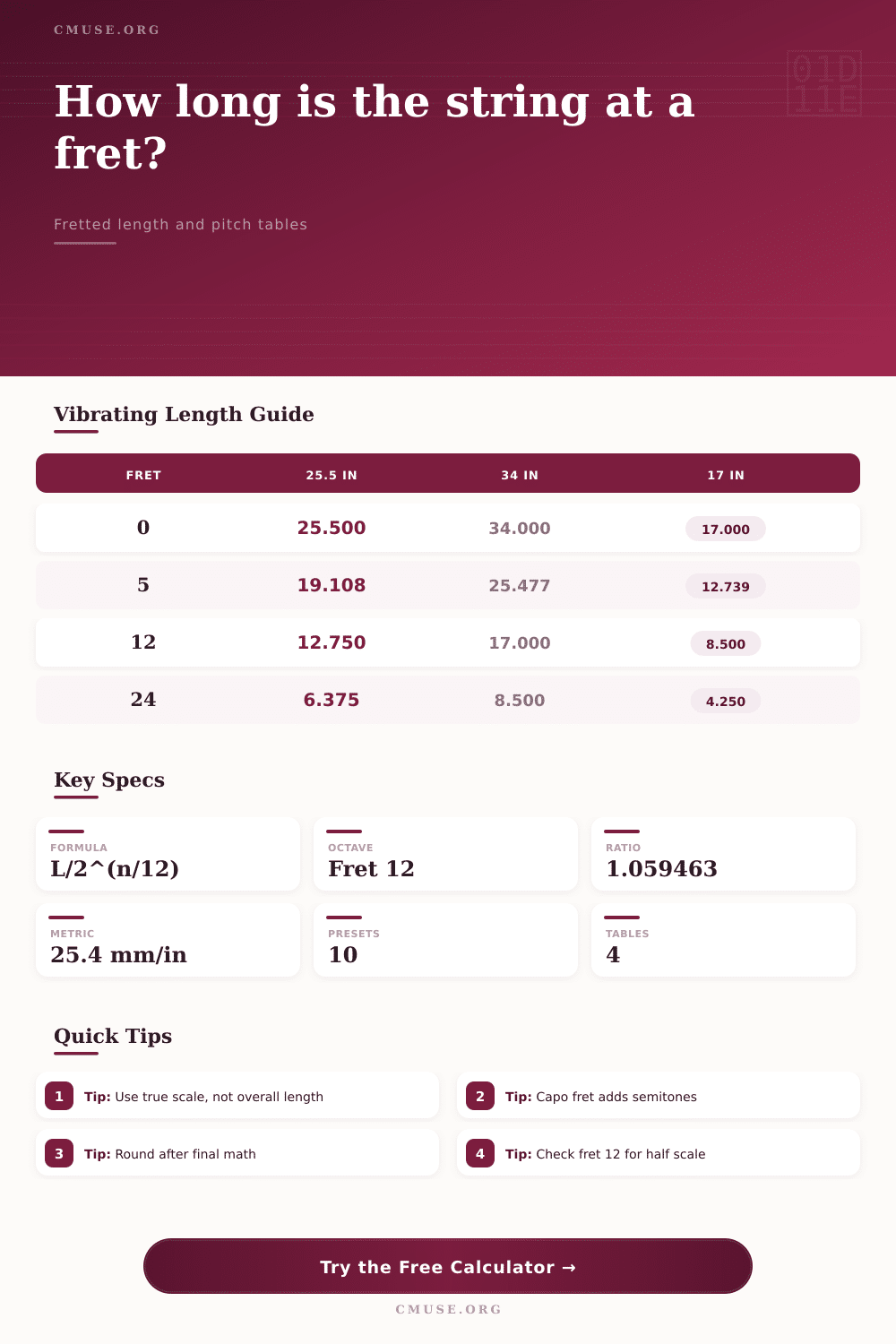
String Vibrating Length At Fret Calculator
Calculate the active speaking length after a fret is stopped, its distance from the nut, the resulting equal-tempered frequency, and detailed length tables for common string instruments.
🎯 Instrument And Fret Presets
⚙ String Length Inputs
Calculation Breakdown
📏 Instrument Scale Grid
📊 String Length And Frequency Tables
| Fret | From Nut | Active Length | Frequency | Length Ratio |
|---|---|---|---|---|
| Calculate to fill the fret table. | ||||
| Checkpoint | Physical Fret | Vibrating Length | Pitch Result |
|---|---|---|---|
| Calculate to fill checkpoints. | |||
| Instrument Scale | Open Length | Same Fret Length | Same Fret Position |
|---|---|---|---|
| Calculate to compare scales. | |||
| String | Open Note | Open Hz | Hz At Fret | Active Length |
|---|---|---|---|---|
| Choose an instrument to fill string frequencies. | ||||
💡 Practical Length Tips
Examine the twelfth fret carefuly. On a bass or guitar, this is exactly halfway along the scale. At this point, pitch increase by an octave and string length is half as long. This is anchor note for instrument. If it is too high, the string feels like rubber, and if it is too low, the note buzzes before it even starts. Too high, and string becomes rubbery. How clear your tone sounds depends on the vibrating length of string as does feel of instrument.
Players tend to assume that all frets is equally spaced apart. Not so. Because music are based off logarithms rather than arithmetic, fretting a string makes it shorter in proportion as you move up the fretboard. To increase pitch of your playing by single semitone, you need to reduce the strings length by about 5% every time. That’s where the maths comes in for the calculator, but understanding the principle enables you to resolve intonation problems yourself. If the string wasn’t made short enough then you can find that a note sounds sharper than you progress further up the fretboard.
How Fret Positions Are Calculated
First off, you need real scale length. That’s the distance from your nut to where strings makes contact with the saddle. That is not the same as overall string length including wrap around the tuning peg. Many beginners will mistake entire string for measurement and come up with incorrect results. The calculator assumes open speaking length.
Placing a capo on third fret, for example, alters math. Consider the capo as new nut. Amount of string that vibrates has shortened. You need less tension to achieve same pitch. Because of this adjustment, chord shapes seem looser or tighter.
The tool calculates frequency based off A440 as a reference point. This can be changed. Many orchestral instrument are tuned higher at around A442 or even A445. When you change that reference, all the other notes changes too. That sounds like a minor tweak, but it makes a big difference to tension of the strings. The higher the pitch, the greater the stress on the strings. If they’re not gauged correctly then this can result in quicker wear and tear or a tinny sound.
These little tweaks make quite a differance throughout the fretboard as this tool illustrates. Accuracy matters. In the upper ranges, even slight differences (a few thousandths of an inch) at the bridge will throw your intonation out the window. That’s why luthiers employ calipers.
As you can see in reference tables, instrument scales are proportionate to one another. For example, compare length of a bass guitar to that of a violin. Yep, the bass is longer. Fret placement is very close together on violin. Your digits need to be precise. Same math, different body demands.
This generates tables depicting geometry of the instrument. The rows are compromises in terms of both pitch accuracy and playability. Close to body of the instrument there is little room for error. This gives rise to intonation compensation. When you pluck a string it stretches which means that saddle cannot be flat. The real world includes stretch, stiffness and friction whereas the ideal is theoretical as shown by the calculator.
To visualize the fretboard, think of it as being divided into smaller sections. Distance between the frets represents a proportion that does not alter. So each fret divides the available string length into an identical fraction. That leads to equal temperament system that we now use. We can play in whichever key we like. But intervals do not sound quite as pure. You sacrifice a little bit of harmonic purity of just intonation. You gain the ability to switch keys at will.
The tool shows you geometry. The figures tell us what to expect. Perhaps you are installing frets on an old guitar, adjusting intonation, building one, etc. The math is not fuzzy; it is exact and repeatable. Learning that scale length determines where the frets go transforms your perception of the instrument. It becomes a mechanical device with precise balance. That middle point; the twelve fret, is still the fulcrum. It’s the midpoint for the structure. When looking at numbers, you should of remembered that central point.