String Spread at Nut Calculator
Calculate nut slot center positions, outside string spread, edge clearance, center spacing, and real open gaps from nut width, string count, margins, and outer string gauges.
Choose a realistic starting layout, then adjust the edge margins and gauges for the actual instrument. Presets use common production and repair-bench targets, not one-size-fits-all spacing.
Layout Breakdown
1. Centerline Spread
When margins are center-based, subtract both margin distances from the total nut width.
spread = nut width - bass margin - treble margin
2. Outside-Edge Margins
When margins are measured to string edges, add half the outside-string gauges before solving centers.
center = edge margin + gauge / 2
3. Open Gap Layout
Equal-gap spacing estimates interior gauges between the outside strings so each air gap feels similar.
gap = open span / (strings - 1)
4. Marking Precision
Slot centers are rounded to the selected bench precision after the exact math is complete.
mark = round(center / precision) x precision
| String | Center From Bass Edge | Rounded Mark | Next Center Step | Estimated Open Gap |
|---|---|---|---|---|
| Calculate to show slot positions. | ||||
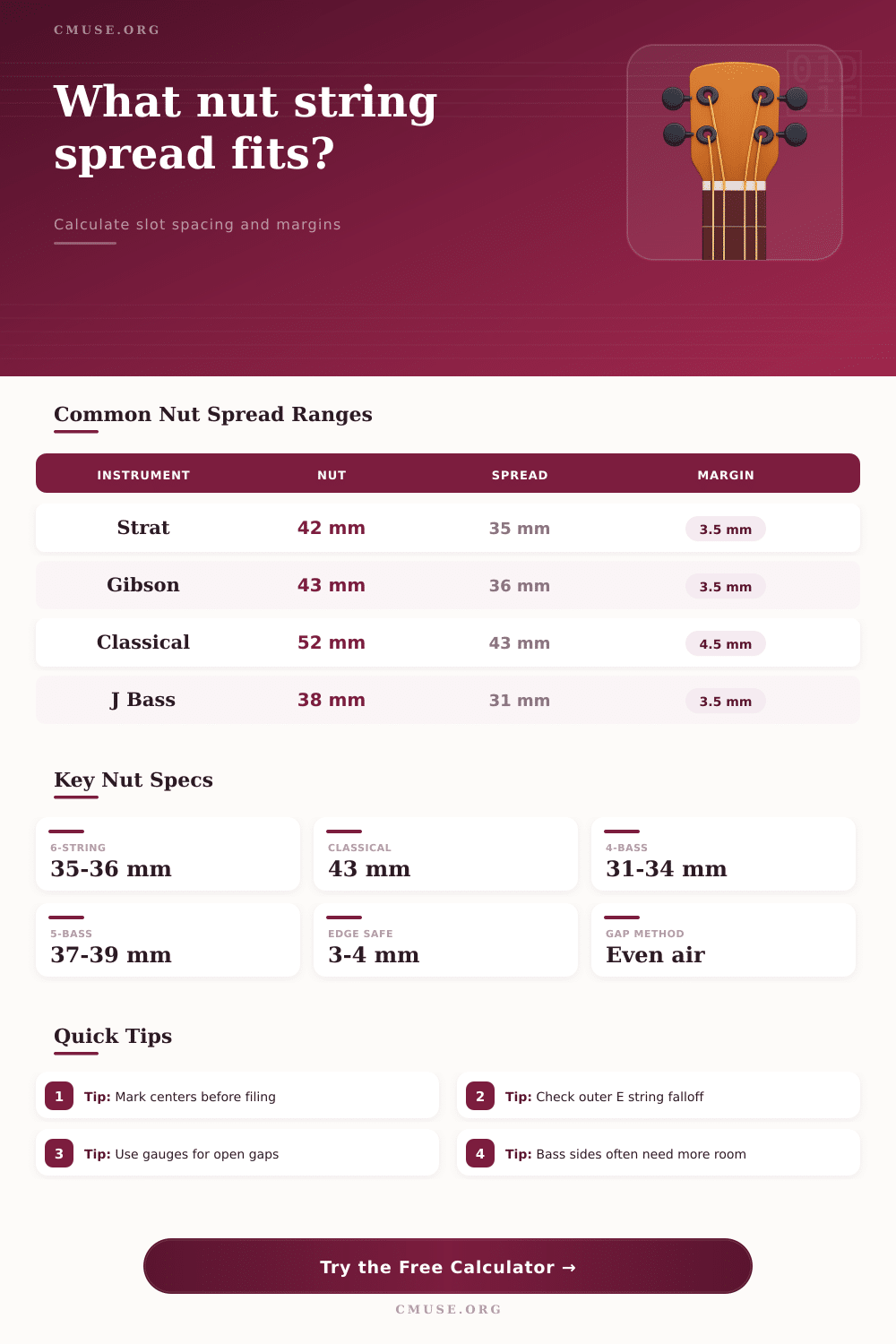
| Instrument Type | Typical Nut Width | Common Center Spread | Edge Margin Target | Spacing Note |
|---|---|---|---|---|
| Modern electric guitar | 41.3 to 43.0 mm | 34.7 to 36.0 mm | 3.0 to 3.7 mm | balanced |
| Wide steel-string acoustic | 44.5 to 45.0 mm | 37.0 to 38.0 mm | 3.4 to 4.0 mm | fingerstyle |
| Classical nylon guitar | 50.0 to 52.5 mm | 42.0 to 44.0 mm | 4.0 to 5.0 mm | wide gaps |
| 4-string electric bass | 38.0 to 42.0 mm | 31.0 to 34.5 mm | 3.0 to 4.2 mm | large gauges |
| 5-string electric bass | 44.5 to 47.6 mm | 37.0 to 40.0 mm | 3.5 to 4.5 mm | low B care |
| 7-string electric guitar | 47.0 to 48.5 mm | 40.0 to 42.0 mm | 3.0 to 3.8 mm | extra slot |
| Method | Best Use | What It Keeps Equal | Risk To Watch |
|---|---|---|---|
| Equal center spacing | Most production nuts | Slot-to-slot center distance | Thick strings reduce bass-side air gaps |
| Equal open gaps | Custom repair and new nuts | Clear air between strings | Centers are not visually identical |
| Slight bass-side fan | Bass, baritone, heavy gauges | More room under wound strings | Can crowd the treble side |
| Outside-edge margins | Falloff-sensitive necks | Actual clearance to fretboard edge | Requires accurate gauge entry |
| Preset | Strings | Nut Width | Margin Pair | Typical Result |
|---|---|---|---|---|
| Modern Strat 42 mm | 6 | 42.0 mm | 3.6 / 3.3 mm | 35.1 mm spread |
| Gibson 43 mm | 6 | 43.0 mm | 3.7 / 3.4 mm | 35.9 mm spread |
| Steel Acoustic 44.5 | 6 | 44.5 mm | 3.8 / 3.6 mm | 37.1 mm spread |
| Classical 52 mm | 6 | 52.0 mm | 4.6 / 4.4 mm | 43.0 mm spread |
| P Bass 41.3 mm | 4 | 41.3 mm | 3.8 / 3.5 mm | 34.0 mm spread |
| 5-String Bass | 5 | 45.0 mm | 4.0 / 3.7 mm | 37.3 mm spread |
Nut spacing is one of those things you think you know until you go to set up brand new guitar and realize that our intuition will trip us up. There are only so many inches available on the fretboard and while that width never changes, actual physical width of each string does. It’s not simply a matter of cramming half a dozen lines into a confined space. You must makes sure your low E isn’t about to slide off the edge and still be able to bend high E.
Most players considers the nut to be nothing more than a stationary bit of bone or synth material. The nut is the first control point in your overall playing experience. Plug in your own measurements into the calculator above and it will do the math for you. It handles the math of removing your desired margins from total width of the nut. Then, it calculates how much space you have left for the strings.
Why Nut Spacing Matters for Your Guitar
So there’s no guesswork involved about whether your heavy gauge bass string is going to fit in the inner slots of a 42 millimeter nut without making things crowded. All you need to do is tell it how many string you’re looking at, what the overall nut width is and how wide you want the edge margins to be on either side. Then it divides that reduced amount up based off whatever type of spacing style you prefer: equal air spaces between strings or equal center-to-center distances.
Once you see how the numbers break down, it is pretty simple logic. Most folks get hung up right there, do I have equal gaps or do I have equal centers? Factory instruments typically go with equal centers which makes them easy to mass produce. You lay out your instrument’s usable width into six equal parts and mark them. Then you file slots at each of these marks. It sounds neat and tidy on paper.
But a.010 high E string has a lot less circumference than a.046 low E string. Centering them equally means the spaces on the bass side get very small compared to the spaces between the thinner trebles. Chording can feel cramped on the bass side but the treble side feels wide open. To compensate for this, switch to an equal gap layout. This treats the air space as variable and adjusts the center points to match, so all intervals of clear string feel the same to your fingers.
If you’re playing jazz chords that require multiple thick strings or just prefer to use heavy gauge sets, this can be realy helpful. You may see the outside edges move in or out a bit to make the math work, but more times than not, the feel on the fretboard is better. It’s a subtle difference, but you will feel it immediatly when moving around complicated voicings.
Builders don’t pay enough attention to edge margin of their instruments. For steel string guitars, just leaving at least 3mm on each side of the outside strings on the nut is a good guideline. That’s enough room so that the string will not slip through the nut when aggressively bent with vibrato, or pulled tight when tuning. Classical guitars and basses have much fatter strings that bend way down at the head stock and sometimes require more margin as well. When you make slots too near the edge, they’ll dig in and break loose if you tune up and down a lot.
That’s explained further on the page, with a reference table showing common instrument types and where they fit. As you may observe from the table, an electric bass nut sits roughly half way between a moddern Stratocaster with its narrower spread and a classical guitar at 52. This is because as you might expect, fingerstyle technique require larger gaps so you have enough room to pluck without hitting adjacent strings. The same applies to classical instruments too. The same applies to the classical instrument too.
For file slots, precision is always better then speed. If you’re starting at one end and filing toward the other, don’t compound tiny measuring inaccuracies by measuring across the entire width of the nut. Each point needs its own mark, use a scribe (or even a sharp knife) to mark each position before cutting it out. The calculator rounds numbers based off how precisely you want things marked. This will help you convert that digital math into something you can actualy see in real life. Consistent placement matters…but not necessarily microscopic accuracy.
Bottom line is that setting up a guitar is all about making trade-offs. You need the string spacing to be narrow enough for easy chords while being spaced far enough apart so one hand isn’t hitting the next string. The tool presents the data to you, but your fingers and ears ultimately calls the shots. If in doubt, start with the preset, then adjust the spacings till they align with how the guitar feels in your grip.
When done properly, a good nut is invisible. When not, it is painfully obvious.