String Skip Interval Calculator
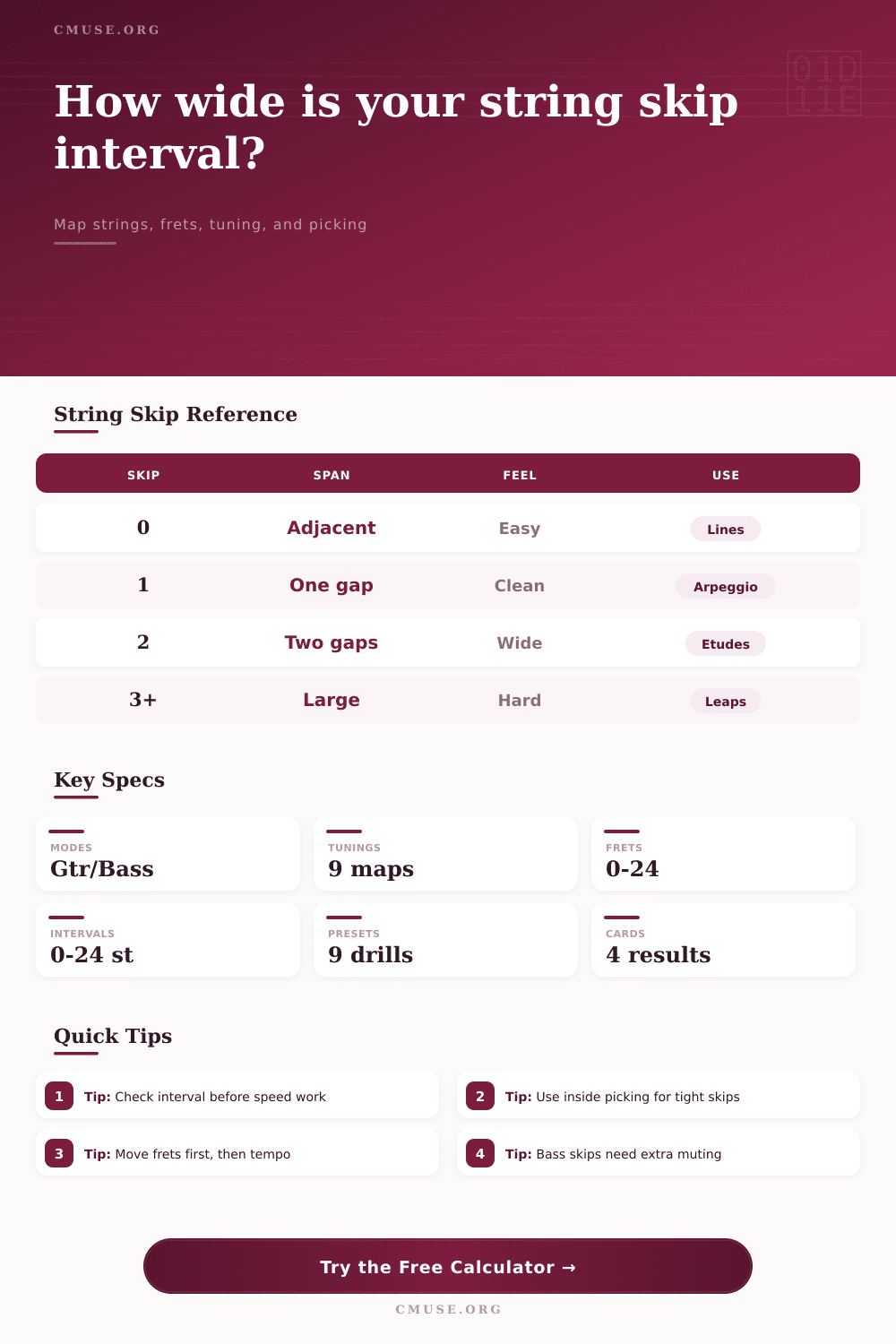
Map a start string and fret to an end string and fret, then check the pitch interval, skipped strings, and picking direction.
String skip result
| Semitones | Interval name | Common string-skip shape | Practice note |
|---|---|---|---|
| 0 or 12 | Unison / octave | Same pitch class across strings | Best for position awareness |
| 3 to 4 | Minor / major 3rd | Triad fragments across one gap | Keep fretting hand compact |
| 5 | Perfect 4th | Open tuning color or adjacent-shape shift | Listen for suspended sound |
| 7 | Perfect 5th | Power interval over one or two gaps | Mute the middle string cleanly |
| 8 to 9 | Minor / major 6th | Melodic skip with wider fret travel | Use slow repeat targets |
| 15 to 16 | Minor / major 10th | Compound third over octave space | Great for bass and chord melody |
| 19 | Perfect 12th | Octave plus fifth | Watch pick depth on wide gaps |
| Mode | Tuning | Low to high strings | Skip character |
|---|---|---|---|
| Guitar | Standard | E2 A2 D3 G3 B3 E4 | Balanced fourths with B-string shift |
| Guitar | Drop D | D2 A2 D3 G3 B3 E4 | Strong low-string fifth and octave jumps |
| Guitar | DADGAD | D2 A2 D3 G3 A3 D4 | Open fourth and suspended shapes |
| Guitar | Open G | D2 G2 D3 G3 B3 D4 | Repeated roots across non-adjacent strings |
| Guitar | Half-step down | Eb2 Ab2 Db3 Gb3 Bb3 Eb4 | Same shapes, lower pitch center |
| Bass | 4-string | E1 A1 D2 G2 | Octaves and tenths sit cleanly |
| Bass | 5-string | B0 E1 A1 D2 G2 | Large low-register skips need muting |
| Bass | Drop D | D1 A1 D2 G2 | Low root movement opens wider shapes |
| Bass | Tenor | A1 D2 G2 C3 | Higher melodic skips feel guitar-like |
| Direction | Best use | Skip risk | Calculator adjustment |
|---|---|---|---|
| Outside alternate | Clear two-note cells | Extra distance around strings | Medium load |
| Inside alternate | Compact adjacent gaps | Pick can trap between strings | Medium-high load |
| Economy / sweep | One-way arpeggio motion | Timing can blur | Lower load when direction matches |
| Downstroke lead | Rock accents and low-string starts | Reset distance increases | Higher at fast tempo |
| Upstroke lead | High-string starts and reversals | Weak accents may show | Higher at fast tempo |
| Hybrid | Wide guitar or bass leaps | Hand balance matters | Lower physical load |
| Study | Typical start to end | Primary interval | Useful picking choice |
|---|---|---|---|
| G major triad cell | 6th string fret 3 to 4th string fret 5 | Octave | Outside alternate |
| C major chord melody | 5th string fret 3 to 2nd string fret 5 | Major 10th | Hybrid |
| A minor pentatonic leap | 6th string fret 5 to 3rd string fret 5 | Minor 7th | Inside alternate |
| DADGAD suspended color | 6th string fret 0 to 3rd string fret 2 | Octave plus fifth | Economy / sweep |
| Bass octave drill | 4th string fret 3 to 2nd string fret 5 | Octave | Downstroke lead |
| 5-string bass tenth | 5th string fret 3 to 2nd string fret 5 | Major 10th | Hybrid |
Often you reach a point in a run where you are comfortabley with the scale fingering, so it runs automatically. Then when you add an extended arpeggio, the passage falls apart. Why? Probably because you are unsure of how far to move the hand. If that happens, the pick will either catch two strings instead of one or miss a string entirely. In other words, its what we call a string skip.
Most people goes on guessing their way around this until they get fed up. The geometry of your fretting hand mean that certain jumps feel different than others; intuitively guessing is often not reliable with more complicated intervals. The calculator above eliminate this guesswork. It accurately maps the semitones in a given interval. It tells you exactly how far you have jumped and how many string you have skipped. It also estimates picking load based off the direction you select. This leaves you free to concentrate on executing the passage without worrying about setting up.
How to Stop Missing Strings When Playing Big Jumps
First off: knowing what happens when we tune differently explains why tuning makes all the difference, as normal tuning set up a visual trick where distance between B and G-strings (a major third) is consistently different than the other intervals (fourths), and our brains try to make same shape again on two strings but don’t account for the tighter spacing. Transposing to an open tuning like Drop D or DADGAD helps you see whats going on. The intervals are completely changed, sometimes being wider and sometimes closer together. Understanding table of intervals on page will help you realize it’s not just about skipping. It is about interval relationships your instrument was designed to play.
It’s easy to neglect picking mechanics till it’s too late but I find that big jumps usually feel safer outside picked, as the pick has further to travel in the air between strings. If you’re able to make your picking action tight then inside picking sound cleaner too. The calculator scores these interactions as difficult if you combine a wide skip with an awkward pick direction where it feels like there is a high chance of messing it up.
Why? Because it combines fret travel with string span, it explains why jumping three strings while going up four frets are much harder than jumping three strings without a fret change. The task is more daunting still for the bassist with longer scales and thicker strings; what was a feasible jump across strings on a guitar is now a huge physical stretch on the bass. A careless mute won’t be covered by velocity, so jumping over three strings on a four string bass wouldn’t of worked unless you can find another way to mute the unused strings quickly. The preset drills for the five- and tenor settings shows how many bass players use either their finger or a hybrid pick for these skips.
Again, keeping the pick closer to the strings is a good way to develop something that are physically possible to play on the instrument. It’s not that practice is about playing fast enough to cover up the mistake but taking the mystery out of the mechanics until you no longer feel nervous when you know exactly what it is your hand is going to commit to. If the move is a wide tenth or a clean octave jump you will stop fearing the gap and begin to respect the geometry. Know where you are heading, as they say and the journey will be much less chaotic.