String Section Size Ratio Calculator
Balance violin I, violin II, viola, cello, and bass desks against hall scale, repertoire weight, seating layout, and the sound profile you want.
String Section Balance Results
| String section | Current count | Target count | Adjustment note |
|---|---|---|---|
| Violin I | 12 | 12 | Anchor section for ratio comparison |
| Violin II | 10 | 10 | Close to standard symphonic weight |
| Viola | 8 | 8 | Supports inner harmony and blend |
| Cello | 6 | 7 | Add depth for romantic repertoire |
| Double bass | 4 | 4 | Stable foundation for mid-size hall |
| Program type | Typical ratio | Common counts | Balance character |
|---|---|---|---|
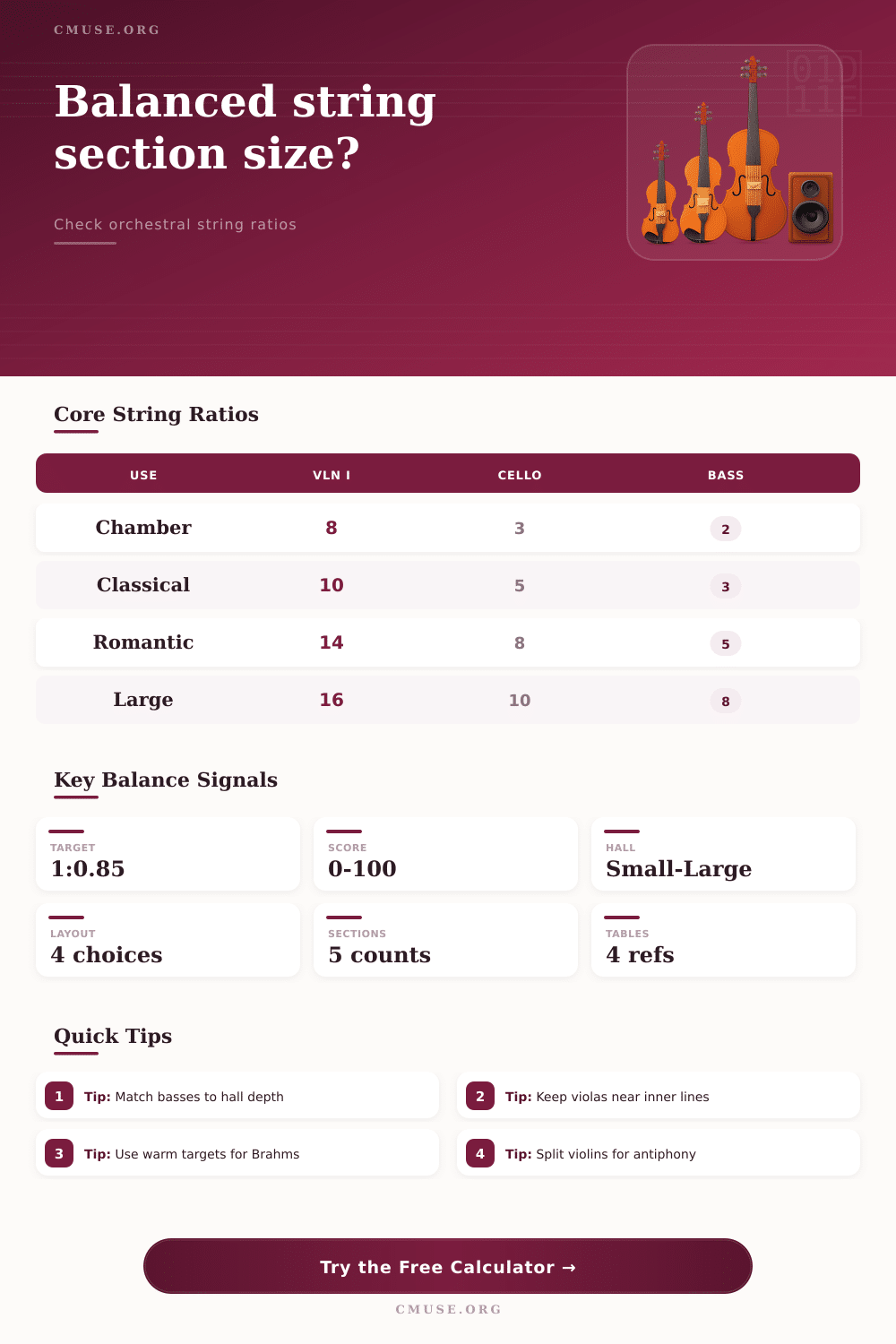
| Baroque or early classical | 1 : 0.80 : 0.55 : 0.45 : 0.20 | 6-5-3-3-1 | Transparent, violin-led, light bass |
| Classical symphony | 1 : 0.80 : 0.60 : 0.50 : 0.25 | 10-8-6-5-3 | Clear melody with firm lower support |
| Romantic symphonic | 1 : 0.85 : 0.67 : 0.58 : 0.33 | 12-10-8-7-4 | Fuller inner parts and broader cello line |
| Late romantic expanded | 1 : 0.88 : 0.75 : 0.63 : 0.50 | 16-14-12-10-8 | Heavy sonority for dense orchestration |
| Opera pit | 1 : 0.80 : 0.60 : 0.50 : 0.30 | 10-8-6-5-3 | Voice-friendly with controlled bass mass |
| Film or studio scoring | 1 : 0.85 : 0.70 : 0.60 : 0.45 | 14-12-10-8-6 | Warm, recordable, bass-supported tone |
| Context | Ratio effect | Stage pressure | Use when |
|---|---|---|---|
| Studio or rehearsal room | Reduce bass and cello mass | High at under 28 ft² per player | Close microphones or dry room |
| Chamber hall | Favor clean violin II response | Comfortable at 30-40 ft² per player | Classical and mixed chamber programs |
| Concert hall | Standard ratios usually translate well | Comfortable at 38-52 ft² per player | Balanced symphonic seating |
| Large hall | Add low-string foundation | Needs wider bass and cello spacing | Romantic, late romantic, film scores |
| Antiphonal seating | Violin II must remain close to violin I | Wider first desk spread | Classical clarity or call-response writing |
| Compact pit | Trim bass count before trimming violas | Very high below 24 ft² per player | Opera, theatre, or limited floor depth |
| Orchestra setting | Violin I/II | Viola/cello/bass | Best fit |
|---|---|---|---|
| Small classical ensemble | 6 / 5 | 4 / 3 / 1 | Haydn, Mozart, chapel concerts |
| Chamber orchestra | 8 / 6 | 4 / 3 / 2 | Classical programs in smaller rooms |
| Regional symphony | 10 / 8 | 6 / 5 / 3 | Beethoven through early romantic |
| Standard symphony | 12 / 10 | 8 / 7 / 4 | Brahms, Dvorak, broad mixed seasons |
| Large symphony | 14 / 12 | 10 / 8 / 6 | Tchaikovsky, Strauss, film concerts |
| Expanded romantic | 16 / 14 | 12 / 10 / 8 | Mahler, Bruckner, large choral works |
If the melodic line gets lost underneath the cello, or if they is lost in a pile on floorboards then that’s going to make the sound of your string section lopsided. It is not because of poor playing but normally due to the combination of mass and geometry.
Before you hire rehearsal space, a ratio calculator turns musical instinct into real numbers. Who fits in what acoustic space in the room? After entering hall dimensions, player numbers and weight of repertoire, the tool does the maths for you. No need to guess at whether your dozen first violins are up to a Brahms symphony or require some extra low-end cover.
How to Balance Your Orchestra String Sections
You’ll see the usual proportions by period in the reference table. You can see how Mozart’s clear balance move towards the thicker textures of Mahler. In all of this, Violin I is the anchor. Its role is to push the energy and set the melodic ceiling. Too thin and no matter how well supported by the bass, the sound are hollow. Too thick and there’s a loss of clarity in middle registers that are home to the harmonies. The strength of the violas hold the texture together.
Acoustics make all the difference so the calculator asks for size of hall and seating arrangement. Sound bounces off surrounding walls rapidy in a small chamber hall requiring little reinforcement from bass instruments. Conversely, in a large venue, low frequencies fades at greater speed. To fill that space you require more physical mass in the double bass and cello section. This adjustment comes directly based off the physics of instruments. The placement of violins will also alter their projection towards the audience.
The expectation stems from the repertoire. The light, agile music of the early Classical period makes every note count. There, you want something leaner. Late romantic music require heavy sonority to survive the brass and percussion layers. This is the basis for the ratio adjustment by the calculator. It will not overstaff for clarity nor understaff for power. Instead, it offers a balance score that tells whether your mix match the norms of style.
And there’s one further twist: studio recording. Details picked up in a controlled environment with microphones can be missed in a live hall. Sometimes you need a few more inner strings to make recorded track sound full on headphones. Boosting the viola and cello presence (relative to the violins) can help. This is often used as a warm target setting to compensate for focusing on capturing the desired blend instead of simply projecting to the back row. You should of considered this.
It is important to avoid common errors, such as correcting only one part of an orchestra without considering how the parts relates to each other. Adding two more first violins does not help if your cellos are still outnumbered four to one. It creates a brighter, flatter sound and leaves you feeling it has no bottom. It creates a brighter, flatter sound and leaves you feeling it has no bottom. Consult the adjustment notes. What is the relationship between sections? You may find that making minor adjustments to lower strings makes a big difference to overall sound balance, instead of making major changes to the violins.
There’s also the limitation of space. An orchestra is not going to fit wherever you want. This is why stage area input takes into account square footage per player. Squishing players onto a stage impacts both their projection and intonation. A high density flag means you might need to cut some numbers or look for a bigger hall. In the end, practical limits may beat ideal theory. They are not rules but guides. There is flexibility in music.
It’s better if you start from a balanced place when rehearsing. You will spend less time correcting acoustics and more time working on musical interpretation. Have the proportions correct on the page first then expect the performers to get it right with their bows. This is how professional orchestras create that seamless, united sound.