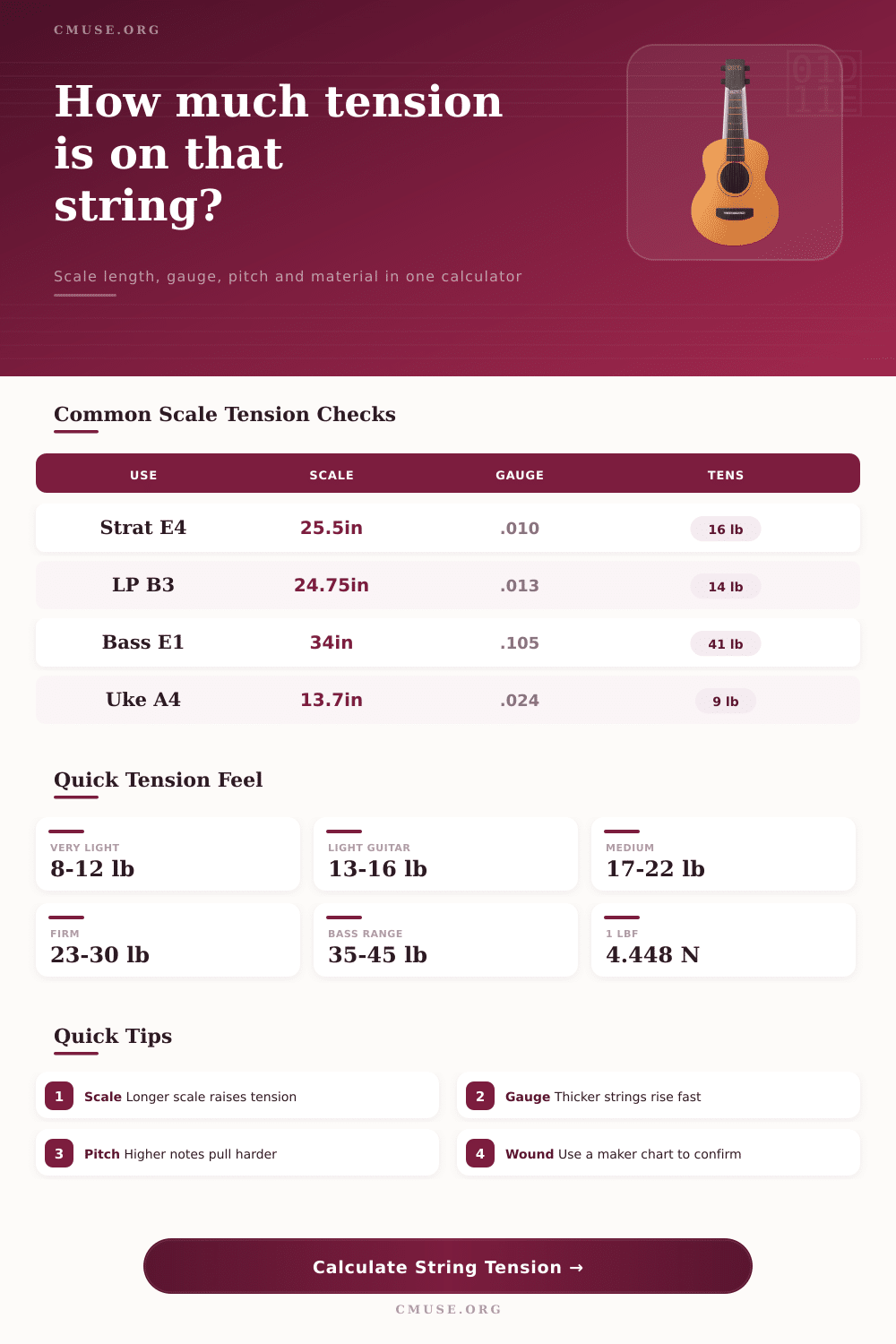
String Scale to Tension Calculator
Estimate string tension from scale length, gauge, pitch, and construction using vibrating-string physics
Preset values are practical examples for comparing tension, not brand-specific maker charts.
Calculation Breakdown
| Instrument | Scale Length | Metric | Tension Effect |
|---|---|---|---|
| Short-scale electric | 24.0 in | 610 mm | Softer at same gauge |
| Gibson-style electric | 24.75 in | 629 mm | Slightly lighter feel |
| Fender-style electric | 25.5 in | 648 mm | Reference long scale |
| Baritone guitar | 27.0 in | 686 mm | Supports lower tuning |
| Long-scale bass | 34.0 in | 864 mm | Higher pull range |
| Soprano ukulele | 13.7 in | 348 mm | Lower pull range |
| Example String | Gauge | Pitch | Scale | Typical Tension |
|---|---|---|---|---|
| Electric high E | .010 plain | E4 | 25.5 in | About 16 lb |
| Electric B | .013 plain | B3 | 25.5 in | About 15 lb |
| Plain G | .017 plain | G3 | 25.5 in | About 16 lb |
| Wound D | .026 wound | D3 | 25.5 in | About 18 lb |
| Acoustic low E | .053 bronze | E2 | 25.4 in | About 25 lb |
| Bass low E | .105 wound | E1 | 34 in | About 40 lb |
| Material | Density Basis | Default Factor | Best Use |
|---|---|---|---|
| Plain steel | 7850 kg/m³ | 1.00 | Plain guitar strings |
| Nickel wound | 8100 kg/m³ | 0.70 | Electric wound strings |
| Phosphor bronze | 8800 kg/m³ | 0.68 | Acoustic wound strings |
| Nylon | 1150 kg/m³ | 1.00 | Classical trebles |
| Fluorocarbon | 1780 kg/m³ | 1.00 | Ukulele trebles |
| Bass wound | 8100 kg/m³ | 0.62 | Large wound bass gauges |
| Family | Light Feel | Medium Feel | Firm Feel | Notes |
|---|---|---|---|---|
| Electric guitar | 12–15 lb | 16–20 lb | 21–26 lb | Per string varies by position |
| Acoustic guitar | 16–22 lb | 23–30 lb | 31–36 lb | Bronze sets pull more overall |
| Bass guitar | 30–36 lb | 37–45 lb | 46–55 lb | Low strings tolerate higher pull |
| Classical / uke | 5–9 lb | 10–16 lb | 17–22 lb | Synthetic strings stretch more |
| Orchestral string | 20–35 lb | 36–55 lb | 56–75 lb | Depends heavily on instrument |
So why should it matter? String gauge matter. Why? Well, if you swap out your strings you’ll probably find that it feel different with your guitar. What’s going on? Well, the tension has changed as scale length of your instrument doesn’t correspond with the gauge (weight) of the string. The guitar neck pull harder; the intonation is altered; your fingers ache before even getting tuned.
In most cases, people look to the string material or brand for the problem, but realy, it’s because the tension doesn’t match the scale length. Gauge isn’t the only factor in play. I’d suggest that’s an incomplete thought.
Why String Tension Matters for Your Guitar
Consider a short-scale baritone: a ten-gauge string is gonna feel loose. There’s not enough length to generate appropriate tension. Contrast that with a long-scale electric and that same ten-gauge string will sound clean because the longer length provide support for the tension.
After inputting the type of material, the string’s gauge, pitch, and scale length, this little tool saves you from guessing whether a thicker string will actualy solve your floppiness or just make your hands hurt. It’s simply about physics, but it’s no joke. String tension are proportional to the string’s linear density and the square of its frequency.
So, what happens when you extend the scale? You have two options: use a thinner string or increase the tension. Keeping the same string thickness while extending the scale mean the tension goes through the roof. That’s why you see many bass player getting their strings wound for them because standard ones aren’t pulling hard enough on a thirty-four-inch scale to stay in tune under heavy picking.
Additionally, the material density is part of the calculation. For example, even though two strings of equal diameters may weigh the same, a wound nickel-string will not weight the same as a plain steel string. Wound strings are not solid rods. They change the density or effective density using cores, wrap materials, and air gaps between core and the wrap. This is why the calculator include the construction factors. If you omit this information, your tension estimates will be off by several pounds.
It does matter if you’re trying to match the feel from one string to another. You don’t want the high B string pulling twice as hard than the low E string. Take this one step further and think about switching from a Fender (twenty five point five inch) scale to a Gibson (twenty four point seven five inches). Although not a massive change on paper, it translates into something you can feel with your fingertips. Each of those strings in the set will be under less tension with shorter-scale guitar.
Many players who has changed between these instruments say that their new guitar has felt stiff until they’ve dropped down to lighter gauges or even changed completely back to a familiar feel. It’s not a flaw, simply geometry.
From the table above, we can see the tension band assigned according to scale length alone for various instrument types. Be mindful of the change in pitch as well. Going with ten gauge on your guitar if it’s tuned down to C standard create a lot less tension. You’ll find that your strings is now looser and might slap on the frets. Some people attempt to remedy it by tweaking their action or tightening the truss rod but that doesn’t solve the problem as the problem lies in mass not hardware. Typically thicker gauges solves this.
When you pluck the string you want to have some snap but also be comfortabley. You want a balance between comfort and stability. The other aspect that can’t be quantified in numbers is the set up aspect of humans. Nothing will calculate how far apart the nut slots were cut. You might also have too much stretch on your guitar which causes the note to play out of tune. All these mechanics can imitate tension issues. Perhaps one string feels slack because it is slipping at the bridge rather than having the wrong gauge size.
Always inspect your hardware before replacing strings based off numbers alone. This device will provide a possible value, then your hands and ears determines the rest. Setting up your guitar correctly makes all the difference to its playability. How comfortable you hold it, its sustain, and its tuning stability are all affected by getting the tension right.
Once you’re at that point where the pitch, gauge and scale match, it’s no longer a fight with the neck but playing it. The place where touch meets theory is what I call the sweet spot. Once you find this, it becomes more than just a good setup; it would of become a great one.