String Mass Per Length Calculator
Find linear density, unit weight, total mass and tension for any string
Results
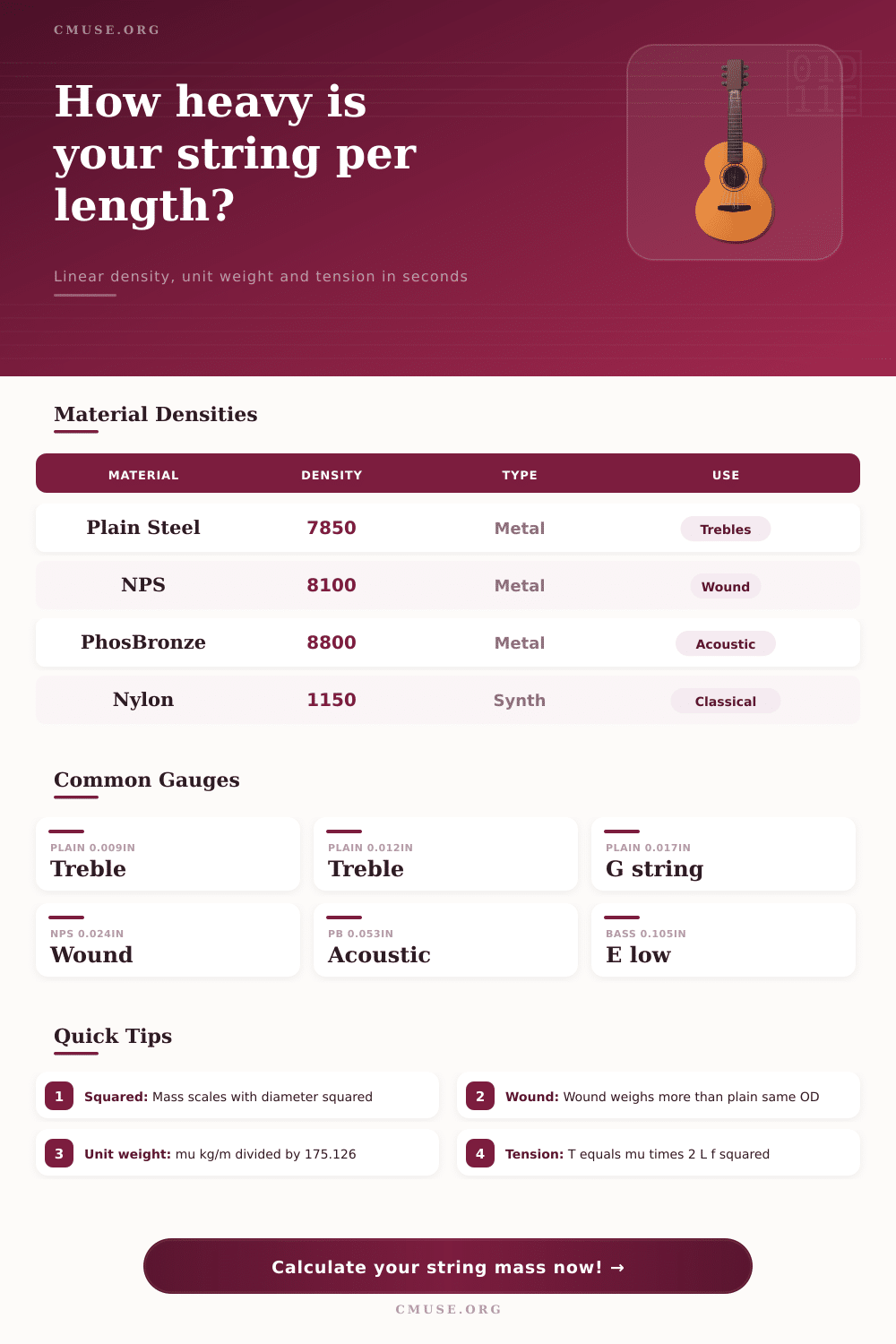
| Material | Density (kg/m³) | Type | Common Use |
|---|---|---|---|
| Plain Steel | 7850 | Metal | Treble / plain strings |
| Nickel-Plated Steel | 8100 | Metal | Electric wound |
| Stainless Steel | 7900 | Metal | Bright wound |
| Phosphor Bronze | 8800 | Metal | Acoustic wound |
| 80/20 Bronze | 8750 | Metal | Acoustic wound |
| Nylon | 1150 | Synthetic | Classical treble |
| Fluorocarbon | 1780 | Synthetic | Classical treble |
| Gauge (in) | Diameter (mm) | Unit Weight (lb/in) | μ (kg/m) |
|---|---|---|---|
| 0.009 | 0.229 | 0.00001399 | 0.00245 |
| 0.010 | 0.254 | 0.00001727 | 0.00302 |
| 0.012 | 0.305 | 0.00002487 | 0.00436 |
| 0.013 | 0.330 | 0.00002918 | 0.00511 |
| 0.016 | 0.406 | 0.00004420 | 0.00774 |
| 0.017 | 0.432 | 0.00004989 | 0.00874 |
| Diameter (in) | Plain μ (kg/m) | Wound μ est (kg/m) | Factor |
|---|---|---|---|
| 0.024 | 0.00917 | 0.01192 | 1.30× |
| 0.032 | 0.01631 | 0.02120 | 1.30× |
| 0.042 | 0.02809 | 0.03652 | 1.30× |
| 0.053 | 0.04476 | 0.05819 | 1.30× |
| Spec | Plain Steel | Phosphor Bronze | Nylon |
|---|---|---|---|
| Density (kg/m³) | 7850 | 8800 | 1150 |
| Typical role | Treble | Acoustic | Classical |
| Relative mass/OD | High | Highest | Lowest |
| Construction | Plain/wound | Wound | Plain |
A string wrapper’s number is not only an indication of thickness but also of its mass per unit of length. And that’s important because it refers to the lineal density which is key to the tension needed to keep a string in tune. Tension in turn affects sound, feel and structural integrity of your instrument. Even when diameter of two strings appears equal, one with higher mass per unit of length will feel stiffer under the finger.
After plugging in the construction type, material, and diameter, the calculator does the math. It calculates total mass, unit weight and linear density. You will no longer has to guess which gauge will give you the tension you want.
How String Weight Changes Feel and Sound
Most players is concerned with outer diameter because that’s what enters their nut slot. But core composition make all the difference. For example, a plain steel string of equal width will have far less mass per inch compared than a wound string. That increased mass enable the lower strings to remain at pitch without snapping the neck. It also maintains an even feel throughout the fretboard.
The reason for this lies on the density of the material. Nylon is light, steel is not. A 0.012-inch nylon string with same diameter as a plain steel string will have almost seven times its mass per meter. That’s the key: Classical guitars play with far thicker gauges on their trebles due to the need for greater mass in a playable tension. The nylon has to be thicker than thin gauge used for electric guitar strings so it has enough weight to work. Play one and it will feel limp and go out of tune at each bend.
Adding to the complexity is that strings are not solid rods at all. They’re wrapped around a core wire with some other material. The wound factor take into account the packing efficiency and air gaps within that coil. It’s an estimation but a good one. This means that the wrap wire itself adds a lot of weight to the string. However, it does not add much to the outside diameter of the string. So you could end up having a thick feeling low E string that fits nicely in a regular slot. Bass guitars would of required drastically shortened scales or ridiculously thick plain strings if it wasn’t for this winding technology.
Theory meets reality and creates tension. The theory here is that amount of tension applied to any given string depends on how long a scale you have. If you play an instrument with high tension, then the instrument has more sustain and volume, yet it also run the risk of warping due to uneven tensioning. Conversely, low tension make for a pleasant feeling when you fret a note, but also sounds dull and has a tendency towards buzzing. Ideally, you should be aiming for some degree of balance across all strings. This means that each string will contribute about the same amount of tension, keeping the neck in line. It also ensures that the feel of the instrument doesn’t vary dramatically as you move up and down the fretboard.
This allows for different adjustments. Longer scale length mean greater tension or more mass. Material might be changed to Phosphor Bronze which is heavier (steel is less dense than this alloy). That alters both the pull at the bridge and the sound produced. The note will be brighter and there will be more pull at the bridge. It is a small thing. But it matters.
String selection is often guesswork to many players. Buy a set and hope for the best. By understanding linear density, you no longer are guessing but instead applying engineering. You can predict what a custom gauge will do before ordering it. Mix materials to fine tune the tension balance. Ensure that a heavier bottom string doesn’t overpower a lighter top string.
Take a look at reference tables on the page. These are handy for making side-by-side comparisons of common gauge and material types. You can see that nylon is lighter than other materials like bronze and steel. Again, don’t try to commit these numbers to memory but use them to identify patterns. Phosphor bronze is heavier than regular steel. This extra weight makes the acoustic sound feel warm and rich. It is not magic. It is physics.
But then you get the instrument out for the first time and all of that goes away. All that’s left is the sound in the room and the feel under your fingers. But that too is based off the principles of tension, length and mass. Better to nail down the numbers initially so as to play the music more effectively later.
It isn’t simply a matter of plucking some wire but controlling energy. Begin with the specs. Believe the numbers. And let the instrument do its work from there. The secret is knowing what it is you’re measuring in the first place. That sticks with you long after the strings has gone flat.