String Gauge to Frequency Calculator
Convert string gauge, scale length, material, and target note into pitch, tension, unit weight, and setup range for guitar, bass, mandolin, violin, and other string instruments.
Choose a real-world starting point, then adjust gauge, material, scale, tuning reference, and desired tension. The calculator uses vibrating-string physics and construction factors for plain, wound, nylon, and gut-style strings.
Calculation Breakdown
Frequency From Gauge And Tension
A string vibrates higher when tension rises or when scale length and unit weight fall.
f = (1 / (2 x L)) x sqrt(T / linear density)Tension From Target Frequency
For a chosen note, the same gauge needs more tension on a longer scale or with heavier material.
T = (2 x L x f)^2 x linear densityEffective Linear Density
Plain strings use full circular area; wound strings use construction factors because the core and wrap do not behave like a solid rod.
density = material density x area x construction factorEqual-Tempered Fret Frequency
Every fret raises pitch by one twelfth-root-of-two step from the open-string target.
fret frequency = open frequency x 2^(fret / 12)| Instrument Profile | Low Range | Typical Range | High Range | Practical Reading |
|---|---|---|---|---|
| Electric guitar plain strings | 8-12 lb / 36-53 N | 13-18 lb / 58-80 N | 19-24 lb / 85-107 N | Lead feel Low is slinky, high is firm. |
| Electric guitar wound strings | 12-16 lb / 53-71 N | 17-24 lb / 76-107 N | 25-32 lb / 111-142 N | Rhythm Common for standard and drop tunings. |
| Steel-string acoustic | 15-20 lb / 67-89 N | 21-30 lb / 93-133 N | 31-38 lb / 138-169 N | Projection Higher loads drive the top harder. |
| Electric bass | 30-36 lb / 133-160 N | 37-48 lb / 165-214 N | 49-60 lb / 218-267 N | Bass feel Scale length strongly affects balance. |
| Classical nylon treble | 9-12 lb / 40-53 N | 13-17 lb / 58-76 N | 18-22 lb / 80-98 N | Nylon Lower density means larger diameters. |
| Mandolin course, per string | 13-17 lb / 58-76 N | 18-25 lb / 80-111 N | 26-32 lb / 116-142 N | Double Total course load doubles. |
| Violin or viola string | 8-11 lb / 36-49 N | 12-17 lb / 53-76 N | 18-24 lb / 80-107 N | Bowed Bow response matters as much as pull. |
| Material | Density Used | Best Gauge Zone | Model Factor | Notes For Frequency Estimates |
|---|---|---|---|---|
| Plain high-carbon steel | 7850 kg/m3 | .007-.026 in | 1.00 solid area | Most predictable for guitar trebles, mandolin, and some violin steel strings. |
| Nickel-plated wound steel | 8050 kg/m3 | .020-.130 in | 0.70-0.86 active area | Wrap and core reduce effective mass compared with a solid cylinder. |
| Stainless wound steel | 7900 kg/m3 | .020-.130 in | 0.72-0.88 active area | Slightly brighter and often a little firmer under the fingers. |
| Phosphor bronze wound | 8800 kg/m3 | .024-.060 in | 0.72-0.86 active area | Useful for acoustic guitar wound strings with denser bronze wrap. |
| Flatwound nickel | 8200 kg/m3 | .030-.135 in | 0.82-0.92 active area | Dense wrap raises unit weight and smooths the feel. |
| Nylon monofilament | 1150 kg/m3 | .024-.045 in | 1.00 solid area | Large diameter can still carry moderate tension because density is low. |
| Fluorocarbon treble | 1780 kg/m3 | .020-.038 in | 1.00 solid area | Heavier than nylon, so similar pitches can use smaller diameters. |
| Synthetic gut core | 1320 kg/m3 | .020-.055 in | 0.78-0.90 active area | Approximate bowed-string core behavior, not a brand-specific chart. |
| Preset | Scale Length | Gauge And Build | Open Pitch | Approx Tension |
|---|---|---|---|---|
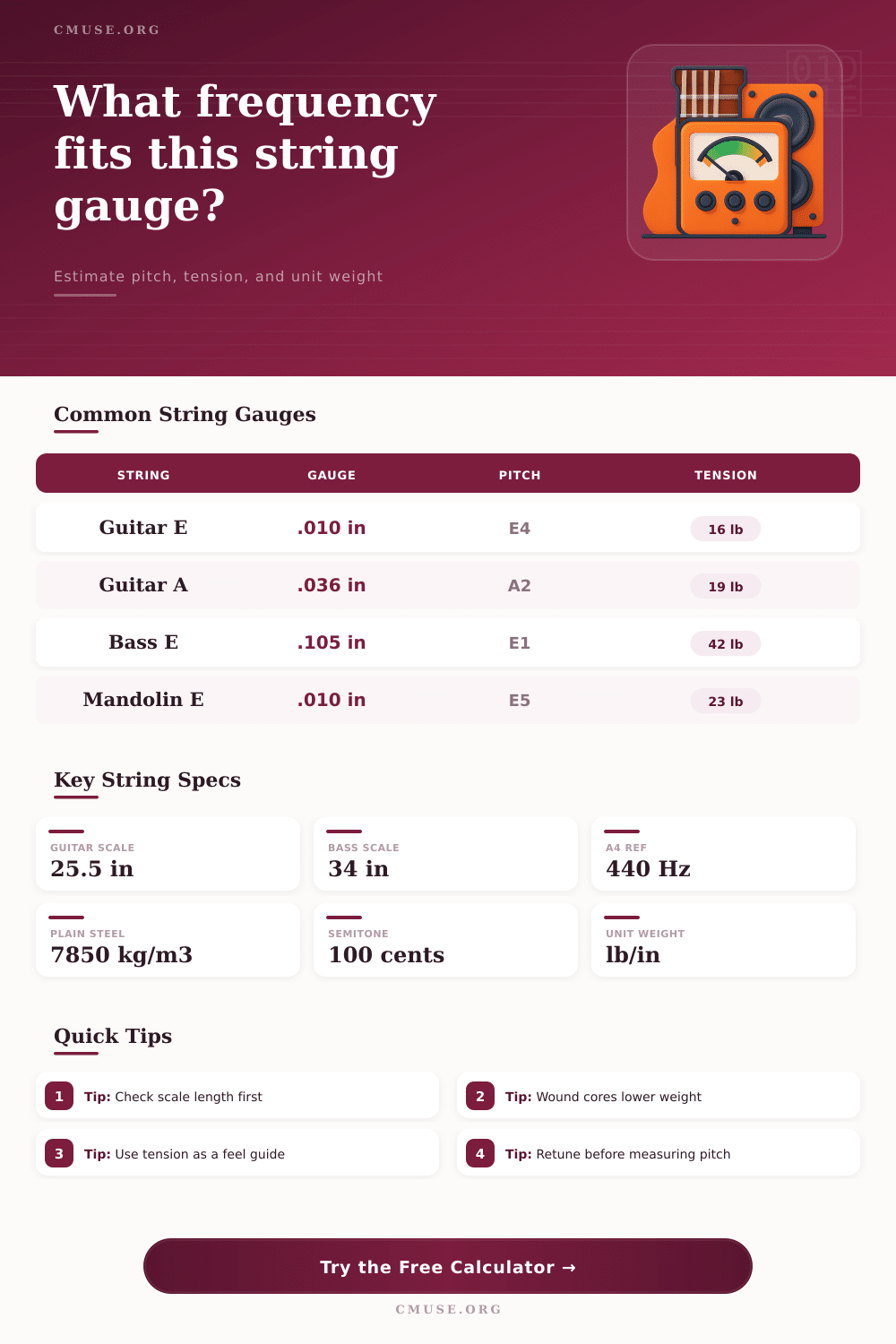
| Electric High E .010 | 25.5 in / 647.7 mm | .010 plain steel | E4, 329.63 Hz | About 16 lb / 72 N |
| Electric B .013 | 25.5 in / 647.7 mm | .013 plain steel | B3, 246.94 Hz | About 15 lb / 67 N |
| Electric Wound A .036 | 25.5 in / 647.7 mm | .036 nickel wound | A2, 110.00 Hz | About 19 lb / 85 N |
| Drop D Heavy .052 | 25.5 in / 647.7 mm | .052 nickel wound | D2, 73.42 Hz | About 22 lb / 98 N |
| Baritone Low B .062 | 27.5 in / 698.5 mm | .062 nickel wound | B1, 61.74 Hz | About 24 lb / 107 N |
| Bass E .105 | 34 in / 863.6 mm | .105 nickel wound | E1, 41.20 Hz | About 42 lb / 187 N |
| 5-String Bass B .130 | 34 in / 863.6 mm | .130 nickel wound | B0, 30.87 Hz | About 34 lb / 151 N |
| Classical Nylon E | 25.6 in / 650.2 mm | .028 nylon | E4, 329.63 Hz | About 16 lb / 71 N |
| Mandolin E Course | 13.875 in / 352.4 mm | .010 plain steel | E5, 659.25 Hz | About 23 lb / 102 N each |
| Violin A String | 12.875 in / 327.0 mm | .026 synthetic core | A4, 440.00 Hz | About 13 lb / 58 N |
| Note | Frequency At A4 440 | Guitar / Bass Use | Mandolin / Violin Use | Gauge Check |
|---|---|---|---|---|
| B0 | 30.87 Hz | 5-string bass low B | Rare extended low range | Usually .125-.135 in wound bass |
| E1 | 41.20 Hz | 4-string bass low E | Below standard violin family use | Usually .095-.110 in wound bass |
| D2 | 73.42 Hz | Drop D guitar or octave course | Low octave mandolin reference | Usually .046-.056 in wound guitar |
| A2 | 110.00 Hz | Guitar fifth string | Octave mandolin lower course | Usually .032-.042 in wound guitar |
| D3 | 146.83 Hz | Guitar fourth string | Viola and mandolin family checks | Usually .024-.032 in wound guitar |
| G3 | 196.00 Hz | Guitar third string | Violin G reference is one octave lower | Plain .016-.018 or wound .020-.024 |
| B3 | 246.94 Hz | Guitar second string | Upper mandolin comparison | Usually .011-.014 in plain steel |
| E4 | 329.63 Hz | Guitar first string | Violin E is one octave higher | Usually .009-.012 in plain steel |
| A4 | 440.00 Hz | Reference tuning pitch | Violin A string | Gauge depends heavily on material |
| E5 | 659.25 Hz | High fretted comparison | Mandolin E open course | Usually .009-.011 in plain steel |
The guitar just doesn’t feel right when you change strings. Maybe it’s because the new low E digs into your fingers or the high E are feeling a bit slack. Why guess when you’re chasing that sound? This handy little calculator take the physics of string tension and converts it to frequencies before opening the pack. If you can take away intimidation factor, it becomes quite simple.
There are only three variables that determine a strings pitch; tension, the weight of a given inch of string, and its length from nut to saddle. Of those three, most musician focus on the gauge listed right on the package. Without taking into account scale length and the density of material, gauge doesn’t reveal very much. Even though two strings may be pitched the same, a point zero ten steel string will have a different sound on a thirty four inch bass as opposed to one with a twenty five inch scale. Your particular configuration is accounted for in the calculator. No guessing about tensions required here nor any formula to commit to memory.
How String Tension Works
That doesn’t necessarily equate to more tension on thicker strings. More tension occur if you raise the gauge with the same pitch. But if you keep the gauge similar and just switch materials, the story flips. The density of that material change. Steel is denser then nylon. What does this mean? You can use a thicker nylon string than a steel one but keep comfortablely tension across an equal note. Why would you want to do that? This happens when trying to figure out what’s going on with new strings and also when switching between electric and classical guitar.
Things get complicated with wound strings. Because these aren’t solid rod-type strings, they has an inner core and an outer wrap. This affects its overall weight or “active” mass vs its outside diameter, and this is calculated in the string’s construction factor. While you don’t need to know the precise metallurgy, you do want to understand that roundwounds of equal size will pull harder and feel denser than their flatwound matches. With this info, you’ll be prompted to enter your core type and material family. This further refines the estimate so it is not just a rough guess.
Tension charts from the manufacturer don’t paint the entire picture. Those are averages; not yours. Friction is added when a bridge has a sharp angle. Tuning may have been raised or lowered just enough to affect things. It allows you to enter an intended working tension and it will indicate what frequency that gauge will actualy produce at that pull. Dial in a more firm feeling on the bass string by setting a higher tension target. Check if your current tuning is heavy enough or if you need to go up a size.
Then there’s total load. With single string instruments, one pulls on the bridge pin, while on instruments like the mandolin with double courses, the tension doubles because two strings is pulling against the same pin. If left unchecked, this added tension will warp the neck over time. The course total row provides another sanity check to see if the choice of tuning is wise based off your hardware.
The bottom line is this… Strings are all about compromise. Sustain without stiffness. You get projection without finger pain. That balance typically comes after a couple of tries, but if you can understand the relationship between tension, pitch, and gauge then each trial is an informed decision rather than a blind guess. It becomes a calculated experiment when it come time to shop. When you get it, you don’t have to guess anymore at what sounds right. Instead, you create sets that feel right. Now you’ll still swap out some strings over time, but only because you know precisely why they sound the way they do.