String Change Interval Calculator
Estimate when to replace a string set using playing hours, corrosion, tuning stability, coating, instrument type, and gig or studio risk.
Wear Breakdown
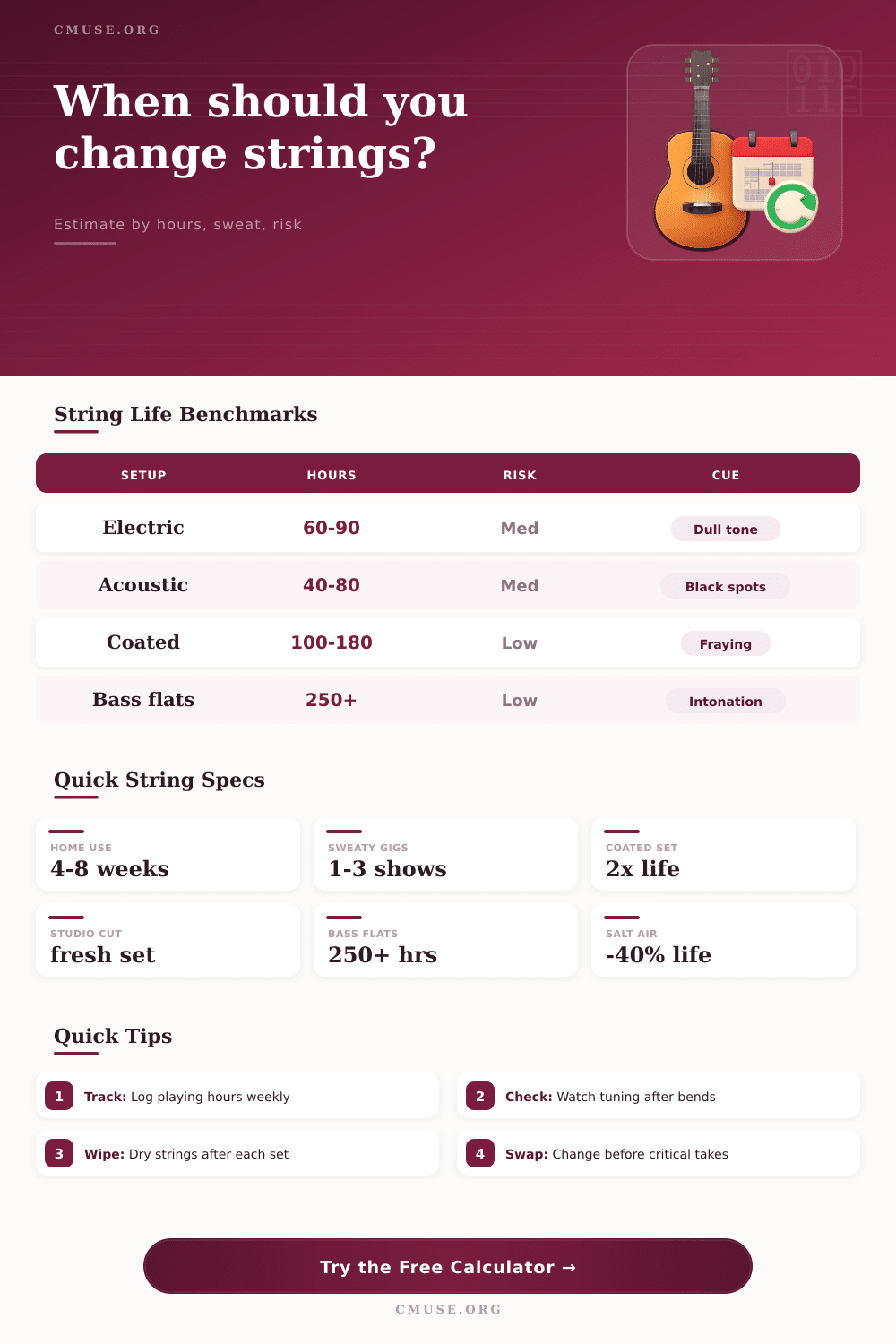
| Instrument setup | Typical string style | Baseline hours | Common change trigger |
|---|---|---|---|
| Electric guitar | Nickel or stainless roundwound | 70 to 90 playing hours | Tuning drift, dark frets, dull bends |
| Steel-string acoustic | Phosphor bronze or 80/20 bronze | 45 to 80 playing hours | Loss of shimmer, black spots, weak sustain |
| Classical guitar | Nylon trebles with wound basses | 120 to 200 playing hours | Wound bass corrosion, intonation stretch |
| Electric bass roundwound | Nickel or stainless roundwound | 90 to 150 playing hours | Reduced brightness, rough winding feel |
| Electric bass flatwound | Polished flatwound set | 250 to 500 playing hours | Intonation issues, dead spots, grime buildup |
| Violin or viola | Synthetic or steel core | 140 to 220 playing hours | False tone, slower response, unwrap at contact points |
| Cello | Synthetic or steel core | 180 to 260 playing hours | Uneven response, pitch instability, worn winding |
| Ukulele or mandolin | Nylon, fluorocarbon, bronze, or steel | 100 to 180 playing hours | Intonation drift, dull attack, visible wear |
| Condition | Multiplier | What it means | Calculator input |
|---|---|---|---|
| Dry hands, case stored | 1.10x to 1.25x | Strings oxidize slowly and feel smoother longer | Low sweat, dry climate |
| Normal room use | 1.00x | Average household humidity and normal wiping | Score 2, normal climate |
| Heavy sweat | 0.45x to 0.80x | Acids and salts shorten winding life quickly | Score 3 to 5 |
| Coastal or salty air | 0.55x | Corrosion risk rises even when the instrument rests | Salt climate |
| Treated cloth routine | 1.15x | Residue is removed before it hardens on windings | String cleaner |
| No wipe-down | 0.80x | Sweat remains on the strings after each session | Rarely wiped |
| Use case | Risk factor | Recommended cushion | Why it matters |
|---|---|---|---|
| Home practice | Low | Use full calculated interval | A dull set is inconvenient, not mission-critical |
| Rehearsal or casual jam | Moderate | Change near the yellow zone | Tuning and feel affect group timing |
| Studio session | High | Shorten by about 15 percent | Old strings can print poor intonation permanently |
| Paid gig or service | High | Shorten by about 25 percent | Breakage, tuning drift, and dead tone are public |
| Tour, audition, one-take recording | Critical | Shorten by about 40 percent | Fresh reliability matters more than maximum string life |
| Symptom | Likely cause | Interval adjustment | Change decision |
|---|---|---|---|
| Black or green spots on windings | Corrosion and skin residue | Shorten strongly | Change before the next serious session |
| Retuning after every song | Fatigued strings or binding points | Shorten strongly | Change after checking nut and bridge contact |
| Fresh tone but fraying coating | Coating worn at pick or fret contact | Moderate shortening | Plan a change soon for recording or gigs |
| Dented plain strings | Fret contact and aggressive bending | Shorten moderately | Change if bends feel uneven |
| Bowed string false tone | Core fatigue or winding damage | Shorten strongly | Replace the affected string or set |
| Stable tuning and clean feel | Normal wear only | Use calculated interval | Keep logging hours |
The high E string won’t stay put before a gig. Tighten it (now it’s flat). Tighten it, now it’s sharp. The stage lights warms up. Your fingers is clammy. You can barely muster a dull thud for your practiced attack. Bad luck? Nope. The string has reached the end of its useful life.
When should you change them? Players’ guess when (by date or by feeling). A better way is to measure actual wear mechanisms. The calculator translate your playing habits into a replacement schedule.
How to Know When to Change Your Guitar Strings
Vibration last for hours, not weeks. The more your strings vibrate, the older they get. If you practice thirty minutes a day five days a week, your strings dies much slower then a touring musician. Play six hours of heavy pick attack and sweaty picking each night, and they’ll die sooner. Enter your weekly hours and select your intensity level (low, high). The calculator do the math. No more guessing what conversion or coefficient to use.
Do you know what is killing them? Know if it’s mechanical or chemical string wear. Mechanical string wear are due to pick attack, fretting and bending. Dents flat strings and frays winding. Chemical string wear is caused by sweat and skin acids that corrode shiny nickel into rough, darkened metal. If you have acidic hands, your strings will rot long before they snap.
It’s also about instrument type: Some instruments requires more tolerance than others. Six months on the same set of electric bass strings may be just peachy, while that steel-string acoustic will lose its shimmer up-top in a few dozen hours of strumming. Material stability (refer back to the table) makes nylon classical guitars more durable than bronze acoustic guitar, which affects your tone. If you’re playing jazz with flatwound bass strings, you don’t need to worry about corrosion. If you are shredding metal with hard picks and stainless steel string, you’ll battle fretboard wear and coating degradation.
String fatigue affect tuning stability. New strings stretch out fast and then settle into pitch nicely. Older ones become permanently bent at the heart of their wires. They lack elastic memory. If you’re casually jamming and having to retune between songs, your strings are half-dead already. This input greatly affects the calculator’s recommendations. Physically speaking, a set requiring regular retunes is compromised. It will lead to tuning problems you simply can’t solve with any amp setting or pedal adjustment. There’s no such thing as an EQ for a string which won’t stay in tune.
Professional and home player differ by risk level. At home, a dull string is an annoyance. On stage it’s a liability. Your performance setting determine a safety margin used by the calculator. For example, you should of change them earlier if it is a critical studio take or audition than if it is just practicing. You can’t afford to have one break in the middle of a solo climax or drift off pitch in the middle of a ballad. When the stakes are high, reliability matters more then economy.
Begin by cleaning your strings after each use. Salts left on the string from dried sweat will cause corrosion. It is cheap insurance. If possible wash up before playing. Keeping your instrument in a case will keep out humidity. Near the coast, salt air is the fastest way to destroy strings. Even gentle playing will cut its life almost in half.
Keep track of your hours honestly. Your calendar fools you when you tell yourself you practice two hours when realy it’s four. Let the data help you reach a consistent tone. A new set doesn’t cost much money, but it does buy you control, clarity and confidence.