Streaming Break-Even Calculator
Estimate how many streams a release needs to recover recording, campaign, distributor, and creative spending after platform payout assumptions, distributor percentage, collaborator splits, and recoup share.
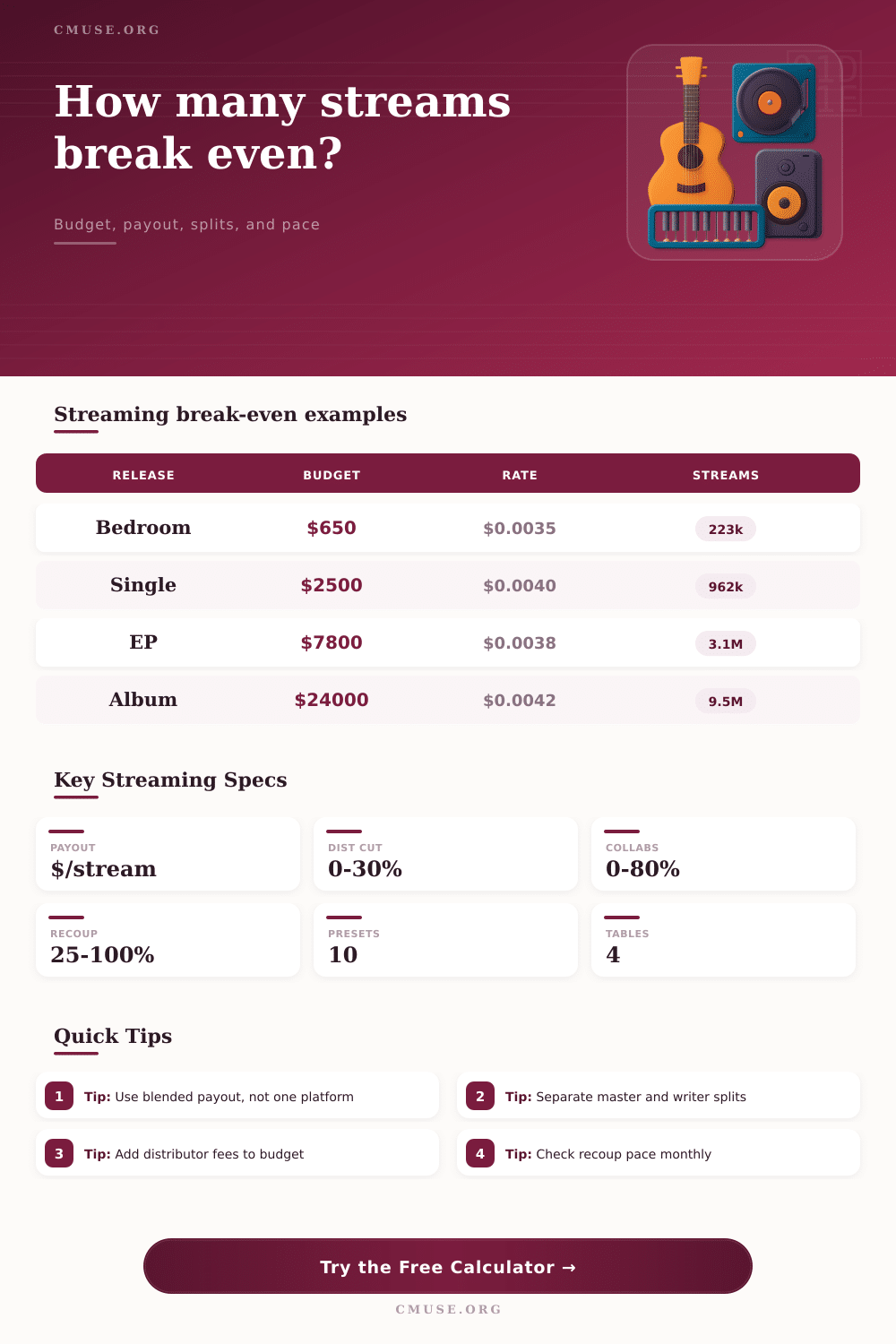
Load a release scenario, then adjust the budget, payout, distributor terms, collaborator share, and recoup allocation. Use a blended payout when the audience is spread across platforms.
Breakdown
Post-distributor stream value
Artist master share after collaborators
Recoup dollars per 10k streams
Daily streams at current pace
| Blended payout type | Typical use | Per-stream input | Notes for break-even math |
|---|---|---|---|
| Low blended catalog | Global audience with many free-tier streams | $0.0025 to $0.0032 | Useful when reports show lower territory or subscription mix. |
| Mid blended release | Independent single across major DSPs | $0.0035 to $0.0045 | A practical starting range when no statement is available yet. |
| Higher blended niche | Subscription-heavy, premium, or focused territory mix | $0.0050 to $0.0070 | Use only when your distributor reports support the rate. |
| Statement-derived rate | Known royalty report or catalog audit | Total master revenue / streams | Best option for precise recoup forecasts. |
| Scenario | Budget profile | Split pressure | Break-even watch point |
|---|---|---|---|
| DIY single | Small recording spend, small campaign | Often 0% to 15% collaborator share | Marketing spend can outweigh recording spend quickly. |
| Featured collab | Moderate campaign and creative assets | Feature and producer shares reduce recoup rate | Check if collaborator percentages apply before or after fees. |
| EP campaign | Multiple masters, broader promotion | Several writers may not affect master recoup | Run per-track and whole-project views separately. |
| Label services | Higher campaign spend and admin fees | Distributor or services cut may be material | Confirm whether fees are costs, percentage, or both. |
| Input | What it changes | Example | Common mistake |
|---|---|---|---|
| Distributor percentage | Reduces every stream before master splits | 15% cut leaves 85% of payout | Using gross payout as if it were artist net. |
| Collaborator master split | Reduces the artist-controlled share | 25% feature leaves 75% to artist side | Mixing master splits with publishing splits. |
| Recoup share | Controls how much artist income repays budget | 80% recoup leaves 20% as current income | Assuming all artist income goes to recoup. |
| Fixed fees | Add to the amount that must be recovered | Annual distributor fee or setup admin | Ignoring small fixed fees on low-budget releases. |
| Monthly pace | Annual streams | Best for | Planning note |
|---|---|---|---|
| 5,000 streams | 60,000 | Early DIY catalog | Small budgets need tight campaign discipline. |
| 50,000 streams | 600,000 | Active indie single | Useful threshold for testing ad and playlist assumptions. |
| 250,000 streams | 3,000,000 | Strong single cycle | Budget recovery may still lag if splits are heavy. |
| 1,000,000 streams | 12,000,000 | Breakout or viral release | Re-run with actual blended payout once statements arrive. |
When an artist completes a music project, the artist must decide whether the revenue that the project will earn will be sufficent to cover the costs of the project. The costs of the project include costs for recording the song, costs for mixing the song, costs for artwork, costs for videos, costs for advertising, and costs for the distributor to set up the project. Additionally, the artist will need to determine at what point the revenue for the project will equal the total costs of the project.
In order for the project to reach this break-even point, the revenue that the project earns from streaming will have to cover all costs of the project after each percentage cut is applied to the revenue and after each fee is deduct from the revenue. To determine the break-even point for the project, the artist will have to perform some calculations. The calculations will begin with the revenue that is earned from the streaming of the project.
How Many Streams You Need to Break Even
However, the streaming platform dont direct the revenue to the artist, instead, the distributor of the project will take a percentage of the revenue from the streaming of the project. Additionally, if the project is a collaborator project, the featured artists and producers may take a percentage of the revenue from the streaming of the project (because they own a percentage of the master recording). Additionally, the artist will have to determine how much of the revenue should be used to cover the costs of the project and how much the artist will keep.
Each of these variables will impact the number of streams that the project will need to reach the break-even point. Many music artists use a blended payout rate for the project instead of the rate that they would receive from each of the different streaming platforms that the projects audience use. The audience of a music project may use numerous different platforms to stream the project, and each of these platforms may have a different rate of paying musicians for the streaming of their projects.
If the artist only used the rate from one of the streaming platforms, the artist may have a false sense of security that they will earn that rate for the project. Instead, by calculating the blended payout rate, which is a single number that represents the average revenue that will be earned from streaming the project on all of the platforms, the artist can perform their calculations in a way that is more accurate than if they use only the payout rate of a single streaming platform. Budget categories play an important role in the calculation of the break-even point of the music project.
For example, in addition to the cost of recording the project, there are other budget categories that may include large sums of money for the artist to spend, such as campaign spending and launch assets costs. In these cases, the artist should add a small percentage to the total project budget to allow for additional fees or costs for the project that may arise after the budget is initially established. For example, if the project budget increases due to additional fees, the break-even point will also increase.
Collaborator splits will also impact the break-even point. For example, if a producer or featured artist owns a percentage of the master recording of the song, then the distributor will split the revenue between the main artist and the other artist that owns that percentage of the master. Thus, the percentage of revenue that the main artist will receive from streaming will be less then if there were no collaborator splits.
Additionally, the artist has to account for the distributor cut and the collaborator split separately to determine how each of these splits will impact the break-even point. In addition to the factors discussed above, the number of streams that the project has currently earned is another value that should be entered into the calculation. The current streams for the project will reduce the number of streams that are required for the project to reach the break-even point.
Thus, a project that currently has a high number of streams will require fewer streams to reach the break-even point than a project that has no streams yet. Additionally, once the artist enters the number of streams that the project has earned into the calculation, the calculation will reveal the number of months that will be required for the project to reach the break-even point. This number is a valuable measure of the projects finances because it accounts for both past and future performance of the project.
The number of streams that the project will earn each month is a variable that will impact the calculation. Additionally, this number can change over time. For example, projects that receive heavy paid advertising may earn a high number of streams each month, but the stream counts may drop after the advertisements end.
Additionally, other projects may earn a steady number of streams each month (known as catalog tracks). Therefore, the artist can use either a conservative or optimistic estimate of the stream count each month. Furthermore, the project may have fixed fees associated with it.
For example, the distributor may have fees each year for the artist to account for, or the project may have a one-time setup fee for the distributor account. Even if the fees are small, they must be accounted for in the calculation to determine the break-even point. Any ignored fees will create an incorrect break-even point.
Beyond knowing the break-even point for the project, another primary value of determining the break-even point is that the artist can use the calculation to test various decisions for the project. For example, the artist can use the calculation to determine how many streams would be required for the project to reach the break-even point if the artist increased the number of streams that are circulated for the project. Additionally, the artist could use the calculation to determine how many streams would be required to reach the break-even point if the collaborator percentages were changed.
Thus, the calculation allows the artist to make concreate, informed decisions about the project. Additionally, the calculation will reveal how far the project will have to go before it reaches the break-even point, and it will show the artist which decisions will shorten that distance to the break-even point.