STIPA Calculator
Estimate speech intelligibility from octave-band modulation transfer, noise masking, distance, and room decay.
Measured MTF mode uses your transfer values directly. Full mode applies masking and reverberation reductions before converting each modulation value to apparent signal-to-noise ratio.
| Octave band | MTF low | MTF high | Speech SPL | Noise SPL | Mod rates |
|---|---|---|---|---|---|
| 125 Hz | 1.6 / 8.0 Hz | ||||
| 250 Hz | 1.0 / 5.0 Hz | ||||
| 500 Hz | 0.63 / 3.15 Hz | ||||
| 1 kHz | 2.0 / 10.0 Hz | ||||
| 2 kHz | 1.25 / 6.3 Hz | ||||
| 4 kHz | 0.8 / 4.0 Hz | ||||
| 8 kHz | 2.5 / 12.5 Hz |
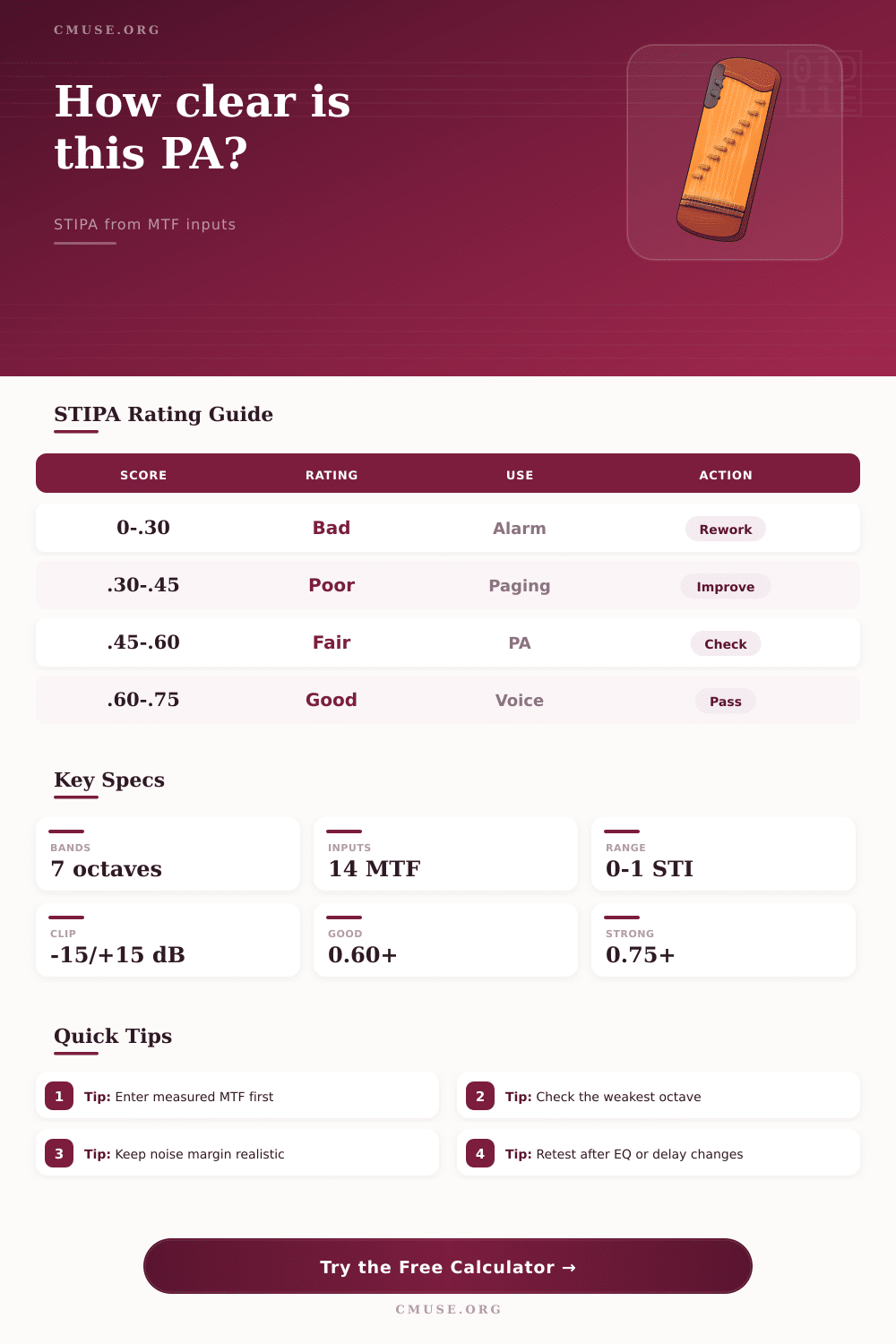
Formula path: corrected MTF = input MTF × noise factor × RT factor × distance factor; apparent SNR = 10 log10(m / (1 - m)); transmission index = (clipped SNR + 15) / 30.
Calculation Breakdown
| STIPA range | Rating | Typical interpretation | Common response |
|---|---|---|---|
| 0.00 to 0.30 | Bad | Words are often lost | Rework coverage, noise, or RT |
| 0.30 to 0.45 | Poor | Short paging may work | Improve SNR and direct sound |
| 0.45 to 0.60 | Fair | Usable for many PA zones | Check weak bands and masking |
| 0.60 to 0.75 | Good | Clear speech for most listeners | Confirm coverage consistency |
| 0.75 to 1.00 | Excellent | High intelligibility | Maintain level and alignment |
| Octave band | Speech role | Male weight | Female weight |
|---|---|---|---|
| 125 Hz | Low warmth, little clarity | 0.085 | 0.000 |
| 250 Hz | Vowel body | 0.127 | 0.117 |
| 500 Hz | Vowel-to-consonant bridge | 0.230 | 0.223 |
| 1 kHz | Core articulation | 0.233 | 0.216 |
| 2 kHz | Consonant clarity | 0.309 | 0.328 |
| 4 kHz | Fricatives and presence | 0.224 | 0.250 |
| 8 kHz | Fine detail, air loss check | 0.173 | 0.194 |
| Venue scenario | Likely target | Watch point | Useful measurement zone |
|---|---|---|---|
| Voice alarm corridor | 0.50 to 0.60 | Door leakage and fan noise | Farthest occupied point |
| Lecture hall | 0.60 to 0.75 | Late reflections | Rear third and side seats |
| Transit platform | 0.45 to 0.60 | Train and crowd noise | Peak-noise listener positions |
| Theater lobby | 0.55 to 0.70 | Reverberant spill | Queue and entrance areas |
| Control room talkback | 0.70 to 0.85 | Nearfield balance | Mix position and producer seat |
| Preset | Room size | Expected STIPA | Secondary check |
|---|---|---|---|
| Airport concourse | 180 ft × 70 ft | Fair to good | Noise margin at 2 kHz |
| House of worship | 95 ft × 55 ft | Fair | RT60 reduction |
| School hall | 70 ft × 42 ft | Good | Rear-seat coverage |
| Transit platform | 220 ft × 28 ft | Poor to fair | Ambient noise swing |
| Control room | 24 ft × 18 ft | Excellent | High-band transfer |
Speech intelligibility is not about the volumes of the sound that needs to be projected into a public address system. Speech intelligibility is about whether or not a person can understand the phrase that is being spoken. For a phrase to be intelligible, it must travel from the loudspeaker to the listener’s ear without being obscured by echoes or background noises.
The STIPA calculation will provide a number between zero and one that represents the level of speech intelligibility. A higher score mean that the listener will more easily understand the message that is being projected. A lower score indicates that the listener will most likely miss the words.
Speech Intelligibility and the STIPA Test
Speech intelligibility is based off the fact that speech contains energy that varies at certain rates. These modulations of the speech will allow the listener to properly understand every consonant and vowel in the phrase. However, echoes will stretch out every syllable of the spoken phrase, and background noise will fill in the quiet spaces between every syllable.
The calculator will use the measured modulation transfer energy of each octave band to calculate the speech intelligibility score. This score is not an indication of the loudness of the public address loudspeakers because the STIPA score is an estimate of the information that the listening room have removed from the speech prior to reaching the listener’s ears. The shape of the room and the distance of the listener from the loudspeakers are two factors that impact the calculation of speech intelligibility.
The shape and distance of the listener affect the balance between the direct sound that reaches the listener versus the reflected sound that reaches the listener. For instance, a long and narrow concourse will reflect the sound in that same length of the concourse, but the late reverberation within that concourse will reflect off of every hard surface within that concourse. The same is true of a fan-shaped lobby; it will reflect sound from the loudspeaker in the lobby, but it is also possible that some listeners will be situated in areas that are not in the direct line of sight of the loudspeaker.
The loudspeaker system in the calculator accounts for these different geometries of rooms so that the distance measurements from the loudspeakers to the listeners are accurate. If the shape of the listening areas is changed in the calculator, the software will automatically calculate the coverage area for that geometry and the distance of the listener from each loudspeaker. Another factor that affects speech intelligibility is noise masking.
Each octave band of noise contains a portion of the energy of the speech signal. The low-frequency sounds provide little intelligibility to the listeners, but the noise in the bands around 2,000 and 4,000 Hz contains the majority of the energy of the consonants in the speech. If the noise in those bands is close to the level of the speech in those bands, intelligibility will decrease.
The calculator allows the levels of speech in each band to be entered as well as the noise in each band; the calculator will automatically calculate the masking of speech by noise in each band. This calculation for masking by noise is more important than using the signal-to-noise ratio for the entire speech signal because the loudness of the system is not as important as having the speech intelligibility in the crucial bands. Reverberation time can be factored into the calculation of speech intelligibility because different rates of modulation of speech will experience the reverb differently.
The faster the modulation rate of speech, the more echoes will interfere with speech intelligibility; the echoes will occur before the next peak in the speech signal. The slower the modulation rate, the more time will occur between echoes of speech. Each band in the speech signal can be weighted according to the modulation rates to determine whether reverberation is the issue with speech intelligibility or the loudspeakers themselves.
The reference tables that you can find on the page that contains the calculator allow a user to determine the speech intelligibility score of a system and understand what that score indicates about that system. If the STIPA score is below 0.45, short paging announcements will only work if the individuals who will hear the announcements are already expecting them to be made. A score between 0.45 and 0.60 means that the system is usable for public-address loudspeaker systems but may require some adjustments to the loudspeakers.
A score above 0.60 means that the speech will be intelligible to most listeners even if they are not paying close attention to the loudspeaker. The thresholds for speech intelligibility are not subjective; they are based upon listening tests performed on the measurements of speech intelligibility. One of the most common mistakes in using the STIPA score is to use the final score as an average of the loudspeaker system’s performance in each octave band.
The average score may be good for the loudspeaker system, but it is possible for one octave band to be weak while the others are strong. The calculator will identify that weak octave band so that the user can adjust the loudspeaker system to improve that band’s intelligibility. Furthermore, the loudspeakers should not be simply turned up to improve intelligibility.
The same rule should apply after any adjustments are made to the loudspeakers. The STIPA calculation should be made again to determine whether the adjustments helped with the intelligibility. Another of the most common errors with the STIPA calculation is to ignore the speech intelligibility calculation methods.
The measured values for each octave band’s modulation transfer are direct measurements of the intelligibility of speech; they do not include the effect of background noise or reverberation. These values can be modified to include the effect of noise or reverberation to determine what may happen if those elements in the listening area were reduced. The value of the calculation methods and the ability to calculate speech intelligibility becomes very important when justifying an upgrade to a loudspeaker system.
A single number for speech intelligibility that is supported by calculations of intelligibility in each octave band is worth more than a general statement about the loudspeaker system’s sound. Furthermore, the calculation methods provide a standard measurement for speech intelligibility that can be used again after any equipment or renovation changes to the loudspeaker system to determine whether or not the changes were successful. The STIPA calculation does not eliminate the importance of the loudspeaker system’s engineers and technicians to understand speech intelligibility.
The calculation only removes the guesswork that may go into determining the contribution of each physical factor to speech intelligibility. If the STIPA score is the number that you expected to find when you measured the loudspeaker and listening area, you can move on to other engineering priorities. If, however, the STIPA score that is calculated is not the number that you expected, you will have a breakdown of the reasons why the loudspeaker and listening area may require adjustments.