Standing Wave Calculator
Solve string, pipe, and room standing waves, then compare frequency, wavelength, period, and node spacing with one music-ready tool.
🎵 Presets
⚙ Solver Setup
String resonance inputs
Use this panel for guitar, bass, violin, or any stretched string where length, tension, and linear density set the pitch.
📈 Quick Spec Grid
📑 Formula Reference
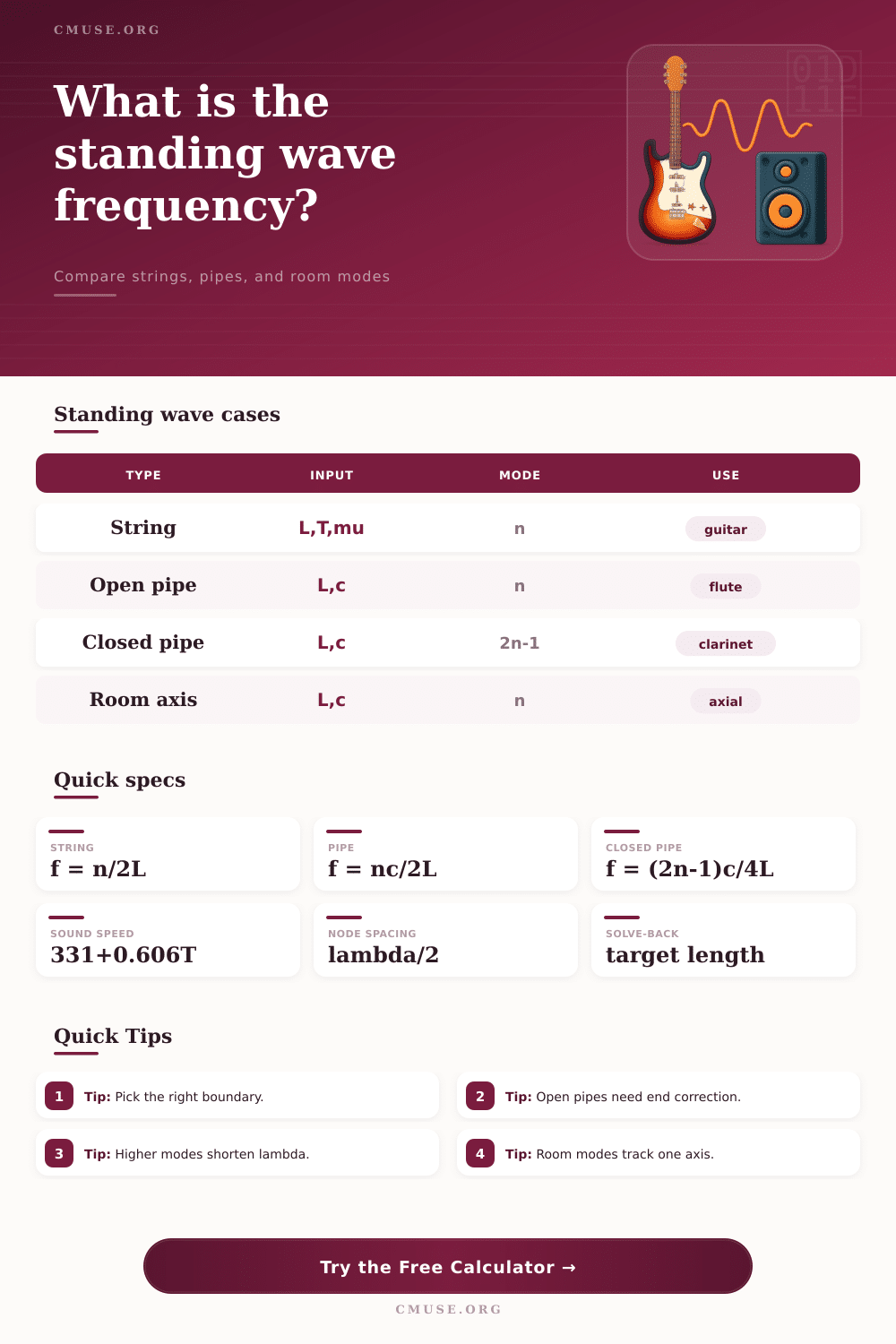
| Medium | Frequency rule | Core inputs | Boundary cue |
|---|---|---|---|
| String | f = n/(2L) × sqrt(T/mu) | L, T, mu, n | fixed ends |
| Open pipe | f = n c / (2L) | L, c, n | open-open |
| Closed pipe | f = (2n-1)c / (4L) | L, c, n | open-closed |
| Room axial | f = n c / (2L) | Axis L, c, n | parallel walls |
📊 Boundary Guide
| Boundary | Mode pattern | Node pattern | Use case |
|---|---|---|---|
| Fixed-fixed | n = 1,2,3... | nodes at ends | strings |
| Open-open | n = 1,2,3... | antinodes at ends | flutes |
| Open-closed | 1,3,5... | node and antinode | clarinet |
| Axial room | n = 1,2,3... | between walls | studio modes |
📋 Common Preset Reference
| Preset | Mode | Dimension | Result focus |
|---|---|---|---|
| Guitar E2 | String | 0.648 m | 82.4 Hz |
| Flute C5 | Open pipe | 0.658 m | 523.3 Hz |
| Clarinet G3 | Closed pipe | 0.330 m | 196.0 Hz |
| Room 12×10 | Axial | 12 ft | 47.1 Hz |
📆 Mode Comparison
| Type | Wave speed | Best for | Watch out |
|---|---|---|---|
| String | tension based | instruments | density changes |
| Pipe | air speed | wind tones | end correction |
| Room | air speed | studio tuning | parallel walls |
| Odd pipe | air speed | clarinet family | skip even modes |
Length and mode checks
Use the active axis or speaking length to see how the fundamental and harmonic modes shift as the resonant path changes.
Boundary and correction checks
Open pipes and rooms can look similar on paper, but correction, axis selection, and harmonic family change the final answer.
💡 Tips
A standing wave is a vibration that reflects back and forth between two point on a vibration until it locks into a specific pattern. Standing wave create specific pattern of sound. These patterns is known as modes, and the modes create the pitch and tone of the sound.
A string is an object that demonstrate the function of standing waves. A string is fixed at both end, such as on a guitar or a violin. The tension of the string impact the functioning of the standing wave, as does the mass of the string.
How Standing Waves Work
If the tension of a string are increased, the speed of the standing wave will increase, causing the pitch of the string to increase. Additionally, if the mass of the string is increased, the mass will resist the string’s tension, leading to changes in the way that the string vibrate. At the fixed ends of the string, nodes will be formed, and nodes will be present at intervals of half of the wavelength of the strings vibrations.
Air column, such as those in flutes or clarinets, also create standing waves, but instead of use a vibrating string, these instruments use vibrating air. Within a flute, the air columns has open ends at both side of the flute. Open ends allow for antinodes to form at those open ends of the air column.
In a clarinet, however, one end of the air column is open and the other is closed. In this case, the modes that are formed are only odd-numbered modes. For this reason, clarinets have a different timbre than flutes.
Additionally, the length of the air column impact the pitch of the standing wave that is formed. However, the temperature of the air also impact the pitch of the standing wave. If the temperature of the air within the flute or clarinet increase, the speed of sound in the air will increase, increasing the pitch of the standing wave.
In this case, though, it is important to account for the end correction in the length of the flute or clarinet. In addition to flutes and clarinets, standing waves can also form in room. Standing waves form within rooms in three dimensions, occurring within the various planes of the rectangular room.
Within a rectangular room of a specific length, the standing waves will have a fundamental frequency mode within that room, as well as higher modes at various octave. Thus, numerous modes can exist within a rectangular room. In order to even out the standing waves within a rectangular room, the walls of the rectangle can be splayed, or portion of the walls can be added to ensure that the standing waves dont become trapped within one portion of the room.
These different setups for standing waves can be compared to one another. For instance, a guitar string will require a certain length for the string to vibrate at a certain pitch, but the flute will require a different length of the flute for the air column to produce that same pitch. Finally, because standing waves in a room have much longer wavelengths than those of a string or a pipe, the dimension of the room will be larger than those of the other standing waves.
In each of these cases, though, the nodes that form within the standing waves will be half of the wavelength of the standing wave. There are error that can be made in calculating the standing waves that are formed by these different objects. For instance, a person may measure the full scale of an object rather than the vibrating portion of that object, leading to incorrect calculation of the standing waves that are formed.
A person may also not account for end correction for Standing waves created within a pipe. Thus, the calculated pitch will be higher than the actual pitch of the standing wave. Finally, a person may also fail to account for the change in temperature of the air.
If the standing waves are calculated at a different temperature than that within the air column, the standing waves will have a different pitch. Boundaries dictate the pattern of every standing wave. If the boundaries of the object are fixed, nodes will be formed at those boundaries.
If the boundaries are open, antinodes will form at those boundaries. Additionally, the speed of the standing wave will determine its frequency, and either the tension of the standing wave (for strings) or the temperature of the air within the standing wave (for air columns) can determine the speed of the standing wave. Thus, by understanding these three component of any standing wave, you can understand the behavior of that standing wave.