Stagehand Hours Calculator
Estimate load-in and load-out person-hours, crew size, department task blocks, and practical schedule buffer for stage, audio, lighting, video, backline, and truck calls.
Stagehand Labor Plan
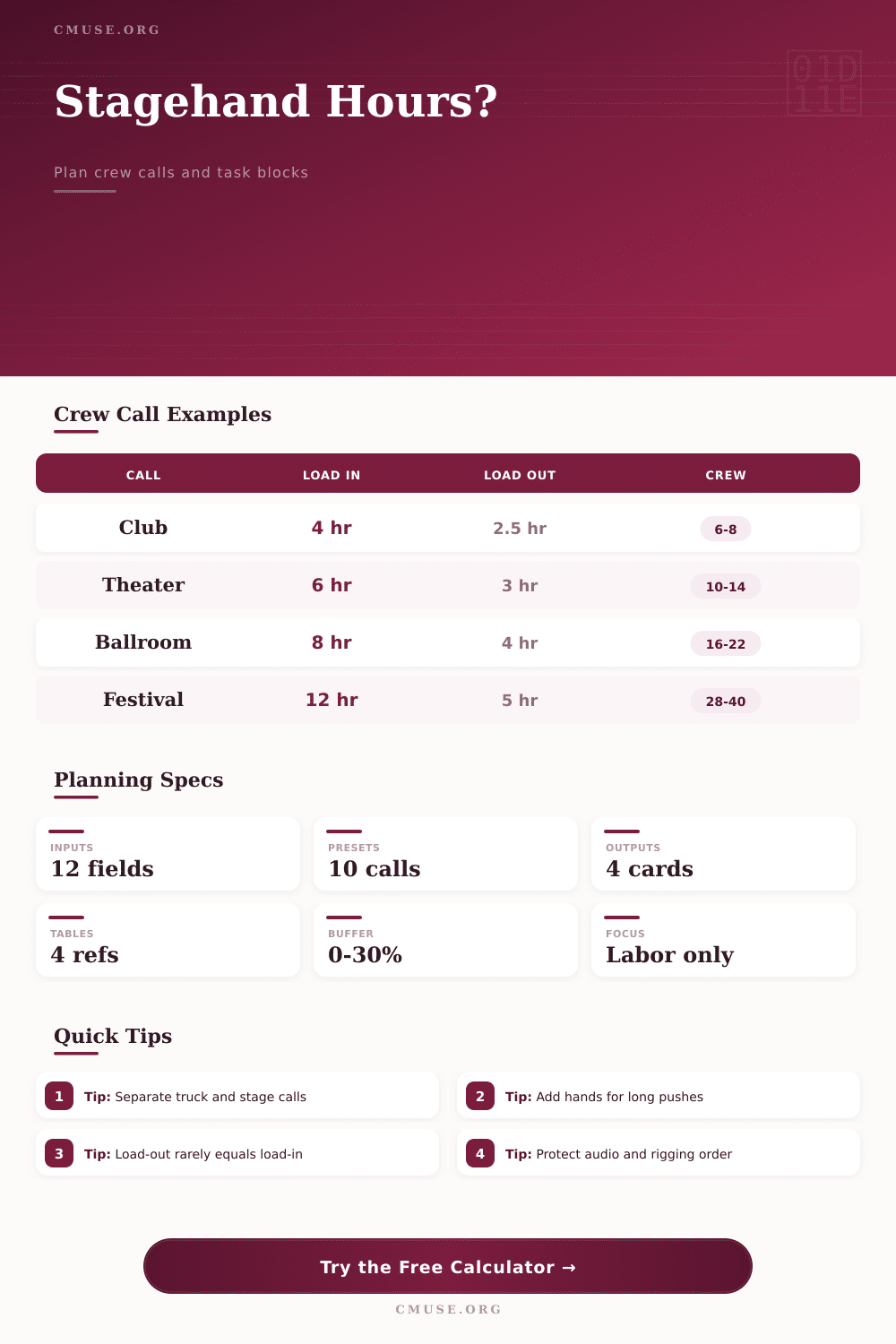
| Production call | Common load-in window | Common load-out window | Typical peak hands |
|---|---|---|---|
| Small club band with shared PA | 3 to 5 hours | 2 to 3 hours | 4 to 8 stagehands |
| Touring theater concert | 5 to 8 hours | 2.5 to 4 hours | 10 to 18 stagehands |
| Corporate ballroom general session | 6 to 10 hours | 3 to 5 hours | 14 to 24 stagehands |
| Outdoor festival main stage | 10 to 14 hours | 4 to 6 hours | 28 to 44 stagehands |
| Task block | Load-in planning rate | Load-out ratio | Call note |
|---|---|---|---|
| Truck handling | 3.5 to 18 person-hours per vehicle | 80% to 100% of load-in | Access, push, and pack order dominate. |
| Stage deck and risers | 0.45 to 0.9 person-hours per 100 sq ft | 50% to 70% of build time | Dance floor and leveled deck need more care. |
| Lighting fixtures and truss | 0.18 hours per fixture plus truss labor | 65% to 80% of load-in | Focus and circuiting keep load-in longer. |
| Audio and backline | Package block plus 0.7 hours per station | 60% to 80% of load-in | Line check is load-in only; pack is faster. |
| Access condition | Handling factor | Where it applies | Planning meaning |
|---|---|---|---|
| Dock level, direct stage path | 1.00 | Truck, deck, risers | Best case for rolling cases and lifts. |
| Ramp or elevator move | 1.12 | Truck, deck, risers | Queue time and elevator cycles add labor. |
| Street load with curb push | 1.22 | Truck, deck, risers | More hands keep the curb from backing up. |
| Grass, ramp, or outdoor field path | 1.32 | Truck, deck, risers | Forks, matting, and weather slow movement. |
| Department | Often starts early | Usually strikes fast | Protect this sequence |
|---|---|---|---|
| Carpentry and stage | Deck, risers, soft goods | Yes, after gear clears | Deck first, then departments can build. |
| Audio | PA position, power, console world | Moderate | Hangs or stacks before backline blocks cable paths. |
| Lighting | Rigging, truss, fixture cable | Moderate to fast | Hang and power before focus and stage dress. |
| Video | LED wall, projector throws, camera risers | Moderate | Wall or screen trim before final scenic positions. |
When I say “load-in,” you might think this would take longer than it does. You’re standing there in the dark venue holding a clipboard. Your stagehand team look at you like you just asked them to move a mountain while cases accumulate in the alley. Why? Because someone wrote a plan based off ideal conditions that don’t happen in real life outside a spreadsheet.
Once you fill out the form above with details about your venue, the calculator know how much time the task requires. This lets you figure out exactly how many workers you’ll need as the weather turns and the clock ticks down. It’s not about speed; you have to know the number at the start when conditions shift.
How to Plan Your Stage Crew
Let’s start at the beginning: how does the crew get there? Most people focus on what is inside house. We will address that shortly. The access path is just admin stuff, right? So everyone ignores it, right? Wrong.
Efficient access is direct. Direct means they drive right onto the stage and drop their trailers, rolling their cases into place while building. That’s the gold standard. Now insert stairs, a long ramp, or even just a curb push and you’re adding labor hours. Gravity and friction enter the mix no matter what else you do so that gets its own handling factor in the tool.
If you’re carrying audio gear up three flights of stone steps in an old theater, you aren’t just moving weight; you’re burning time on every trip. There goes weight being moved around. And that take longer each trip. The number of stair flight matters because it changes how the task feels. A good shift becomes harder physical labor that saps morale long before showtime.
But then there’s also the gear. Gear takes time, particularly in audio where setups is often modular and heavy. In lighting, it requires pulling cables, hanging fixtures, and focusing beams. For video walls, it means checking structures and carefuly aligning displays. All departments has their own workflow.
To make this clearer, we break each task down by block, allowing you to view how much time each department will take. Even if your event looks like it could be staffed with enough people overall tasks like hanging a bunch of lights within a narrow time frame change things. The numbers will tell you that you’ll need more people at peak even though on paper you might think you’ll have plenty of people.
Knowing how many people you’ll have to pay for overall (total hours) gives you an idea of how much cash you should of set aside. Knowing how many people you’ll need on one specific night (peak crew size) tells you who you should hire for that particular evening. Those are two different pieces of data.
You can have a big gig that only needs one guy for several days; or a small gig that demands 20 hands for two hours. Getting those mixed up can lead to understaffing bottlenecks … or having to pay someone to sit around.
Don’t overlook the buffer. Equipment breakdowns happen, people get lost driving, and the electrical outlets might not be compatible with your plug. Adding fifteen or twenty percent more then you think isn’t being negative; it’s making sure your team can perform their best and stay calm. This gives you a solid number that works for what you need, adding this in automatically depending on which option you pick. Not having a buffer will mean everything that goes wrong cost you in OT, shrinking your profit margin.
Last, consider the load-out. The time to load out will not be proportional to the time to load in. Often it’s quicker because taking the show apart is easier than putting it together, but there is typically less wiggle room. Because the calculator considers this relationship, you can size your team based off how they get in and how they get out.
You don’t want security looking at their watches when stage is still occupied. If you know the audio crew takes less time to strike than to build, you can pull hands away from mics and move them to pack cases. Keep the workflow moving and save yourself several hours of confusion at the end of an already long week with this simple alteration in planning.
This isn’t fortune telling… This is planning for variables within your own control. You’re ready to anticipate when and how many hands will be needed to execute a show. Your venue is no longer an unmovable object that you have to overcome; it’s now something you can move through smoothly. That’s what makes the difference between a chaotic night of stress and a smooth show.