Power Draw Stage Calculator
Estimate live stage power from audio amps, lighting, backline, voltage, power factor, duty cycle, circuit count, circuit capacity, and current draw.
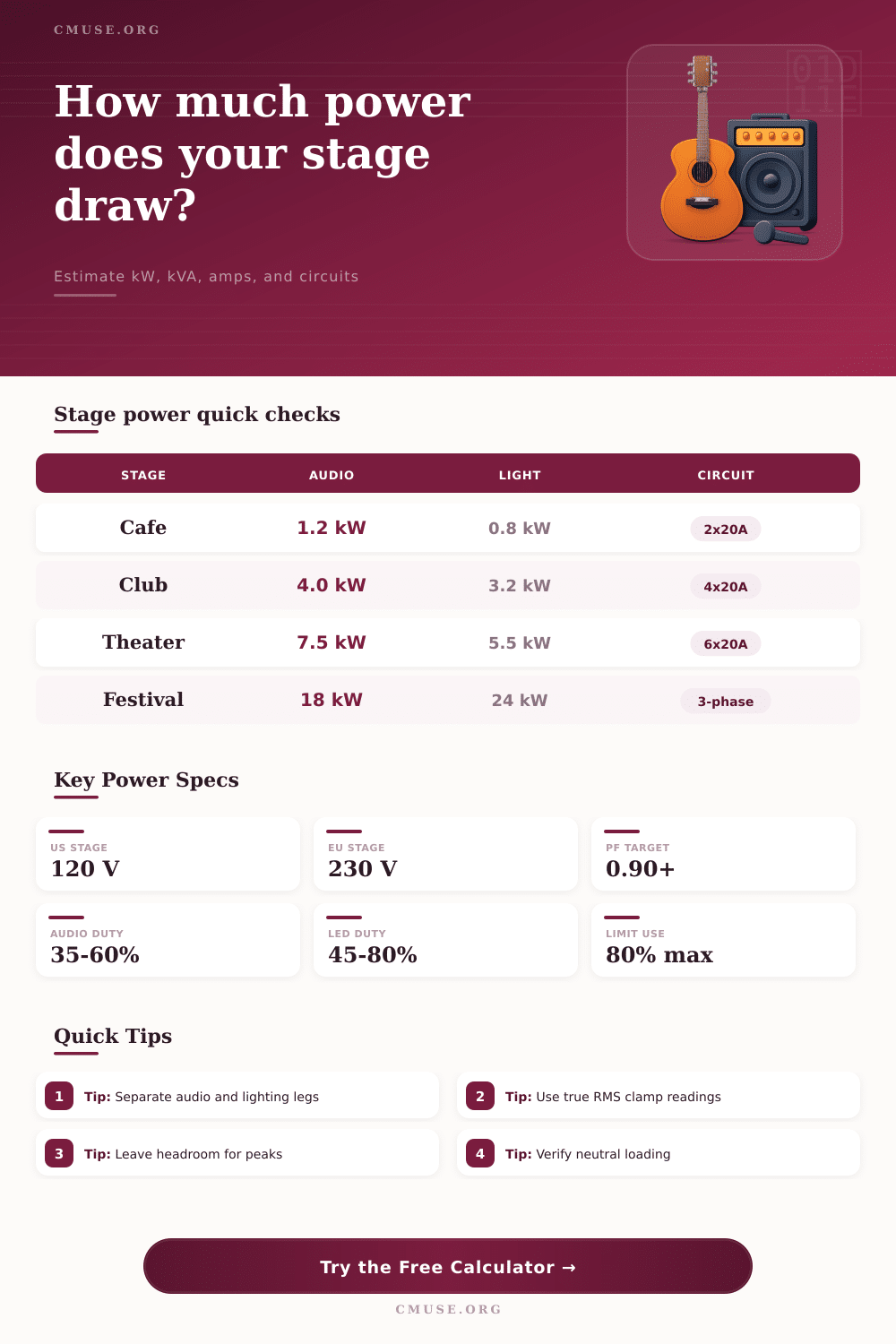
Choose a named show profile, then edit the draw, duty cycle, voltage, and circuit details to match the rider, distro, breaker sizes, and measured current on site.
Common US branch circuit voltage
Common EU/UK branch circuit voltage
Target PF for modern stage supplies
Typical continuous planning limit
| Stage preset | Typical audio | Typical lighting | Suggested power check |
|---|---|---|---|
| Coffeehouse Duo | Two powered tops, tiny mixer | Small LED color wash | One or two 20 A branches |
| Bar Band Night | Powered PA plus monitor wedges | LED pars and a few effects | Split audio, lights, and backline |
| Club EDM Rig | Sub-heavy PA or amp racks | Movers, strobes, haze, pixels | Check peaks and dimmer noise |
| Festival Side Stage | Full PA, monitors, consoles | Daylight LEDs and effects | Use distro legs and clamp readings |
| Load type | Duty range | Power factor cue | Planning note |
|---|---|---|---|
| Class D audio amps | 25% to 60% | 0.85 to 0.99 | Music crest factor lowers average draw, but sub peaks still need headroom. |
| LED lighting | 40% to 85% | 0.70 to 0.98 | White looks, strobes, and pixel effects can raise actual current quickly. |
| Tungsten dimmers | 60% to 100% | Near 1.00 | Dimmed tungsten can still demand serious feeder capacity. |
| Control and video | 70% to 100% | 0.85 to 0.99 | These loads are steadier and should stay on clean, protected circuits. |
| Circuit type | Nominal watts | 80% plan | Stage use |
|---|---|---|---|
| 120 V, 15 A | 1,800 W | 1,440 W | Small backline, RF, or control rack. |
| 120 V, 20 A | 2,400 W | 1,920 W | Common audio, LED, or backline branch. |
| 230 V, 16 A | 3,680 W | 2,944 W | EU/UK stage branch with higher wattage per outlet. |
| 208 V, 30 A 3-phase | 10.8 kVA | 8.6 kVA | Small distro feed for mixed stage loads. |
| 208 V, 60 A 3-phase | 21.6 kVA | 17.3 kVA | Medium production package or lighting sub-distro. |
| Category | What to include | Common miss | Best check |
|---|---|---|---|
| Audio amps | Powered tops, subs, wedges, amp racks | Startup surge and bass-heavy peaks | Clamp each rack during soundcheck |
| Lighting | Fixtures, dimmers, movers, haze, practicals | Strobe and full-white looks | Meter worst cue, not idle look |
| Backline | Instrument amps, keys, pedals, drum pads | Heaters, chargers, and pedalboards | Separate from clean audio if possible |
| Video/control | Consoles, playback, screens, RF, network | UPS charge draw after load-in | Keep on labeled protected circuits |
A power calculator is a tool that will help a person to calculate the amount of electrical currents that a stage production will use. Stage productions tend to use more or less power than the ratings from individual equipment manufacturers. For instance, a music band may use amplifiers that are rated for thousands of watts, but the bands dont play at those levels often.
Similar considerations applies to lighting equipment and LED lights; the lights may remain at a low current until full lights is selected to be used, at which time the current from those lights will increase. The power calculator is helpful for creating an estimate as to how much power will be drew by a stage production, as that tool helps to fill the gap between the ratings from the equipment and the actual power that those stage production elements will draw. To calculate the power that a stage production will draw, a person will have to enter several different values into the calculator.
How to Use a Stage Power Calculator
An individual may enter parameters including the number of amp channel or powered cabinets to be used, the wattage of each of those cabinets, the class of amplifiers that will be used, the duty cycle for each category of equipment to be used, the voltage for the stage production area, and the power factor of the production. Each of these factors must be accounted for to allow for the power calculator to provide an accurate estimation of the current that will be drawn by the individual production elements. The output of this calculator will provide an individual with several different measurements of the power that will be drawn by the stage production.
The calculator will output measurements for the average real power that the production will draw, the apparent load that will be created as a result of the power factor and headroom calculations, the line current that the production will draw based on the voltage settings, and the percentage of the circuit that the production is to be used by. Additionally, fields can be utilized to enter the headroom that will be provided to bass-equipped devices or additional production equipment, as well as to enter the measured current from the production devices as measured during the performance of the production. In addition to the fields for entering the various performance and power values, the power calculator also includes reference tables that provide recommendations for common types of stage productions.
For instance, the calculator may include reference tables for club EDM music productions, live musical theater productions, and other types of stage performances. Additionally, the calculator may include a table that provides wattage recommendations for circuits with a 20 amp branch and using the 80 percent continuous load rule for electrical circuits. While each of the tables included in the power calculator can assist in the planning of stage productions, the actual calculations provided by the calculator are more detailedly and accurate.
Therefore, the reference tables should not be relied upon in place of the calculator’s calculations. In addition to the calculations that can be performed with the power calculator, there are other variables in stage productions that the calculator cannot account for. For instance, the length of cables that are used to distribute power to the production elements can lead to voltage drops in the power that is transmitted along those cables.
Additionally, if the cables are of a certain gauge or if the circuits are shared neutrals, the shared neutrals can lead to overheating of those circuits. Additionally, some of the LED lights that are distributed to stage productions may introduce harmonic currents that increase the RMS readings of the lights beyond the calculations provided. Finally, the temperature in the area where the production will occur can increase the power draw of some equipment when the area reaches those temperatures.
These variables cannot be accounted for within the power calculator, however, an experienced sound designer will account for these variables during the production. Another recommendation for utilizing the power calculator is to utilize the calculator twice for each stage production that is to occur. During the first calculation, an individual may use the figures from the artist rider for the production and the duty cycle for each of those performance types from previous performances by that band or production company.
Additionally, during the second pass with the power calculator, an individual can enter the measured current from the stage production elements into the calculator. By comparing the calculated and measured current, an individual will know if the production plan was conservative in its calculations, or if the power draw from the production is too close to the limitations of the electrical distribution system. It is also a recommendation to separate audio, lighting and video circuits to each of their own circuits to ensure that a failure in one area will not impact the other areas of the production.
Additionally, the power calculator can be used to ensure that each of these separate circuits will not exceed their limitation. For instance, the calculator can be used to determine if the lighting rig for the production will come close to the recommended 80 percent limit for electrical circuits and power distribution. If close to that 80 percent limit is determined, an individual will know that some lighting equipment will need to be moved, or that some additional electrical distribution systems may be requested for the lighting design.
Another value of the power calculator is that it forces an individual to consider each of the load types separately. Each calculation within the power calculator forces consideration of each of the variables, and provides a comparison between calculated and measured variables. Thus, the power calculator transforms vague ideas regarding power requirements into a precise consideration of how close the electrical distribution system will come to its limitations.
An understanding of how close each stage production is to its electrical limitations prevents those stage productions from losing power during there performances.