Staccato Length Calculator
Work out the played (sounding) duration, the silent rest gap that defines the detachment, and the MIDI tick length for staccato, staccatissimo, tenuto, legato and any other articulation at any tempo and PPQN
Full Calculation Breakdown
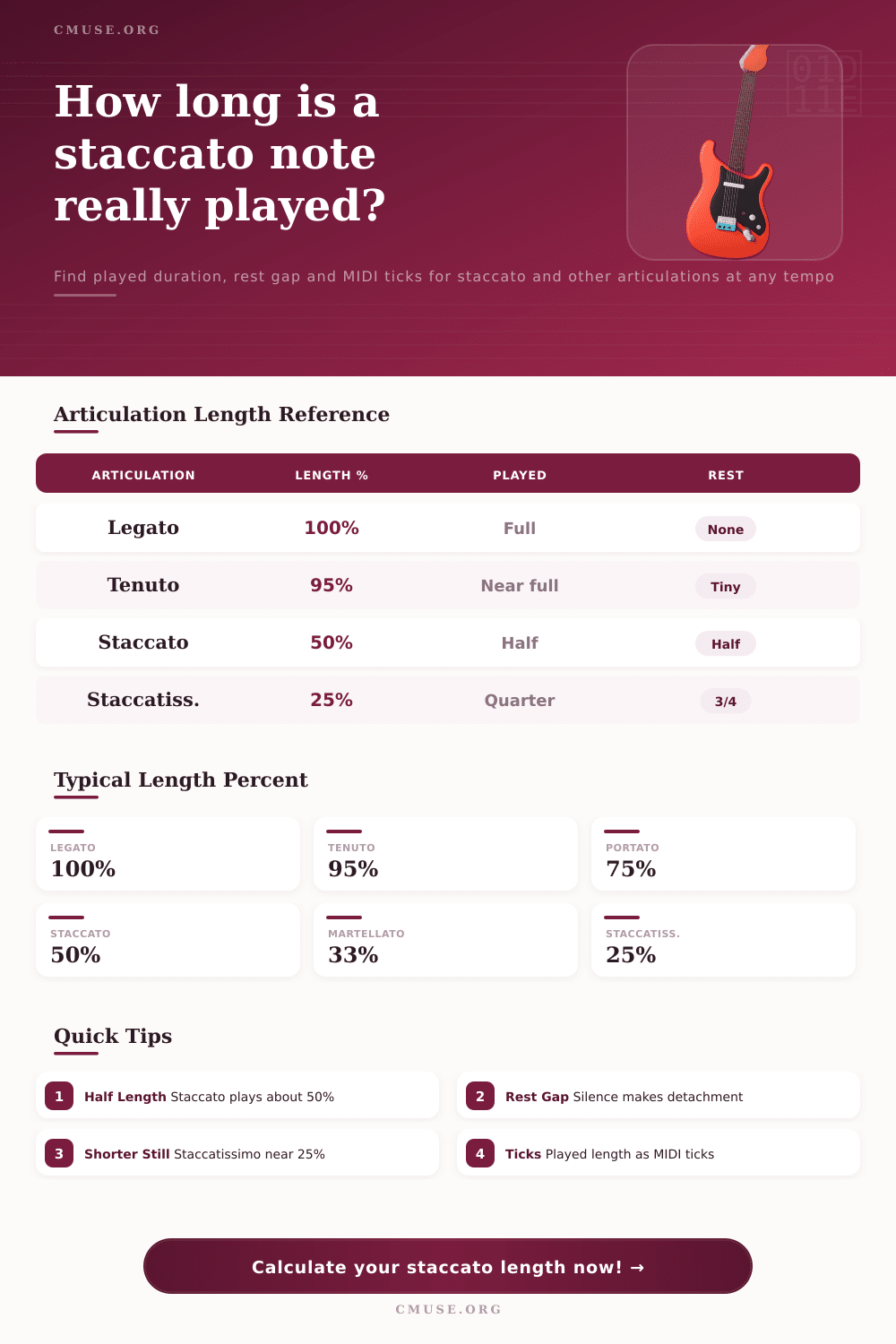
| Articulation | Typical Length % | Played Portion | Rest / Gap |
|---|---|---|---|
| Legato (slurred) | 100% | Full value | None (connected) |
| Tenuto | 95% | Nearly full | ~5% (slight) |
| Normal / non-legato | 80% | Most of value | ~20% |
| Portato | 75% | Three quarters | ~25% |
| Mezzo-staccato | 65% | Two thirds | ~35% |
| Staccato | 50% | Half value | ~50% |
| Martellato | 33% | One third | ~67% |
| Staccatissimo | 25–33% | Quarter to third | ~67–75% |
| BPM | Quarter Note | Eighth Note | Sixteenth Note |
|---|---|---|---|
| 60 | 1000.00 ms | 500.00 ms | 250.00 ms |
| 80 | 750.00 ms | 375.00 ms | 187.50 ms |
| 90 | 666.67 ms | 333.33 ms | 166.67 ms |
| 100 | 600.00 ms | 300.00 ms | 150.00 ms |
| 110 | 545.45 ms | 272.73 ms | 136.36 ms |
| 120 | 500.00 ms | 250.00 ms | 125.00 ms |
| 140 | 428.57 ms | 214.29 ms | 107.14 ms |
| BPM | Staccato Quarter | Staccato Eighth | Staccato 16th |
|---|---|---|---|
| 80 | 375.00 ms | 187.50 ms | 93.75 ms |
| 90 | 333.33 ms | 166.67 ms | 83.33 ms |
| 100 | 300.00 ms | 150.00 ms | 75.00 ms |
| 110 | 272.73 ms | 136.36 ms | 68.18 ms |
| 120 | 250.00 ms | 125.00 ms | 62.50 ms |
| 130 | 230.77 ms | 115.38 ms | 57.69 ms |
| 140 | 214.29 ms | 107.14 ms | 53.57 ms |
| Note Value @120 | Legato 100% | Staccato 50% | Staccatissimo 25% |
|---|---|---|---|
| Whole note | 2000.00 ms | 1000.00 ms | 500.00 ms |
| Half note | 1000.00 ms | 500.00 ms | 250.00 ms |
| Quarter note | 500.00 ms | 250.00 ms | 125.00 ms |
| Eighth note | 250.00 ms | 125.00 ms | 62.50 ms |
| Sixteenth note | 125.00 ms | 62.50 ms | 31.25 ms |
It’s tempting to assume that a staccato note is just a blip. It isn’t. A staccato note are a precise amount of silence that sits between tones. It is the part that matters. Get this wrong and what you hear is a robot pressing keys; get it right and you have music that feels alive.
Once you input your style of articulation plus your desired tempo, the calculator do the rest of the maths for you. It lets you concentrate on the feel without having to guess at conversions and coefficients.
How to Use the Staccato Calculator
Staccato as in ‘detached’ is something most musicians learn early on. Exactly how detached should it be? Not very often do they learns. Since staccato is traditionally shown in notation this way, it implies that about half the note are sounded and half is not. Easy enough you might think. Translating that idea into exact performance practice or even digital audio is where the issue lie.
At a BPM of 120, a quarter note is precisely 500 milliseconds long. Played staccato, you want around 250 milliseconds of sound and another 250 milliseconds of nothing. The trick is essentially knowing what you are measuring. It’s not simply a question of making the note shorter but making gap between notes longer while maintaining their starting point position. In today’s world of music-making it makes all the difference.
When editing a MIDI sequence in a piano roll view, wanting to adjust the length of notes or edit the velocity curve, how long does the note gate stays open? Knowing precisely this number of ticks is critical when programming a MIDI part. With this app, you choose your PPQN, whether you’re using the old standard of 96 ticks per quarter note or even the more precise 480 or 960 ticks common in today’s DAWs; and it translates that vague percentage into actual numbers of ticks. No guesswork anymore; you’ll know with certainty what amount of silence your creating.
This is all neatly explained in the reference table on the page where its clear that a staccatissimo is at roughly 25%, whereas a tenuto is located nearer to 95%. These figures are guidelines, not rules. Each period of music history, each instrument, and each individual performer have their own preferences. For example, the way they control note length differs between players. A wind player uses breath and a string player use bow pressure. In contrast, a clarinetist may produce a shorter staccato because of the way the air column dies away during a performance.
Use the calculator as a starting point and adapt the custom percent field to match your chosen style or instrument type. What many producers do is cut all notes equally. The result are a mechanical and flat texture. Real performance depends on small variations in note lengths. A single staccato note could of been drawn out a little longer to draw attention to a harmonically shifting chord, while another could be pulled back to add sense of urgency.
The key is that without knowing where the centre is (the 50% rule) you have no reference point from which to deviate purposefuly. Everything is relative to tempo too. At 200 BPM a 250-millisecond gap hardly seems like any space at all whereas at 60 BPM the same gap seem enormous. To allow for this difference, you can set the calculator to your desired beats per minute. The actual time values will vary wildly, but the feel of the articulations stay constant.
It is not just about an exact number of milliseconds, but about the specific musical gesture you want to achieve. Rhythm includes silence; it’s active and as much a part of the attack than the tone itself. Mastering this means understanding where to place the silence between your notes. It is no longer just about hitting the right pitch; it is about shaping the space around the notes.
Next time you encounter a staccato dot, consider it less a brief note than a specific quantity of breath. This change in thinking completeley changes how you hear the music.