SPL Subtraction Calculator
Subtract background noise from a total sound pressure level reading, estimate the true source SPL, and check whether the measurement gap is reliable.
Choose a realistic studio, venue, or room measurement, then edit the total SPL, background level, distance, averaging, weighting, and source count.
12.0 dB
Total-to-background gap
92.0 dB
Corrected SPL at reference distance
86.0 dB
Estimated SPL per identical source
+6.0 dB
Margin against target SPL
| Total Minus Background | Subtract From Total | Corrected Source | Measurement Quality |
|---|---|---|---|
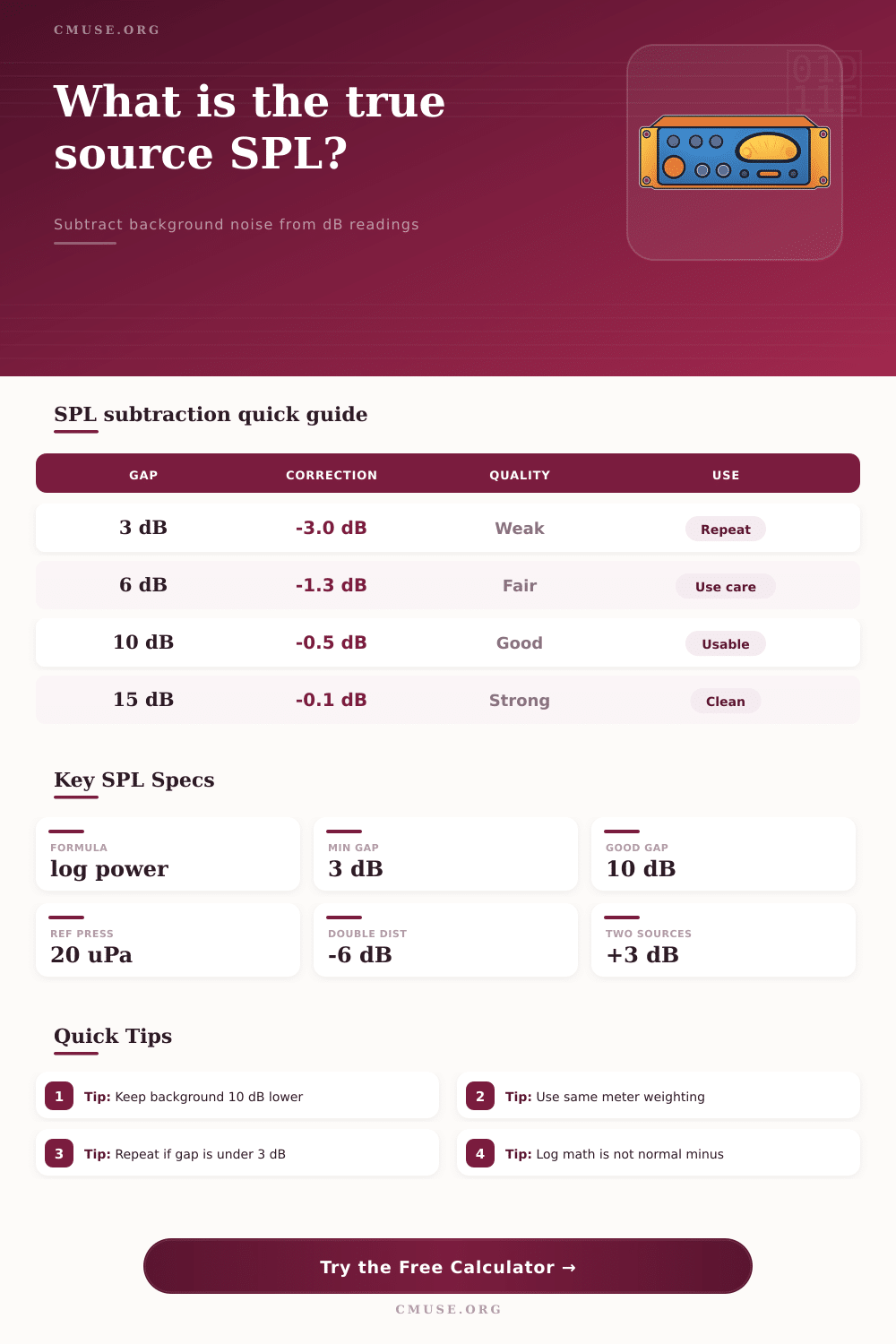
| 3 dB gap | 3.0 dB | Total - 3.0 dB | Technical minimum; repeat if possible |
| 6 dB gap | 1.3 dB | Total - 1.3 dB | Usable with careful notes |
| 10 dB gap | 0.5 dB | Total - 0.5 dB | Good practical measurement |
| 15 dB gap | 0.1 dB | Total - 0.1 dB | Background has little influence |
| 20 dB gap | 0.0 dB | Nearly total reading | Clean source-dominant result |
| Scenario | Total Reading | Background | Likely Use |
|---|---|---|---|
| Vocal booth with HVAC | 72 dBA | 54 dBA | Clean vocal source estimate |
| Studio monitors in room | 86 dBC | 62 dBC | Listening calibration check |
| Guitar amplifier room | 98 dBA | 70 dBA | Room exposure and isolation notes |
| FOH during crowd noise | 101 dBA | 88 dBA | Show SPL logging with crowd removed |
| Subwoofer test band | 104 dBZ | 83 dBZ | Low-frequency source check |
| Adjustment | Rule | Example | Calculator Use |
|---|---|---|---|
| Double distance | About -6.0 dB | 1 m to 2 m | Normalizes corrected source SPL |
| Half distance | About +6.0 dB | 2 m to 1 m | Compares readings at a standard point |
| Two equal sources | About +3.0 dB | Two speakers playing same level | Estimates SPL per identical source |
| Four equal sources | About +6.0 dB | Four boxes in a simple cluster | Separates combined source result |
| Ten equal sources | About +10.0 dB | Large ensemble or array estimate | Shows average level per source |
| Item | Formula Or Setting | Meaning | Watch Point |
|---|---|---|---|
| SPL subtraction | 10 log10(10^(Lt/10) - 10^(Lb/10)) | Removes background acoustic energy | Only valid when total is above background |
| Distance correction | 20 log10(distance / reference) | Free-field inverse-square adjustment | Rooms and arrays can change the slope |
| Identical sources | 10 log10(source count) | Combined level from equal sources | Sources must be similar and active together |
| A weighting | dBA | Human-hearing weighted level | Common for exposure and venue limits |
| C or Z weighting | dBC / dBZ | More low-frequency content retained | Better for subwoofer and full-band checks |
In order to determine the loudness of a sound, it is necesary to account for background noise in the environment, as background noise is almost always present. Background noise can range from the sound of an air conditioning system in the room to the sound of traffic on a street outside the window; these background noises will contribute to the total reading that is obtained from a sound level meter. In order to determine the actual loudness of the sound that is being measured, it is necesary to subtract the background noise from the total reading obtained from a sound level meter.
This process is referred to as SPL subtraction. In order to perform SPL subtraction, it is first necesary to take two separate sound level meter reading. The first reading will be of the source sound that is being measured and the background noise in the area.
How to Remove Background Noise from Sound Readings
The second reading will be of the background noise alone, when you are not playing the source sound. These two readings can be taken with the same settings on the sound level meter. You will need to convert the decibel reading to a linear power measurement, the linear power of the background noise must be subtracted from the total linear power of the sound and background noises, and the result must be converted back to decibels.
An SPL subtraction calculator can perform these calculation for you. The difference between the total sound reading and the background noise reading will indicate the reliability of the result of the SPL subtraction calculation. If the total sound level is only slightly more than the background noise level, the background noise will have a dramatic impact on the result of the SPL subtraction calculations.
Errors in measurement will result in error in the result of the SPL subtraction calculation. However, if the difference between the total sound level and the background noise level is ten decibels or more, the background noise has a minimal impact on the sound that is being measured. The background noise level is low relative to the level of the sound that is being measured.
This difference between the total sound level and the background noise level can be seen on the SPL subtraction calculator, allowing you to determine reliability of the calculation prior to obtaining the result of the calculation. Finally, the distance at which the sound level measurement is taken will impact the result of the calculation. The SPL of sound decreases with distance from the sound source.
This calculation can incorporate distance between the sound level meter and the sound source. Additionally, the SPL calculation accounts for situations in which there are multiple sound source. The SPL calculation can determine the loudness of each individual sound source by entering the number of sound sources into the SPL calculation.
The calculator also allows you to account for the environment. For instance, if you were measuring the sound level of a room with highly reflective walls, you would expect the sound level to change more differently than if you were measuring in an open field. To ensure accuracy in your measurement, you should use identical settings for your meter for both the total reading and the background reading.
For example, if you used A-weighting for your total reading, you should also use A-weighting for your background reading. The same is true for the response time of the meter. Any differences between the settings for these two sound level measurements will negatively impact the accuracy of the subtraction of those two reading.
The calculator allows you to input these settings to ensure that the two measurements have the same settings. The environment can play a role in the accuracy of the SPL subtraction calculations. For instance, sound reflecting off of the walls of a room will increase the sound level readings of a meter, and the sound level readings will change if the position of the microphone changes within those room.
Because the calculator outputs an estimate of the average energy of a space, it cannot account for specific instances of noise in that environment, such as a hum or buzz. Thus, you should consider the positioning of the microphone and the environment when reviewing the results of the SPL subtraction calculation. Background noise is not a constant value.
Background noise can change based off the number of individual in the area, the air conditioning system in the area, and countless other factor. Thus, you should take the background reading as close as possible to the time that the total reading is taken. By taking these two measurements at different times, you can understand how much the background noise may change over time.
Finally, many individual may be surprised to discover that the corrected measurement of sound level is not an exact value. Instead, it is an estimate that includes uncertainty in the measurement. The uncertainty in the estimate is based upon the accuracy of the sound level meter that is used to take the measurements, and how far apart the total reading and background reading are.
For instance, if you are using a phone application with low accuracy to measure the sound level, you will need a larger gap between the total and background readings before the calculator can provide you with a measurement that you can trust. By including a measurement of the uncertainty of the SPL subtraction calculations, the calculator ensures that you dont over-interpret small change in sound level. Overall, the purpose of sound level subtraction is not to reach a value of 0 for the background noise, but rather to reach a point at which the uncertainty of the measurement does not impact your interpretation of the sound level reading.
The SPL subtraction calculator can help you to reach this goal. By reviewing the corrected sound level and the energy being removed by background noise, you can determine whether the sound level measurement of the source is truly as loud as the sound level meter indicate.