SPL Distance Calculator
Estimate sound pressure level at a listener position, solve the distance for a target level, and account for speaker count, power change, and room adjustment.
🎧 Listening and Speaker Presets
📏 SPL and Distance Inputs
📊 SPL Rule Grid
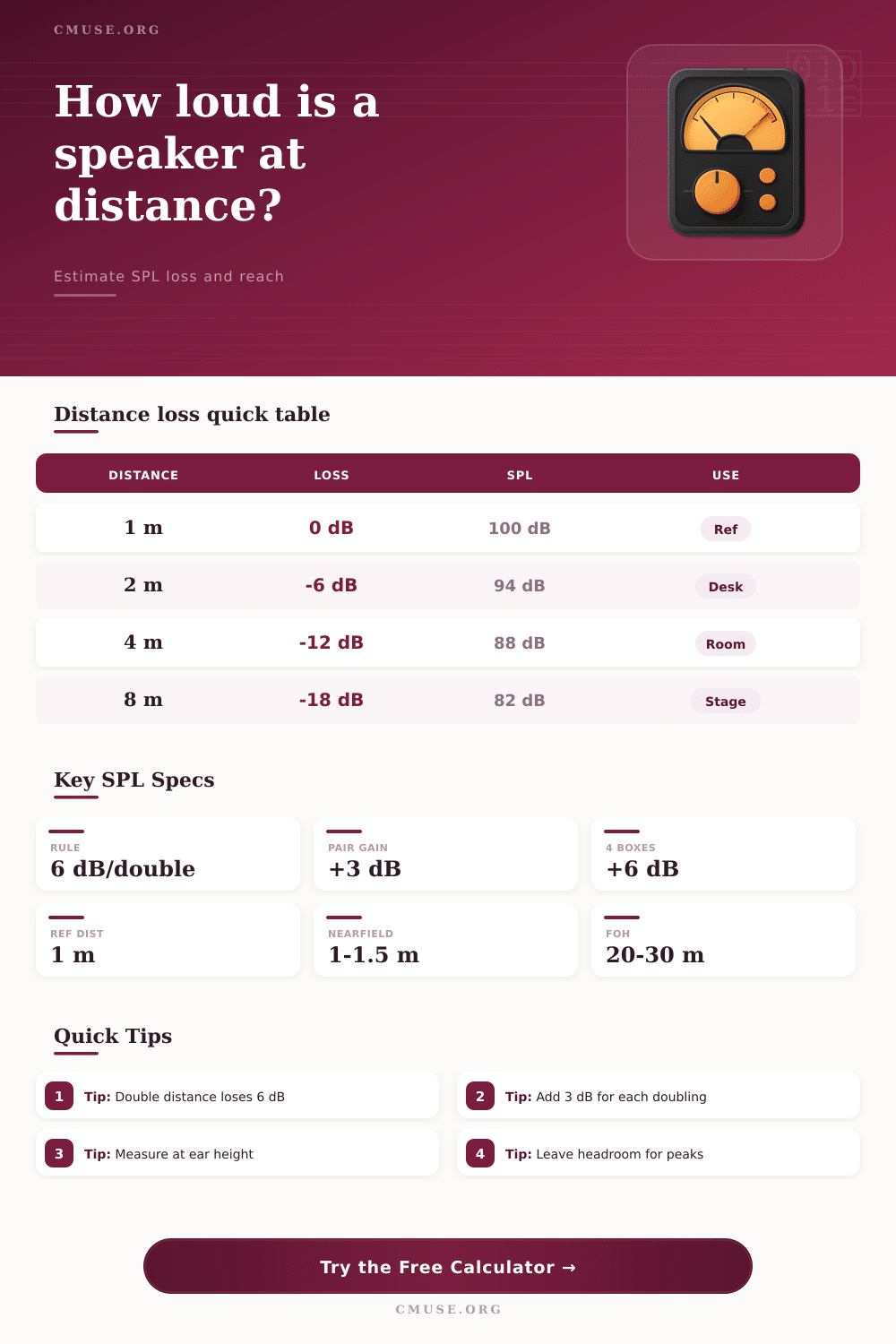
🔊 Distance Loss Reference
| Distance From Source | Ratio vs 1 m | Inverse-Square Loss | 100 dB Source Result |
|---|---|---|---|
| 1 m / 3.3 ft | 1x | 0.0 dB | 100.0 dB SPL |
| 2 m / 6.6 ft | 2x | -6.0 dB | 94.0 dB SPL |
| 4 m / 13.1 ft | 4x | -12.0 dB | 88.0 dB SPL |
| 8 m / 26.2 ft | 8x | -18.1 dB | 81.9 dB SPL |
| 16 m / 52.5 ft | 16x | -24.1 dB | 75.9 dB SPL |
🎛 Speaker Count and Level Change
| Same Signal Sources | Approx Gain | Best Use | Note |
|---|---|---|---|
| 1 speaker | +0.0 dB | Mono cue | Reference baseline |
| 2 speakers | +3.0 dB | Stereo pair | Common studio setup |
| 4 speakers | +6.0 dB | Small PA | Coverage matters |
| 8 speakers | +9.0 dB | Distributed PA | Delay alignment matters |
| 12 speakers | +10.8 dB | Large array | Pattern control dominates |
🎶 Common Audio Scenarios
| Scenario | Typical Distance | Target Range | Calculation Priority |
|---|---|---|---|
| Nearfield monitoring | 1.0-1.5 m | 75-85 dB | Low fatigue and balance |
| Practice room PA | 3-6 m | 85-95 dB | Vocal clarity |
| Small venue FOH | 8-18 m | 90-100 dB | Rear-seat reach |
| Stage wedge | 1-2 m | 90-105 dB | Feedback margin |
| Outdoor speech | 15-40 m | 75-88 dB | Distance loss |
📐 Formula Breakdown Table
| Formula Step | Expression | Meaning | Used For |
|---|---|---|---|
| Distance loss | 20 log10(d/ref) | Inverse-square drop | SPL at listener |
| Speaker gain | 10 log10(count) | Added same-signal sources | Arrays and pairs |
| Listener SPL | source + gains - loss | Predicted level | Main result card |
| Target distance | ref x 10^(margin/20) | Reach before target | Inverse solving |
Sound travels outward in all directions, and as distance increase from the sound source, the sound become thinner. The inverse-square law explain the relationship between distance and sound pressure. According to the inverse-square law, if you double the distance from the sound source, the sound pressure level will drop six decibels.
Knowing the inverse-square law is essential when calculating sound pressure levels for studio monitor, live sound systems, or speaker setup. In order to calculate sound pressure levels correctly, it is necessary to understand what is being measure. The sensitivity of the speakers is usualy measured at one meter, but most people dont listen to speakers at a meter distance.
How Distance, Power and Rooms Change Sound Level
A sound pressure level calculator can make it easy to calculate the sound pressure level for different scenarios by entering the sound pressure level of the speakers, the distance at which the sensitivity is published, and the distance at which the listener will be. The calculator also accounts for multiple speaker being played at the same time, as adding another speaker will increase the sound pressure by three decibels, and adding four speaker will increase the sound pressure by six decibels. This value only applies to the speakers being added next to each other at a distance, as well as when the listener is far enough from the speakers for the sound wavefronts to merge.
Another factor to consider is the impact of the listening room on the sound pressure level. If the listening room contain carpeting, the carpeting will absorb some of the sound energy. The sound pressure level will be reduced in a carpeted room by a few decibels.
Hard reflective halls will add to the sound pressure level being radiated from the speakers. The sound pressure level will increase in a hard reflective room. These setting can be accounted for in the sound pressure level calculator.
However, the room adjustment is only an estimate to prepare the system for the room. There will never be a replacement for walking the space with a sound meter while the system is running. Changes in the power that is provided to the speakers will change the sound pressure level.
If you double the power to the speakers, the sound pressure level will increase by three decibels. This is one of the reason that a power trim field is featured in the sound pressure level calculator. Users might be inclined to adjust the sound pressure level by three decibels by increasing the power to the speakers.
However, a six-decibel loss in sound pressure level due to distance will be more noticeable than a three-decibel increase from playing multiple speakers. The sound pressure level calculator display the sound pressure level and the headroom that remains for the speakers. Headroom is the amount of power in watts that is provided to the speakers after the safety margin is subtracted from the power provided.
Twelve decibels of headroom should be provided for live sound performance. Eight decibels of headroom will be sufficient for playback in the studio. By using the sound pressure level calculator, people can experiment with changing one variable at a time.
For example, if the distance between the speakers and the listener is increased by two meter, the sound pressure level will drop. If the number of speaker is increased, the sound pressure level will rise. If the type of room is changed from a typical room to a hard reflective one, the distance at which the sound pressure level is measured will feel louder.
These type of experiments will allow users to understand the relative importance of each variable in their particular situation. In some instances, the loss of sound pressure level with distance may be so great that it is impossible to compensate by adding speakers. In other instances, reducing the power to the speakers by a small margin will allow for a more accurate sound pressure level at the back of the room.
Many people tend to underestimate the importance of headroom. By entering the power provided to the speakers and the safety margin, the sound pressure level calculator will show the headroom that remains for the speakers to play at peak sounds. If the headroom drop into the seventies, the speakers will be working too hard.
This is not a reflection on the accuracy of the sound pressure level calculator but an indication that the loudspeakers or the power to the loudspeakers are the limiting factor in the system. Outdoor speech system have no gain from the reflected sound waves in the room. The loss of sound pressure level due to distance will be great for outdoor speech systems due to the long distance between the speakers and the audience.
To combat this loss in outdoor speech systems, you can increase the number of speaker, increase the power provided to the speakers, or set the speakers up to have tighter control over the pattern of the radiated sound energy. The sound pressure level calculator will not design the speaker array that will be used for outdoor speech systems. However, using the calculator will provide an idea of whether or not the speakers that are to be used will be able to reach the audience.
For nearfield monitoring of musical instrument in the studio, the distance related loss of sound pressure level is small for distances between one and one and a half meters from the speakers to the musicians. Because the loss of sound pressure levels due to distance is small for nearfield monitoring, the early reflections of sound waves from the musicians’ monitor desks and the room walls are the main concern for sound pressure level. The sound pressure level calculator allow users to account for damping in the room.
However, adding physical treatments to the monitor desks or walls will have a greater impact on the reflected sound waves than adjusting the sound system. The sound pressure level calculator allows users to keep the mathematical conversation regarding what the sound system can and cannot fix. There are also reference tables for the sound pressure level calculator.
These tables demonstrate the sound pressure level loss as the distance between the speakers and the listener increases. These tables also demonstrate how many speaker will be necessary to increase the sound pressure levels at the listener’s location. These tables allow users to become familiar with the factors that affect sound pressure level.
With the recognition of factors like four meters creating a twelve-decibel sound pressure level loss, people will no longer find distance factor to be arbitrary in their use of sound systems. None of the sound pressure level calculation in the sound pressure level calculator will ever replace the need for taking physical measurement in the actual listening seats. The factor that will impact the sound pressure levels in the listening seats include the temperature in the room, the humidity in the room, the sound absorption of the audience, and the directivity of the loudspeakers.
The sound pressure level calculator will allow the user to know if the sound system is in the correct range for the listening area. However, it is up to the user to decide if the change in one variable is worth the change in another. The physics of sound is the same in every situation, but the variable in each situation will continue to change.