Speed of Sound Calculator
Compare air, water, helium, and solids, then estimate wavelength, travel time, and distance using real acoustics reference values.
Air
20C reference
Water
Fresh water
Glass
Rigid solid
Steel
Longitudinal wave
| Medium | Approx speed | Temp | Typical use |
|---|---|---|---|
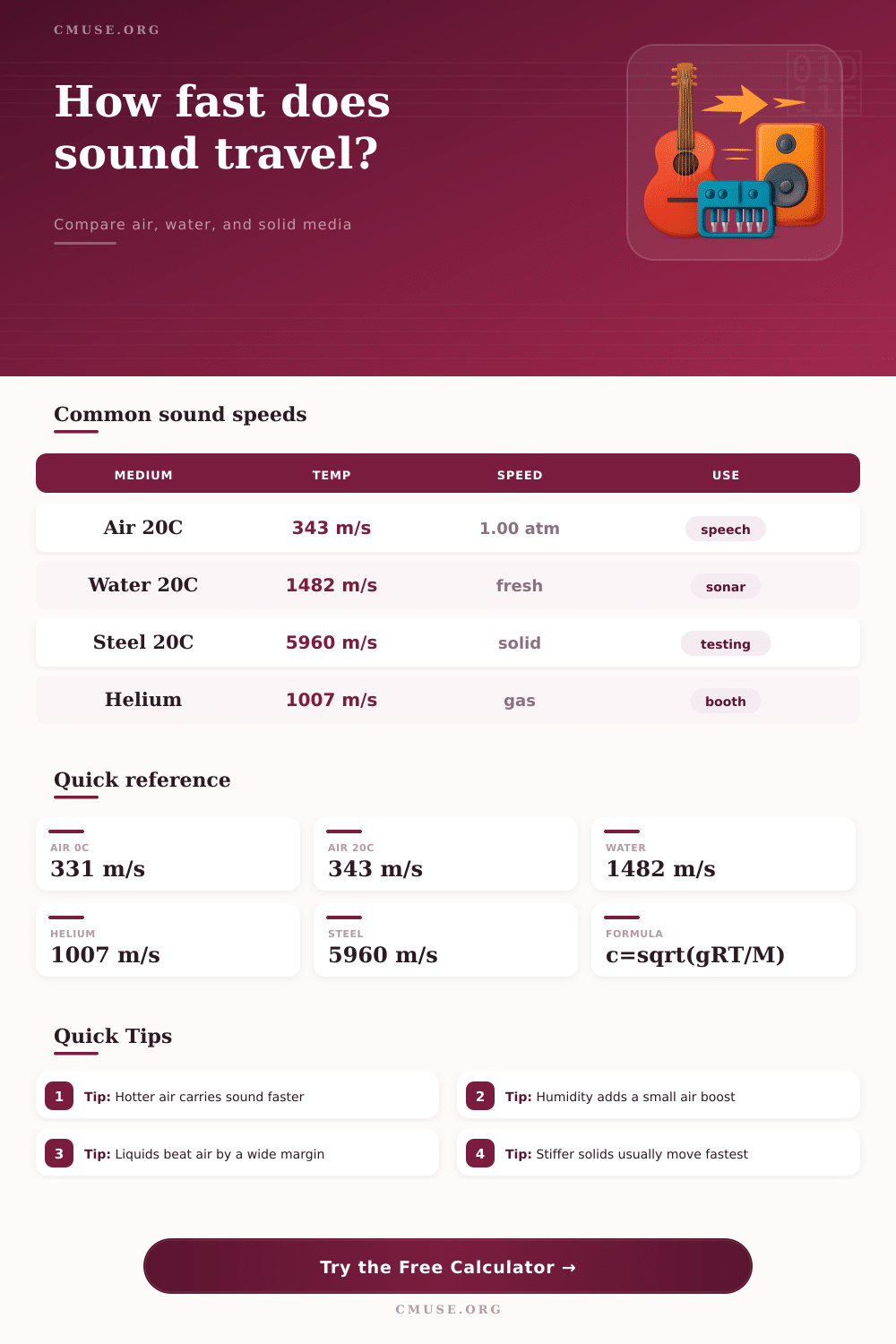
| Air | 343 m/s | 20 C | Speech |
| Helium | 1007 m/s | 20 C | Vocal effects |
| Fresh water | 1482 m/s | 20 C | Sonar |
| Steel | 5960 m/s | 20 C | Impact testing |
| Air temp | Speed | Wavelength at 1 kHz | Note |
|---|---|---|---|
| 0 C | 331 m/s | 0.331 m | Cold start |
| 10 C | 337 m/s | 0.337 m | Cool room |
| 20 C | 343 m/s | 0.343 m | Studio norm |
| 30 C | 349 m/s | 0.349 m | Warm air |
Sound travels at different speeds depending on an medium that sound travels through. The speed of sound are not a constant value. For lightning, the light signal travels faster then the sound signal, so we see the flash of light before we hear the thunder.
Sound travels at around 343 meter per second through the air on a mild day. The speed of sound change due to the fact that temperature, moisture in the air, and the density of the medium affect the speed of sound. If you know how many seconds it takes for light from lightning to the sound of thunder, you can use the speed of sound to calculate the distance of lightning.
What Affects the Speed of Sound
Temperature change the speed of sound. Changes in temperature change the speed of sound because heat affects the movement of molecules in the medium. If the temperature increase, the molecules in the medium will move faster, allowing sound to travel at a faster rate through the medium.
For every degree of Celsius that the temperature increases, the speed of sound increase by 0.6 meters per second. If the temperature decreases, the speed of sound decrease. If it is a freezing day outside, the speed of sound will be at around 331 meters per second.
Therefore, sound travels at a slower rate on a freezing day than on a hot day. Humidity also play a role in the speed of sound. Humidity affects the speed of sound because the humidity changes the composition of the air.
Humidity replace heavier nitrogen in the air with lighter water vapor molecules. If the air is humidified, the molecules in the medium will allow sound to travel faster through the medium. Although the impact of humidity on the speed of sound is very minor, the inclusion of humidity and high temperatures will impact the speed of sound in a more significant manner.
Sound travels at different speeds through different mediums. For instance, sound travels at different speeds through liquid and solids. Sound travels faster through water than through the air.
If sound travels through fresh water, it move at 1,482 meters per second. Sound also travels fast through solids. For instance, sound travels at around 6,000 meters per second through steel.
Because sound can travel so fast through steel, engineer use steel to detect cracks in metal beams. Wavelength is a measurement of sound that the speed of sound and the frequency of the sound determine. The wavelength is calculate with the formula: wavelength = speed of sound divided by the frequency of the sound.
If the frequency of the sound increase, the wavelength of that sound will decrease. If the speed of sound increases, as it does with an increase in temperature, the wavelength of the sound will also increase if the frequency of that sound remain the same. Engineers use the speed of sound and the wavelength of sound to determine how sound will interact with the size of a room.
If a room is too small in comparison to the wavelength of sound, standing wave will occur in the sound. Standing waves can interfere with the sound that is playing in that room. If you know the time it takes for the sound to travel and the speed of sound in the medium, you can calculate the distance that the sound traveled through the medium.
The formula to calculate distance is distance = speed of sound multiplied by the length of time that the sound traveled. For instance, if a sonar pulse is sent through the water, you can calculate the distance between the sonar device and the object. If you know the length of time that it took for the sonar pulse to return to the sonar device, then you can calculate the distance to the object.
The same can be done to calculate the distance to an echo in a large hall. Other environmental conditions affect the speed of sound. For instance, the wind outdoors can move the sound wave by moving the air through which the sound travels.
Another environmental factor in outdoor settings is the temperature gradient that exist between areas of varying temperatures. These gradients bend the sound waves, changing the loudness of the sound in certain areas versus the loudness of the sound in other areas. In indoor environments, furniture and other objects will absorb the sound energy; however, the temperature and the medium in which the sound travels primarily affect the speed of sound.
To avoid errors in calculations for the speed of sound, it is essential to account for these various variable. If you do not account for these variables, errors in calculations will result. For instance, if you assume that the speed of sound in air is at room temperature when the weather is cold, then the calculations will be incorrect.
If you calculate the speed of sound without accounting for humidity when the environment is very humid, the sound calculations will be inaccurate. To calculate the speed of sound with accuracy, you must account for the properties of the medium through which the sound travels. The properties of the medium dictate the speed of sound.