Speed of Sound Frequency Wavelength Calculator
Convert frequency, wavelength, and period across air, water, helium, carbon dioxide, wood, glass, aluminum, steel, and custom media with temperature and humidity context.
🎵 Named Medium and Frequency Presets
⚙ Wave Inputs
📊 Current Spec Grid
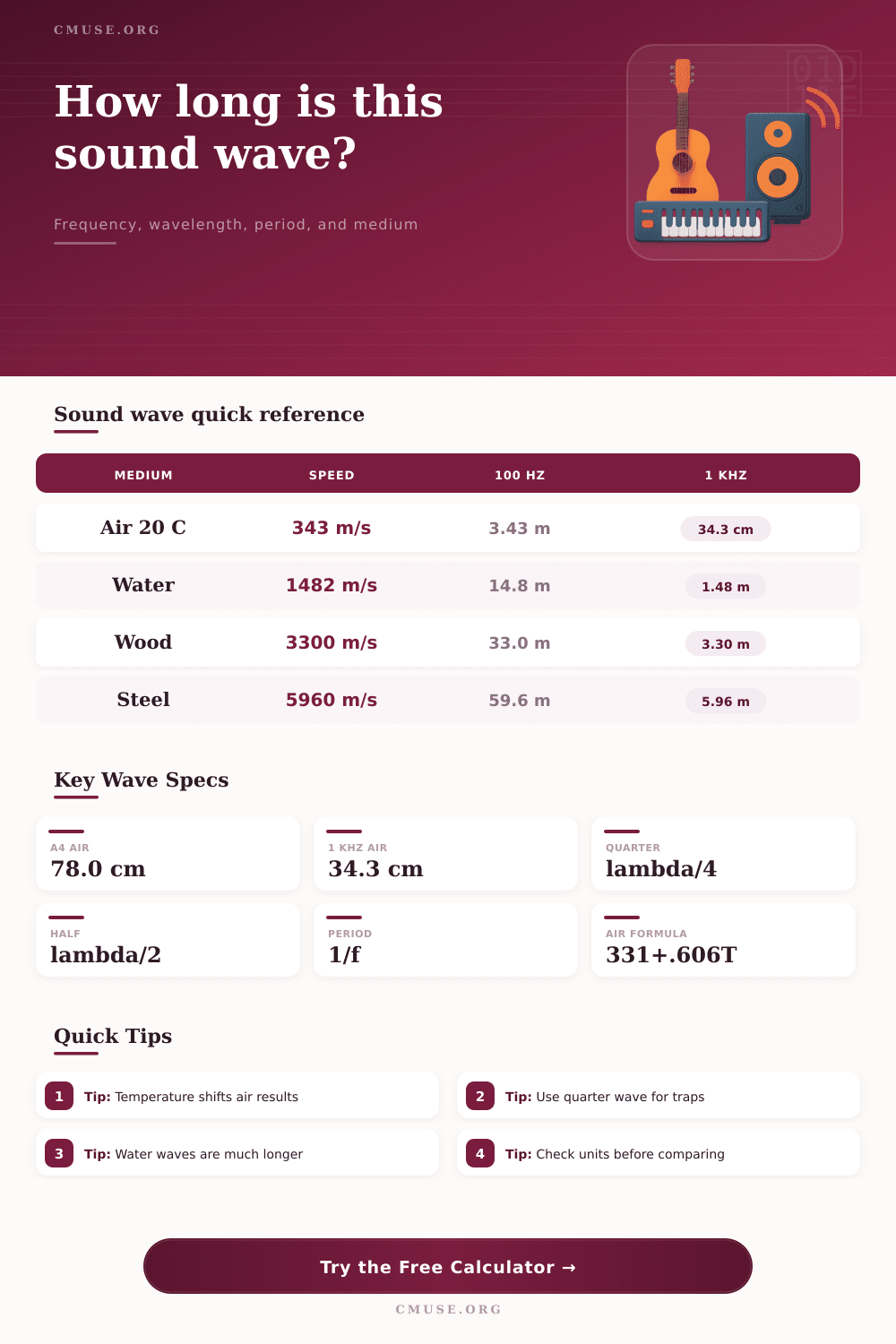
🔍 Medium Comparison Grid
Air
Water
Wood
Steel
📐 Speed of Sound Reference Table
| Medium | Typical speed | Temperature behavior | Audio use case |
|---|---|---|---|
| Air, dry around 20 C | About 343 m/s | Rises about 0.606 m/s per C | Speaker delay, room modes, wave traps |
| Humid air | Slightly above dry air | Humidity adds a small warm-air correction | Outdoor stage and climate-sensitive checks |
| Fresh water | About 1482 m/s | Depends on temperature and impurities | Underwater transducers and sonar pings |
| Spruce or softwood along grain | About 3300 m/s | Varies strongly by grain and moisture | Instrument tops, braces, and body resonance |
| Steel | About 5960 m/s | Material grade changes the exact speed | Strings, rails, frames, and mechanical ringing |
🌊 Frequency to Wavelength Table in Air
| Frequency band | Example frequency | Approx wavelength at 20 C | Practical reading |
|---|---|---|---|
| Sub bass | 40 Hz | 8.58 m / 28.1 ft | Room dimensions dominate the result |
| Bass | 100 Hz | 3.43 m / 11.3 ft | Quarter wave is near common treatment depth extensions |
| Midrange | 1 kHz | 34.3 cm / 13.5 in | Comparable to baffle edges and small spaces |
| Presence | 4 kHz | 8.58 cm / 3.38 in | Small offsets can create strong phase changes |
| Air band | 10 kHz | 3.43 cm / 1.35 in | Mic placement and fine geometry matter |
🧮 Formula Breakdown Table
| Goal | Formula | Calculator input | Result meaning |
|---|---|---|---|
| Find wavelength | wavelength = speed / frequency | Medium speed and Hz | Physical length of one cycle |
| Find frequency | frequency = speed / wavelength | Medium speed and meters | Cycles per second for that wave length |
| Find period | period = 1 / frequency | Hz or solved Hz | Time for one complete cycle |
| Find phase | phase = distance / wavelength * 360 | Spacing or path length | Angular offset after wrapping one cycle |
| Find delay | delay = distance / speed | Path length and medium | Travel time through the selected medium |
📏 Quarter and Half Wave Planning Table
| Fraction | Length formula | Common audio use | Design caution |
|---|---|---|---|
| Quarter wave | wavelength / 4 | Tube resonators, traps, boundary estimates | Open-end correction can shift tuning |
| Half wave | wavelength / 2 | Standing wave spacing and open pipe checks | Room boundaries rarely behave perfectly |
| Full wave | wavelength | Cycle length and phase reference | Compare against the actual medium, not just air |
| Two waves | wavelength x 2 | Long spacing, delay, and repeated phase wrap | Higher fractions can hide repeated cycles |
The speed of sound influence how a sound wave behave and changes the wavelength of that sound wave, even when the frequency of the sound wave remain the same. A tone that oscillate at 440 Hz travel nearly 78 centimeters in air at room temperature, but the same tone travel almost four time as far in spruce wood, and over seventeen times as far in steel. Beyond calculating the wavelength of a sound wave, the wavelength is also dependent upon the medium through which the sound travel, the temperature of the medium, and the distance that the sound wave need to traverse the medium.
The distance may be the length of a room mode, for instance, or it may be the distance between a loudspeaker and a microphone; understanding the medium through which sound will travel will allow for calculation to be made regarding the wavelength of that traveling sound wave. Air is one of the most common media through which sound waves travel, but the speed of sound in air is somewhat variable. The speed of sound in air change with changes in temperature; every degree that the air is heat increases the speed of sound in air by 0.6 meters per second.
How speed of sound, temperature and material change a sound’s wavelength
Humidity also affect the speed of sound in air; humid air permit sound to travel at a higher speed than dry air. This relationship between humidity and speed of sound in air can be calculate with a calculator that allows for the entry of the air temperature and relative humidity. Air pressure have little effect upon the speed of sound in air; however, humidity does affect the speed of sound in air differently at different altitudes; specific humidity input will be required in these situations.
Other media, however, have different speed of sound than air does. For instance, the speed of sound in fresh water is 1,482 meters per second; as a result of the high speed of sound in water, a tone with a frequency of 1,000 kHz have a wavelength in fresh water of approximately 1.5 meters, compared to 0.34 meters in air. This difference in speed of sound in air versus water explain why sonar signal can travel over long distances in the ocean, yet do not travel nearly as far through the air.
The speed of sound in wood is 3,300 meters per second; as a result, sound travel quickly through spruce wood, which allow for standing wave modes to exist on the soundboard of an instrument that has spruce for its soundboard material. Steel and aluminum also exhibit high speed of sound within those materials, which explain their importance in the study of mechanical ringing of musical string instruments. Frequency and wavelength are direct related to one another.
Knowing the frequency of a sound wave will allow for the calculation of its wavelength, and knowing the wavelength will allow for the calculation of the frequency. The wavelength of a sound wave is vital in understanding concept like standing waves and resonators; if the wavelength is known, the size of the resonator can be calculate. The period of a sound wave is the length of time that it take for a sound wave to complete one cycle, and the period is commonly express in milliseconds.
The period is of most importance to those who must synchronize sound delay and audio processing software. Phase and delay are concept that relate to the addition of length to a sound wave. For instance, if a sound reflect off of a plane that is one meter from the sound source, the sound wave will have traveled one meter; at 1,000 Hz, the sound will have traveled almost three complete cycle, indicating a phase shift of almost 1,080 degree.
At 100 Hz, however, the sound will have traveled only one third of a cycle, so the phase shift at 100 Hz will be different than that at 1,000 Hz. These phase calculation are of importance to sound engineer, who must align sound driver and microphones properly. The fraction selector on a sound calculation calculator will allow engineer to calculate the distance of quarter waves, half waves, or full waves.
It is common for people to believe in a fixed speed of sound in air. For instance, a mixing studio with a temperature of 18 degrees Celsius will have a speed of sound that is three meters per second slower than a studio that is at 23 degrees Celsius. The difference in speed of sound will affect the length of a 40 Hz tone by nearly 30 centimeters.
Another common error is to ignore the direction of sound through solids. For instance, the speed of sound through spruce may be twice as fast in the grain of the wood as it is across the grain; in these case, a sample of the solid will need to be measured to determine the actual speed of sound in that material. Once wavelength is known, it is possible to determine where acoustic treatment will be most beneficial in a space.
For instance, treatment that is effective at reflecting sound wave of 100 Hz will have a required thickness of 86 centimeters; such a depth may be too deep for a living room, so membranes or folded acoustic treatment will be use instead. As the frequency decrease, the wavelength becomes long wavelengths. For instance, 4,000 Hz have a wavelength of 8.5 centimeters, so even small change in the placement of acoustic treatment will have a profound impact on the sound of the reflected sound waves.
While the sound calculator will allow engineer to perform the calculation necessary to determine such depths, actual listening test should be performed to determine the best placement of acoustic treatment. Understanding the relationship between frequency, wavelength, and medium allow individual to manipulate sound waves. For instance, if an individual understand that changes in the temperature of a medium will impact the wavelength of sound that travels through it, that individual will be able to manipulate the wavelength of sound through heating the medium.
Similarly, if an individual understand that changing the medium through which sound travels will change the wavelength of sound through that medium, the individual can make change to the distance between microphones. When these three variable are understood and linked in their relationship to one another, individuals will be able to control sound in a variety of application.