STI Calculator
Estimate Speech Transmission Index from room volume, listener distance, octave-band RT60, speech level, and background noise.
Presets convert automatically; calculation is normalized internally.
| Band | RT60 seconds | Noise dB | Speech offset | Importance |
|---|---|---|---|---|
| 125 Hz | -5 dB | 0.04 | ||
| 250 Hz | -2 dB | 0.10 | ||
| 500 Hz | 0 dB | 0.18 | ||
| 1 kHz | -1 dB | 0.26 | ||
| 2 kHz | -3 dB | 0.24 | ||
| 4 kHz | -6 dB | 0.14 | ||
| 8 kHz | -9 dB | 0.04 |
The calculator applies 14 modulation frequencies from 0.63 Hz to 12.5 Hz for each octave band, then averages the modulation transfer index by band.
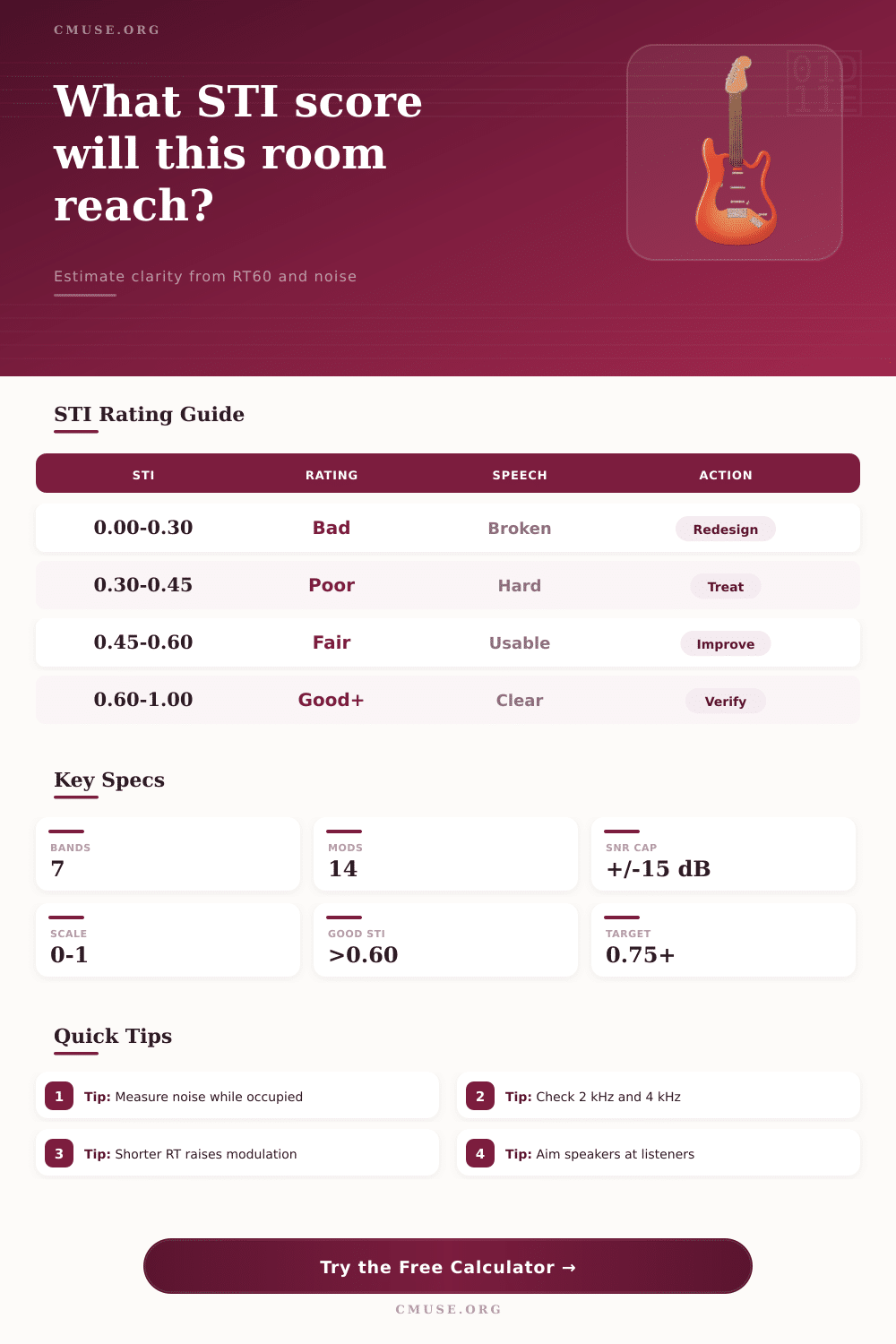
| STI range | Rating | Practical meaning | Common target |
|---|---|---|---|
| 0.00 to 0.30 | Bad | Speech fragments are lost | Not acceptable |
| 0.30 to 0.45 | Poor | Frequent repetition needed | Emergency only |
| 0.45 to 0.60 | Fair | Short messages usually understood | Minimum utility |
| 0.60 to 0.75 | Good | Normal speech is clear | Rooms and paging |
| 0.75 to 1.00 | Excellent | Critical detail is intelligible | Training and control |
| Band | Speech role | Weight | Typical risk |
|---|---|---|---|
| 125 Hz | Warmth and masking | 0.04 | Rumble |
| 250 Hz | Vowel body | 0.10 | Room boom |
| 500 Hz | Speech energy | 0.18 | Muddiness |
| 1 kHz | Core articulation | 0.26 | Long RT60 |
| 2 kHz | Consonant detail | 0.24 | Noise masking |
| 4 kHz | Clarity edge | 0.14 | HF loss |
| 8 kHz | Sibilance | 0.04 | Air absorption |
| Step | Formula | Purpose | Output |
|---|---|---|---|
| Distance | Lp = L1m - 20 log10(d) | Level at listener | dB |
| Noise | mN = SNRlin / (1 + SNRlin) | Noise transfer loss | 0 to 1 |
| Reverb | mR = 1 / sqrt(1 + (2 pi f T / 13.8)^2) | Modulation smear | 0 to 1 |
| Apparent SNR | 10 log10(m / (1 - m)) | STI conversion | -15 to +15 |
| Band TI | (SNRapp + 15) / 30 | Normalize index | 0 to 1 |
| Preset | Room size | Noise | Expected concern |
|---|---|---|---|
| Small Classroom | 30 by 22 ft | 42 dBA | Mid-band RT60 |
| Lecture Hall | 70 by 45 ft | 38 dBA | Distance loss |
| Worship Space | 90 by 60 ft | 40 dBA | Long decay |
| Transit Platform | 160 by 28 ft | 68 dBA | High noise |
| Control Room | 24 by 18 ft | 28 dBA | Coverage balance |
| Paging Concourse | 220 by 70 ft | 72 dBA | Masking noise |
Speech intelligibility are different from loudness. Speech intelligibility relate to an ability of the listener to understand the specific word that were spoken. While many people may believe that increasing the loudness of speech will lead to an increase in speech intelligibility, increasing the loudness of speech dont always lead to increased intelligibility of the words that were spoken.
In some case, increasing the loudness of speech can actualy make the words that are spoken more blur for the listener, which is again difficult to understand. One of the measurement of speech intelligibility is the Speech Transmission Index (STI). The STI isnt a measurement of loudness in a room.
What Affects How Well Speech Is Understood
Instead, the STI measure how well changes in the volume and frequency of speech can reach the listener. Speech include rapid changes in volume and frequency. Smearing those changes due to too many reverb or background noise in a room will reduce the intelligibility of the speech.
Several different variable affect speech intelligibility. For instance, the volume of the room, the distance that the listener is from the speaker, the RT60 of the room, and the signal-to-noise ratio of the room can each affect speech intelligibility. For instance, sound naturaly decrease with distance from the speaker, so distance from the speaker is one variable that affect speech intelligibility.
The RT60 of a room is the amount of time it take for sound to decay in that room. The length of time of the RT60 will affect how long sound continues to be heard after the speaker stops making sound. If the RT60 is too long, the tail of one syllable may begin to overlap with the next syllable.
This masking of one syllable prevent the listener from properly understand the speaker speech. Different frequency within speech impact speech intelligibility in different ways. For instance, low frequency in speech provide the power to speech but may create a muddiness to the sound in a room with too much low frequency sound.
The two to four kilohertz range of speech contain the sharp sounds of consonants and is a critical frequency range for speech intelligibility. If there is a high amount of reverb in this frequency range, even if the background noise is low, the intelligibility of speech will suffer. Background noise can also impact speech intelligibility.
Background noise act as a veil over speech. In a quiet room, background noise is low. In loud environments, like a train station, background noise is high.
High background noise level make it so that the direct sound of the speakers speech needs to be loud enough to overcome the background noise. One way of increasing the direct sound of speech is to aim the speaker that are playing the sound directly at the listeners. This will increase the direct sound that reach the listeners but will decrease the amount of sound that reflect off the walls of the room.
The requirement for speech intelligibility will vary from space to space. For instance, a control room may have high requirement for speech intelligibility due to the fact that a single misinterpreted word could result in an error in the rooms size. In contrast, a concourse may only need to have enough speech intelligibility for a passenger to find there gate.
Once you have established the speech intelligibility for a space as a baseline, it may be possible to adjust some variable in the space to increase speech intelligibility. For instance, changing the position of the speakers within the space or changing the materials that the ceiling of the space is made of can change a space from having poorly speech intelligibility to good speech intelligibility.