Speaker Wire Gauge Calculator
Size copper or CCA speaker cable by one-way run length, speaker impedance, amplifier power, and allowed power loss.
🔊 Listening and Stage Presets
🎚 Cable Run Inputs
Measure amplifier to speaker, not the round trip.
Use the continuous or expected peak channel power.
Recommended Gauge
14 AWG
copper speaker wire
Delivered Power
94.1 W
5.9% cable loss
Round-Trip Resistance
0.139 Ω
voltage drop estimate
Total Wire to Pull
55 ft
16.8 m across runs
📌 Speaker Wire Spec Grid
100%
Copper Conductivity Baseline
~1.6x
CCA Resistance Factor
5%
Common Power Loss Target
2x
Round-Trip Conductor Path
The calculator uses DC resistance per 1,000 ft for standard AWG copper conductors at room temperature, then estimates cable loss with the speaker as a resistive load. Real speakers vary with frequency, so the result is a practical sizing estimate for audio runs.
📊 AWG Resistance Reference
| Wire Gauge | Copper Ohms / 1000 ft | Copper Ohms / 100 m | Typical Speaker Use |
|---|---|---|---|
| 22 AWG | 16.14 Ω | 5.295 Ω | Very short low-power leads |
| 20 AWG | 10.15 Ω | 3.330 Ω | Short desktop or test wiring |
| 18 AWG | 6.385 Ω | 2.095 Ω | Short 8 ohm room speakers |
| 16 AWG | 4.016 Ω | 1.317 Ω | Moderate home theater runs |
| 14 AWG | 2.525 Ω | 0.828 Ω | Long rooms and 4 ohm loads |
| 12 AWG | 1.588 Ω | 0.521 Ω | Long home theater or small PA |
| 10 AWG | 0.999 Ω | 0.328 Ω | Long high-power stage runs |
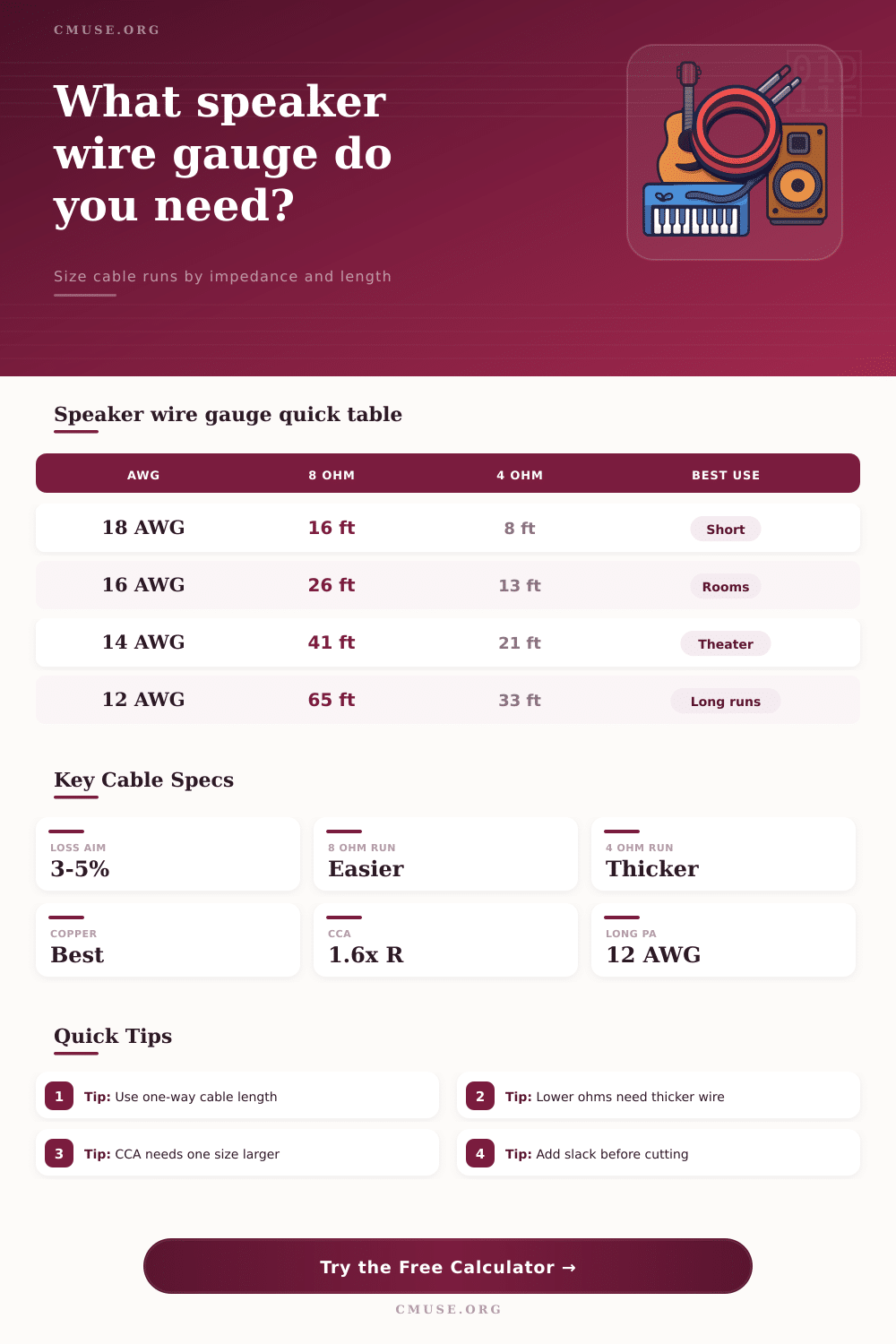
📏 Max One-Way Copper Run at 5% Power Loss
| Wire Gauge | 8 Ohm Speaker | 6 Ohm Speaker | 4 Ohm Speaker | Best Fit |
|---|---|---|---|---|
| 18 AWG | 16 ft / 5.0 m | 12 ft / 3.8 m | 8 ft / 2.5 m | Nearfield and short shelves |
| 16 AWG | 26 ft / 7.9 m | 19 ft / 5.9 m | 13 ft / 4.0 m | Average room runs |
| 14 AWG | 41 ft / 12.5 m | 31 ft / 9.4 m | 21 ft / 6.3 m | Theater fronts and surrounds |
| 12 AWG | 65 ft / 19.9 m | 49 ft / 14.9 m | 33 ft / 9.9 m | Long rooms and low impedance |
| 10 AWG | 104 ft / 31.7 m | 78 ft / 23.8 m | 52 ft / 15.8 m | Stage, PA, and long trunks |
🔀 Gauge Comparison at 50 ft One-Way, 8 Ohms
| Wire Gauge | Round-Trip Resistance | Power Loss | Delivered from 100 W | Recommendation |
|---|---|---|---|---|
| 18 AWG | 0.639 Ω | 14.2% | 85.8 W | Too thin for this run |
| 16 AWG | 0.402 Ω | 9.3% | 90.7 W | Usable only for casual listening |
| 14 AWG | 0.253 Ω | 6.0% | 94.0 W | Close for many home rooms |
| 12 AWG | 0.159 Ω | 3.9% | 96.1 W | Preferred for clean margin |
| 10 AWG | 0.100 Ω | 2.4% | 97.6 W | Strong margin, bulky cable |
🎛 Speaker Load Sensitivity Reference
| Nominal Load | Max Round-Trip R for 5% | Current at 100 W | Gauge Impact |
|---|---|---|---|
| 16 ohms | 0.415 Ω | 2.50 A | Most forgiving for long runs |
| 8 ohms | 0.208 Ω | 3.54 A | Standard home reference load |
| 6 ohms | 0.156 Ω | 4.08 A | Often needs one gauge thicker |
| 4 ohms | 0.104 Ω | 5.00 A | Use shorter runs or heavier wire |
| 2 ohms | 0.052 Ω | 7.07 A | Very demanding for passive cable |
🏠 Common Audio Run Examples
| Scenario | One-Way Run | Load | Target Loss | Typical Gauge |
|---|---|---|---|---|
| Desktop amp to bookshelf speakers | 6 ft / 1.8 m | 8 ohms | 5% | 18 AWG copper |
| Media console to front towers | 18 ft / 5.5 m | 8 ohms | 5% | 16 AWG copper |
| Receiver to rear surrounds | 35 ft / 10.7 m | 8 ohms | 5% | 14 AWG copper |
| Rack amp to studio passive monitor | 12 ft / 3.7 m | 4 ohms | 3% | 12 AWG copper |
| Stage amplifier to wedge monitor | 60 ft / 18.3 m | 8 ohms | 5% | 10 AWG copper |
| Passive subwoofer from power amp | 25 ft / 7.6 m | 4 ohms | 5% | 10 AWG copper |
Tip: Speaker wire calculations use round-trip conductor resistance, so a 25 ft speaker run behaves like 50 ft of conductor in the loss math.
Tip: If the result lands at the edge of a gauge, choose the next thicker wire for connector resistance, routing bends, and future speaker changes.
Another component that you can purchase for the speaker system is a speaker wire. Speaker wire must be select carefully to ensure that the speaker wire dont limit the electrical current from the amplifier to the speaker. When selecting speaker wire, one of the factors to consider are the resistance of the speaker wire.
Resistance is a factor that slows the electrical current that pass through the wire. If the speaker wire
Choose the Right Speaker Wire