Speaker Room Size Calculator
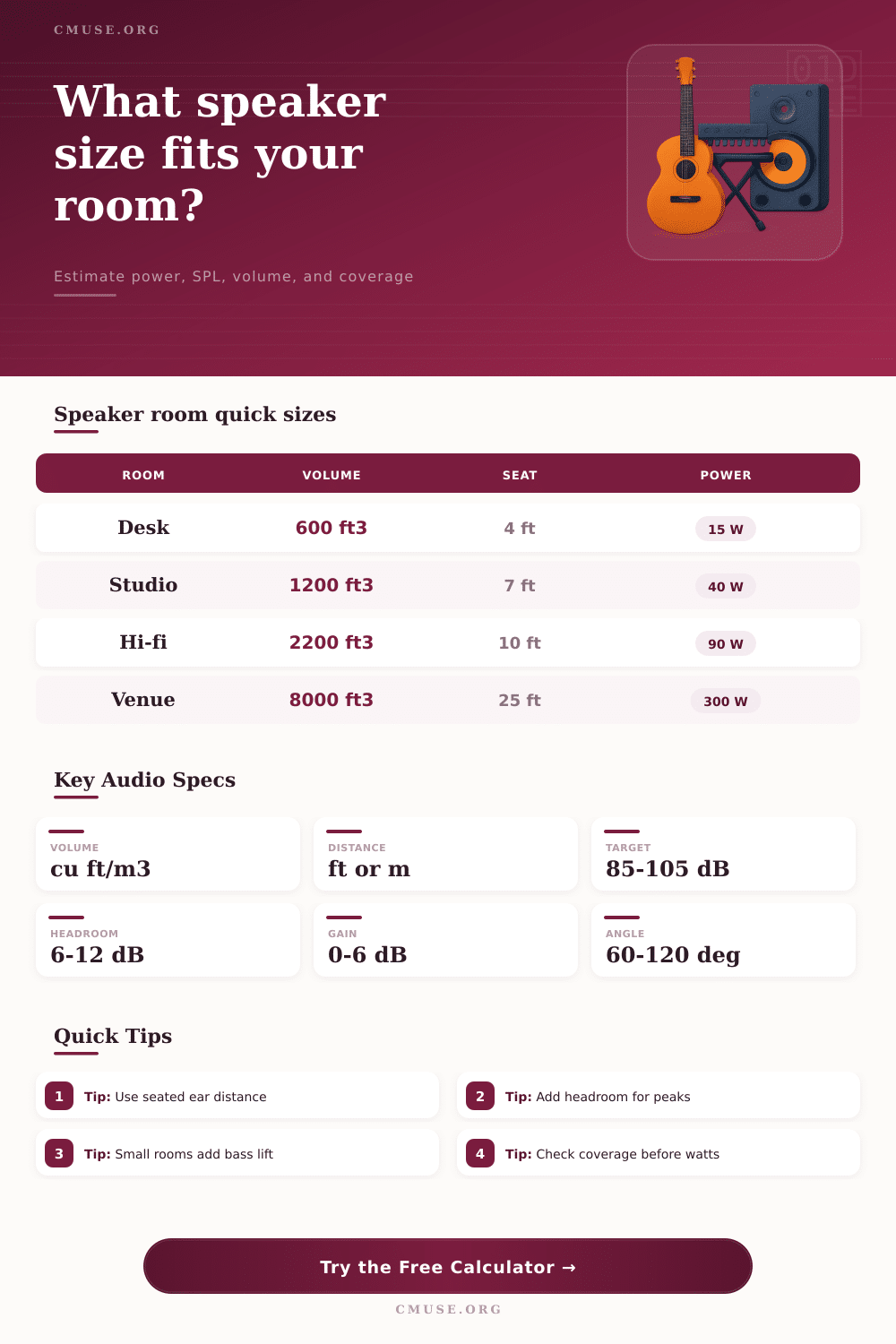
Estimate room volume, usable coverage, listening-distance loss, SPL target, room gain, and recommended amplifier power for music rooms, studios, hi-fi rooms, and small venues.
🎧 Named Room Presets
⚙ Room, SPL, and Speaker Inputs
📊 Current Room Spec Grid
🔍 Speaker Coverage Comparison
Nearfield Monitor
Bookshelf / Tower
Small PA Top
Ceiling Fill
📐 Room Size and Speaker Class Table
| Room Class | Volume Range | Typical Listener Distance | Speaker / Amp Planning Note |
|---|---|---|---|
| Booth or desktop nook | under 700 cu ft / under 20 m3 | 3 to 5 ft / 0.9 to 1.5 m | Nearfield monitors often need modest watts but careful placement. |
| Small practice room | 700 to 1400 cu ft / 20 to 40 m3 | 5 to 8 ft / 1.5 to 2.4 m | Bookshelf, small monitors, or compact PA speakers can work. |
| Medium hi-fi or mix room | 1400 to 3000 cu ft / 40 to 85 m3 | 7 to 12 ft / 2.1 to 3.7 m | Choose sensitivity and headroom before assuming large wattage. |
| Large classroom or rehearsal room | 3000 to 8000 cu ft / 85 to 226 m3 | 12 to 25 ft / 3.7 to 7.6 m | Higher sensitivity speakers reduce amplifier demand dramatically. |
| Small venue or worship room | 8000+ cu ft / 226+ m3 | 25 ft+ / 7.6 m+ | Coverage pattern, speaker count, and array gain matter as much as watts. |
🔊 Sensitivity, Distance, and Power Reference
| Sensitivity | 90 dB at 3 m | 100 dB at 3 m | Typical Speaker Type |
|---|---|---|---|
| 84 dB, 1W/1m | 36 W | 358 W | Small sealed speaker or compact monitor |
| 88 dB, 1W/1m | 14 W | 143 W | Common bookshelf or studio monitor |
| 92 dB, 1W/1m | 5.7 W | 57 W | Efficient hi-fi tower or larger driver |
| 96 dB, 1W/1m | 2.3 W | 23 W | Small PA top or efficient horn system |
| 100 dB, 1W/1m | 0.9 W | 9 W | High-output PA cabinet |
💡 Coverage Angle Table
| Coverage Angle | Cone Diameter at 3 m | Best Use | Room Size Note |
|---|---|---|---|
| 60 deg | 3.5 m / 11.4 ft | Focused nearfield or controlled directivity | Great when reflections need control. |
| 80 deg | 5.0 m / 16.4 ft | Balanced hi-fi and studio coverage | Useful starting point for stereo listening. |
| 90 deg | 6.0 m / 19.7 ft | Small PA mains or stage fill | Covers wider seats with less toe-in. |
| 100 deg | 7.2 m / 23.4 ft | Distributed room fill | Good for broad but moderate SPL coverage. |
| 120 deg | 10.4 m / 34.1 ft | Ambient or ceiling coverage | Wide pattern trades focus for spread. |
🎛 Common Room Preset Comparison
| Preset | Dimensions | Volume | Typical Target |
|---|---|---|---|
| Recording Booth | 5 x 5 x 8 ft / 1.5 x 1.5 x 2.4 m | 200 cu ft / 5.7 m3 | 75 to 85 dB monitoring |
| Practice Room | 8 x 8 x 8 ft / 2.4 x 2.4 x 2.4 m | 512 cu ft / 14.5 m3 | 85 to 95 dB rehearsal |
| Home Studio | 10 x 12 x 8.5 ft / 3.0 x 3.7 x 2.6 m | 1020 cu ft / 28.9 m3 | 78 to 85 dB mixing |
| Hi-Fi Room | 16 x 20 x 9 ft / 4.9 x 6.1 x 2.7 m | 2880 cu ft / 81.6 m3 | 80 to 90 dB listening |
| Music Classroom | 24 x 30 x 10 ft / 7.3 x 9.1 x 3.0 m | 7200 cu ft / 203.9 m3 | 88 to 98 dB instruction |
🎚 Room Gain and Headroom Guide
| Setting | Calculator Effect | When to Use | Practical Note |
|---|---|---|---|
| 0 dB room gain | No SPL credit | Outdoor, very dead, or large open rooms | Most conservative for power planning. |
| 2 dB room gain | Reduces watts by about 37% | Typical furnished music room | A reasonable default for many indoor spaces. |
| 4 dB room gain | Reduces watts by about 60% | Small room or boundary-supported placement | Do not use if bass buildup is being filtered away. |
| 6 dB headroom | About 4x power over average target | Speech, compressed music, background playback | Can be enough when levels are controlled. |
| 10 dB headroom | 10x power over average target | Dynamic music and general listening | Common target for clean transient margin. |
| 15 dB headroom | About 32x power over average target | Live mix peaks or wide crest factor material | Often demands efficient speakers or multiple cabinets. |
💡 Practical Speaker Room Tips
Choosing the appropriate speaker for a room require you to understand several different variable. These variables include the volume of the room, the distance that you will be from the speakers, the sensitivity of the speakers, and the volume that you will require in the room. Each of these variable will allow you to understand if a given speaker system will sound balanced or if the system will sound strain.
While the calculator will provide you with mathematical result based off the specifications for your room, you must understand each of these variables in order to make an informed decision about your speaker system. One of the primary measurement of a room that you must consider when choosing speakers is the volume of the room. For larger rooms, you will require more power to reach the same level of loudness as you will find in smaller room of the same dimensions.
How to Choose the Right Speakers for Your Room
Additionally, smaller rooms will often allow bass to build up within the room due to the nature of how sound reflect in smaller areas. The second of the main variables to consider is the distance that you will be from the speakers. If you double the distance between yourself and the speaker, the sound pressure level will drop by six decibels.
This drop in sound pressure level mean that you will have to increase the power of your amplifier or purchase speakers with higher sensitivity to compensate for this drop. The calculator takes into account this drop in sound energy to ensure that you can determine if your amplifier is capable of providing the sound pressure to your desired target level. As with most things in sound systems, you will likely under-estimate the drop in sound energy as it increases at a rapidly rate with distance.
The third of the main variables to consider are the sensitivity measurement of the speakers. Speakers with higher sensitivity require less power to reach the same level of output from the speakers. Additionally, if the sensitivity of the speakers is higher, it is possible to halve the amount of power that is required to operate the speakers at the same level.
Sensitivity is measured at one watt and one meter, so the speaker sensitivity calculator can help you to translate that sensitivity measurement to the real world at your listening position. You should use this speaker sensitivity calculator to translate the sensitivity measurements of the available speakers because it is difficult to compare the sensitivity of speakers without also consider other factors. The last of the main variables to consider are the coverage angle for the speakers.
If the coverage angle for the speakers is narrow, the sound energy will be focused on a smaller area. This type of coverage angle will leave the positions to the side of the speaker with less sound energy. A wide coverage angle will help to spread the sound throughout the listening area, but the wide angle will also reduce the intensity of the sound delivered to the center of the listening area should you use only a single pair of speaker.
The calculator helps to determine whether the theoretical coverage angle of the speakers will provide adequate coverage of the listening area based upon the floor area of the room. Factors such as room gain and headroom relate to the acoustic behavior of the listening room. If the listening room is furnished, boundary reinforcement will lower the power requirement for the speaker system.
Rooms without boundary reinforcement, such as dead spaces or outdoor areas, will require more power to achieve the same level of reinforcement as an enclosed space with boundaries. Headroom is used to protect the speaker system from musical peaks in the audio signals that may exceed the level of the average musical signal. Selecting a specific headroom level alters the behavior of the system, and the calculator can show how headroom will impact the size of the amplifier for the speaker system.
Common mistake are made when treating one of these variables in isolation from the others. For example, one might purchase a high-wattage amplifier for a small listening room with efficient speakers, or one might place large speakers into a small area in an attempt to provide adequate bass reinforcement to the area. Such mistakes can be avoided with the use of this calculator, which displays both the power and coverage requirement for the listening space simultaneously.
Showing both the required power and the coverage fit will prevent you from overbuilding one aspect of the system while underbuilding another aspect of the system. Tables on the page provide context for each of these variables. The tables relate the different classes of listening rooms to the distances at which listeners should sit from the speakers, the coverage angles that will work well in each situation, and the difference in the sensitivity levels of speakers and the power required to move the diaphragms of the speakers at high levels.
These tables will help you to understand the calculator output of the calculator. Within real listening rooms, there are additional variables beyond those that are represented in the calculator. Factors like the absorption of sound by the furniture in the listening room, the shape of the listening area, and the way in which the speakers interact with the walls of the listening area will have an impact upon the acoustic behavior of the listening area.
The calculator provides an estimate of the power, coverage, and headroom requirements of the listening area; however, you must make additional adjustment to the speaker system through listening tests and adjustments to the placement of the speakers. Thus, the calculator output should be treated as a guide to establishing realistic expectations of the performance of the speaker system in the listening area. Thus, the calculator output can help you to ensure that the system behave as a single source of sound.
Youll find that the results are alot more helpful when you consider the rooms size. It wouldnt be as accurate if you didnt use teh calculator. Its better to be careful than to recieve teh wrong sound.
You should of checked the measurements twice.