Crossover Frequency Calculator
Calculate speaker crossover frequency from capacitor, inductor, or LC values with fast reference outputs.
🔌 Calculator Inputs
📊 Formula Reference
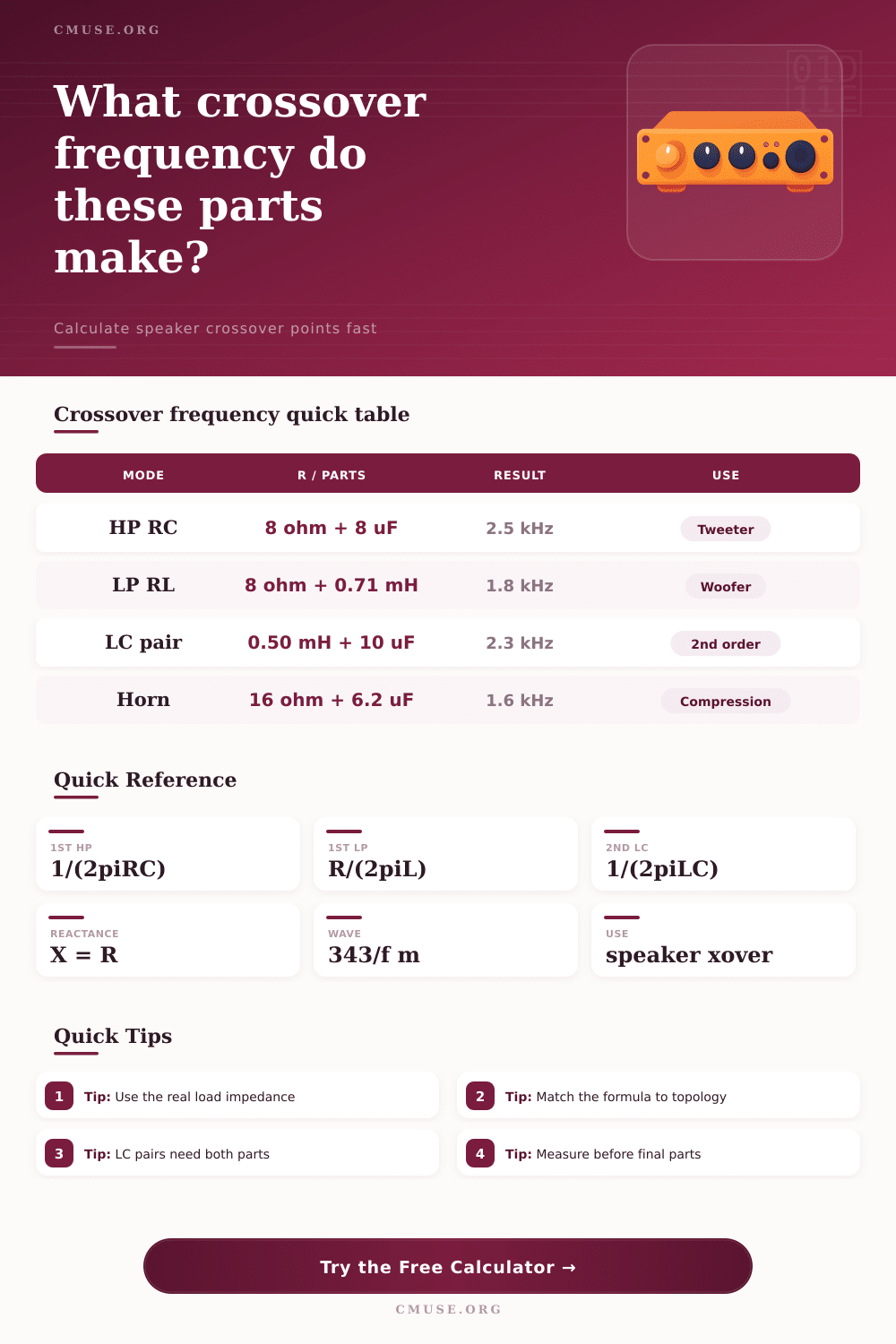
| Mode | Formula | Inputs | Use |
|---|---|---|---|
| High-pass RC | fc = 1 / (2piRC) | C + R | Tweeter |
| Low-pass RL | fc = R / (2piL) | L + R | Woofer |
| LC pair | fc = 1 / (2pi sqrt(LC)) | L + C | 2nd order |
| Resonance | X = R at fc | Load match | Quick check |
🔧 Key Specs
🎵 Common Crossover Targets
| Build | Impedance | Freq | Note |
|---|---|---|---|
| Tweeter | 8 ohm | 2.5 kHz | RC high-pass |
| Horn | 16 ohm | 1.6 kHz | RC high-pass |
| Woofer | 8 ohm | 1.8 kHz | RL low-pass |
| 2-way LC | 8 ohm | 2.3 kHz | Butterworth |
The crossover frequency is the main place where audio signal divides and go to various speakers or subwoofers. Audio crossovers control that frequencies go to particular audio path or loudspeaker driver. It exactly points how the sound divides and what parts of the audio range plays every speaker
The most many high fidelity speakers have at least two units: deep unit for low sounds and high unit for high. Do not send rugged cymbals to the deep unit, neither low tones to the high unit. Filter net separates them.
How to Set the Crossover Frequency for Speakers and Subwoofers
When you build speaker with several drivers, the crossover divides the freqnuencies for best range.
There are three main kinds of crossovers. High-pass filters leave only high frequencies to the high units, protecting against distortion and damage. The signal that crossover allow depend on the type: high pass blocks low, low pass blocks high.
The crossover frequency self is the frequency where the power of the speaker declines in half (-3 dB) and continuously diminish.
The most common advised crossover frequency, also THX standard, is 80 Hz. Without gear it well serves as start. Modern AV receivers allow to manually set spots for every channel.
Start at 80 Hz for satellites and adapt according to the system. Subwoofers technically reach 20 Hz, but room modes and position affects the actual output.
For big front speakers 80 Hz answer, because they self go until almost 40 Hz. At little speakers 120 Hz are better. Configuration between 80 and 100 Hz operate well for surround speakers and protect against damage.
More than 150 Hz do not answer, because directionality disappear for those frequencies with the subwoofer. 120 Hz and 150 Hz commonly use for little, slim speakers.
Set subwoofer crossover at 80. 85 Hz are usual, because more highly it twists the stereo image. Under 80 Hz do not advocate even for big tower speakers. Chest thumps happen under 80 Hz, especially at 60 Hz, so the subwoofer must take them.
High-pass filter at 12 dB each octave and 40 Hz dilute 20 Hz-tone in -12 dB regarding input. Room sound also matters, so adapt according to what sound best in thespace.