Speaker Crossover Calculator
Plan 2-way and 3-way crossover points with component estimates for each driver band.
🎼 Inputs
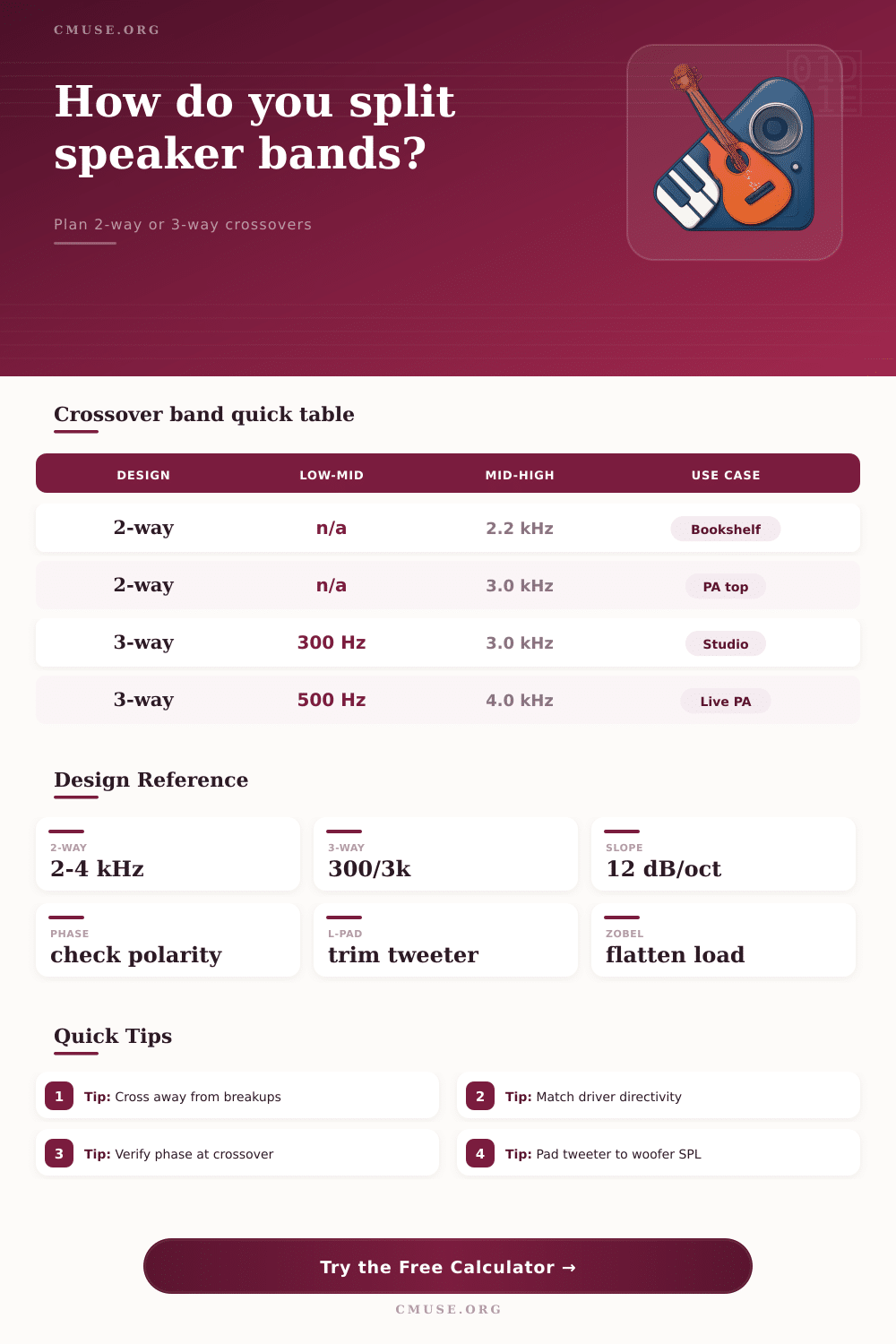
| Design | Low-Mid | Mid-High | Target |
|---|---|---|---|
| Studio 3-way | 300 Hz | 2800 Hz | Flat nearfield |
| PA 2-way | n/a | 1800 Hz | High output |
| HiFi 2-way | n/a | 2200 Hz | Smooth vocal |
| Live 3-way | 500 Hz | 3500 Hz | Wide coverage |
A speaker crossover is an electronic circuit that decides at what frequency the amplifier output will be crossed over from a low frequency driver like a woofer to a high frequency driver like a tweeter. It divides the signal into frequency bands so that each driver receives only the frequencies it is built for
Almost all speakers have several drivers and use crossover networks to lead the right frequencies to each of them. Capacitors, inductors and resistors combine to direct high sounds to the tweeter and low to the woofer. A highpass filter leads high frequencies to the tweeter, a lowpass to the woofer, and a bandpass to a midrange driver.
How Speaker Crossovers Work
You make crossover networks for speakers using audio pass filters. To set the transition between a woofer and a tweeter, you put a low pass filter on the woofer signal and a high pass filter on the tweeter signal. The tweeter handles highs, the woofer handles lows, and a subwoofer handles ultra-lows.
The spot where high frequency drivers cross over low drivers is the crossover point.
Audio crossover networks are neccesary, because you cannot build one speaker that works through the whole audio range. For deep sound a lot of air must be moved, so you need a big and heavy cone. For high sounds you need a smaller, agile and fast transducer.
Because of that the whole audio range divides into two or more parts.
Passive crossover networks for speaker systems are very easy to install. They go between the amplifier and the speaker without need of power, a switch or ground. The wire of the amplifier goes to the input of the crossover.
Active crossovers use op-amps, while passive ones base on capacitors, inductors and resistors.
Home cinema 5.1 surround sound systems use crossover networks that separate the ultra-low frequencies to send them to a subwoofer, and then turn the remaining low, mid and high frequencies to five speakers around the listener. New receivers usually allow you to set a separate crossover point for every channel, which helps to avoid that low sounds go to every speaker.
At the crossover point there should be some overlap so that no frequency is lost. Those limits are not strict, they roll off, so a smooth transition with some overlap matters. Subs are usually set to 80 Hz as an upper limit.
Many bookshelf speakers reach 60 or even 50 Hz, but usually you put the crossover point at 80 Hz to reduce mid-bass distortion. A good rule is to set it 15, 20 Hz above the natural default spot of the speakers. Also the place of the subwoofer strongly affects the crossover region.
The crossover has resistors that limit the power to every speaker. A three-way speaker with 100 W RMS uses 100 W for the bass driver, 40 W for the midrange and 30 W for the tweeter. The best crossover networks are designed specially for particular combinations of drivers.