Half Space Loading Calculator
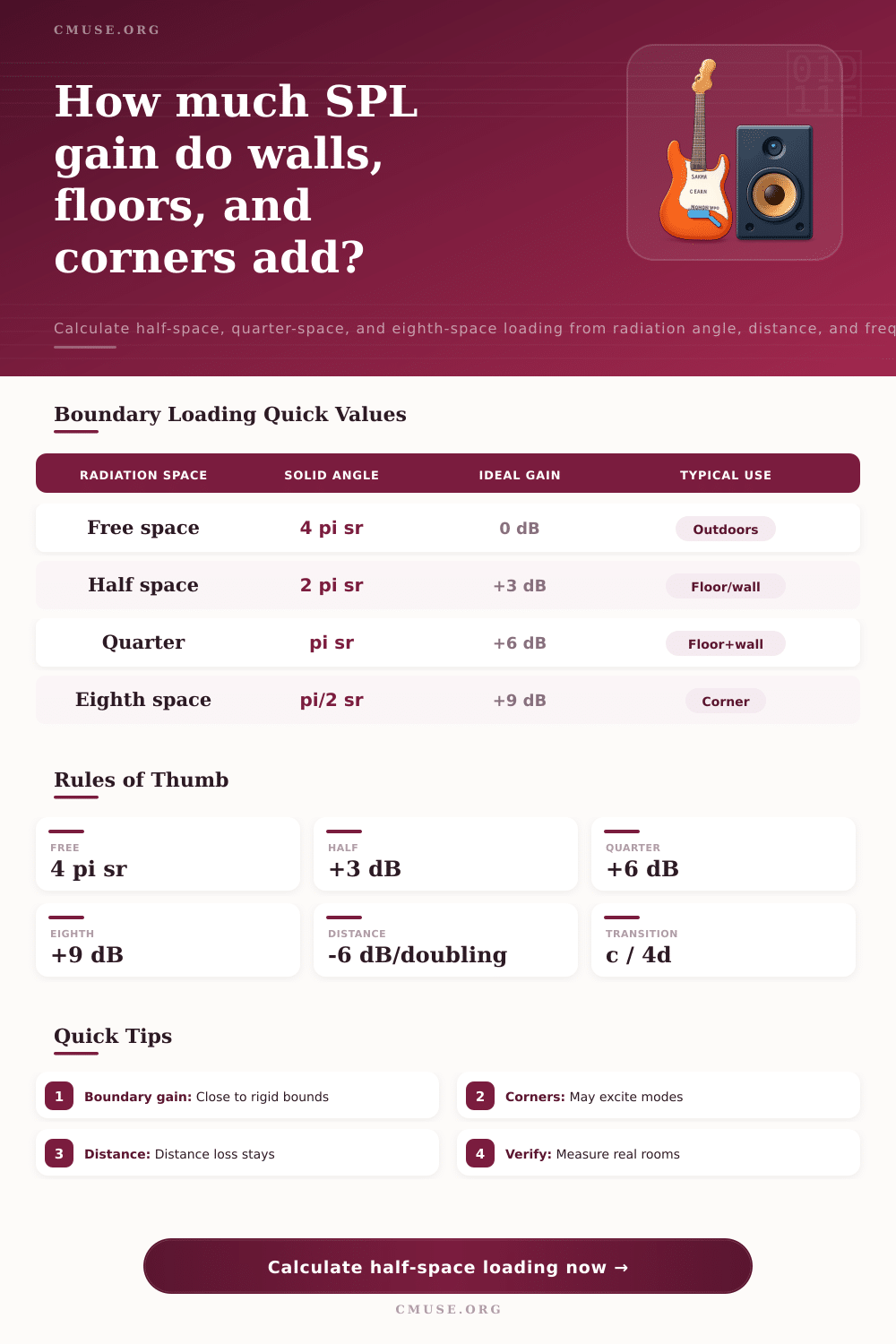
Estimate loudspeaker boundary loading for free, half, quarter, and eighth-space radiation, including solid angle, boundary gain, SPL delta, distance loss, and the transition frequency where spacing starts to matter.
Calculation breakdown
Radiation loading comparison
| Mode | Solid angle | Ideal gain | Adjusted at Hz |
|---|
Distance SPL table
| Distance | Distance delta | SPL with loading | Note |
|---|
Frequency transition sweep
| Frequency | Wavelength | Loading factor | Gain |
|---|
Loading grid by space and distance
Ever had a speaker sounding real big and boomy when placed in one area of a big room? Or real thin in another? That’s not magic. That doesn’t mean something is wrong with your gear. It means physics is doing its thing. We refer to it as boundary gain… Or the amount by which you change the output of your gear based on where you place it.
The formula for that is handled by the above calculator if you input the proper dimension of your room and space between speakers. You won’t have to mess around guessing at conversions and coefficients, which are typically what trip people up. It’s really all down to solid angles. Think of a loudspeaker surrounded by a sphere of air. When the speaker is radiating in free space (such as inside a big anechoic chamber or out on a large open field) it sends sound everywhere. It covers four pi steradians.
How Speaker Placement Changes Sound
Now place that speaker on a hard floor. You’ve just cut that radiation pattern in half. All of that energy once sent downward into the ground is no longer able to go anywhere but straight back towards your ears. So you end up doubling the acoustic power in the other hemisphere, three decibels of gain right there. Then put that speaker up against a wall too and you’ve got another three decibel increase because you’ve cut the area covered by the speaker yet again, this time only a quarter of what it was before. And if you stack that thing real deep into the corner where two walls and the floor comes together…well, then you’re talking nine decibels of free gain from your own room.
And that’s where folks mess up. “Nine decibels” rings in your ears, and suddenly you think your subwoofer has tripled its efficiency in terms of electrical power. Nope. It’s still working just as hard at the amp level. What changes is that instead of wasting energy spreading into open space, it hits something. That something then bounces the energy back in a helpful way.
For system designers, this mean there are huge implications when deciding how much headroom is actualy needed. If you’re a flown line array in a big room most of the time you’re operating in free space conditions. That means you need vastly more amplifier power to produce the same crowd SPLs as a subwoofer in a small club set up in a corner-load situation. The calculator allows you to pick your type of radiation space and then adjusts the best gain based off this fact.
In theory that sounds great, but in practice? Well, not so much. A suspended wooden stage isn’t like a concrete one. Drywall covered with dense acoustic foam doesn’t reflect nearly as much energy as does a brick wall. Real rooms tend to be a bit of a mess and this tool lets you compensate for their effectiveness. Soft curtains and thicker carpets will absorb some of those reflected waves before they combine with the direct sound, thus eliminating some of the potential gain. That’s why measurement trumps speculation. You can estimate how much of an improvement might occur, but you need to measure it using a mic in the real world.
There’s also the matter of distance, which acts strangely in combination with those boundary effects. For every doubling of the distance between you and the source, the SPL decreases by six decibels. That’s basic wave physics. When you’re near a boundary, however, and particularly if you’re near a low frequency (the wavelength being longer than the dimension of your room), that distance rule bends. It tells you the approximate transition frequency where the speaker no longer act as though it were a point source in open space but instead begins to interact with its environment. Below this frequency, it’s all about the boundaries. Above it, it’s all about directivity.
Room placement is something most folks do as an afterthought. Buy their speakers, find somewhere to put them where they will fit on the stand and bitch because there isn’t any bass or they have harsh highs. That flips the script when you understand half-space loading. Placement becomes a gain staging tool. You’re no longer moving furnitures around. Instead, you’re tuning the sensitivity curve of the system with your floors and walls.
It is a small thing. After you see how much free boost a corner will give you, you begin seeing the listening space in a different way. You’re no longer fighting against the room. You’ve started working with the room. This allows the physics to do half the work for you, so your amplifiers shouldn’t of have to run hot.