Diffraction Loss Calculator
Estimate baffle step loss, compensation dB, wavelength, driver offset balance, edge radius smoothing, and edge diffraction hot spots for loudspeaker layouts.
Calculation breakdown
Driver-to-edge diffraction frequencies
| Edge | Distance | First frequency | Risk |
|---|
Compensation target table
| Target | Boost | Use when |
|---|
Frequency loss sweep
| Frequency | Wavelength | Step loss | Net loss |
|---|
Diffraction loss grid
Build a speaker that measures flat in anechoic chamber. But in your livig room, it sounds thin and bright. Most often, it’s not because of drivers themselves. Typically, it’s because of edges of box they mount on. Until you learn about the geometry behind diffraction loss, it feels like magic.
When sound hits a sharp corner, it scatters. Some of its energy reinforces other soundwaves. Some of it cancels out. What result is a frequency response that doesn’t stay steady; it vary wildly. I’ve run the math for you in the calc above, but knowing what those numbers mean change the way you design your speakers.
How to Fix Speaker Diffraction Problems
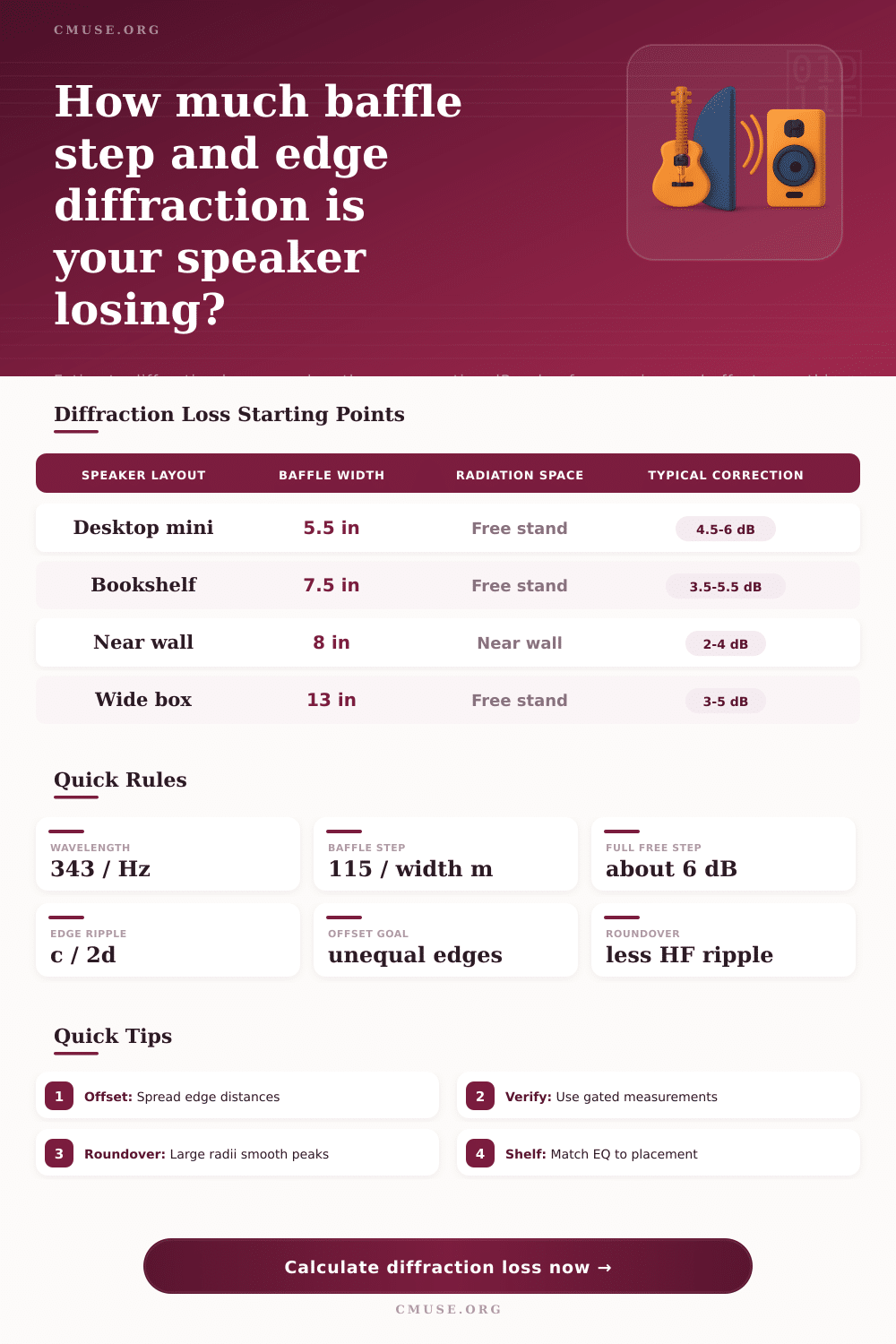
Let’s begin with baffle step alone. When a small driver radiates low frequency sound, it do so in every direction. Higher pitches has shorter wavelengths. Eventually, the sound becomes directional and projects efficient forward, while the cabinet blocks the back wave. Because of this change, there’s a natural drop in output. If free standing, you lose approximately six decibels. That’s a big deal. Without compensating for this you’ll have a system that sound bass heavy. Why? Because the midrange drops considerablly.
Width isn’t everything; radiation space counts, too. For example, if a bookshelf speaker is placed next to a wall, then that boundary provides some support. Energy reflected off the wall and floor return to the listening area, which reduce the severity of that step loss. Instead of losing six decibels, perhaps it’s just two or four. That’s where the tool allows you to pick the location environment. Based on room gain, it will adjust what the maximum likely loss can be.
Why don’t equalization curves translate from one room to other? Another problem is edge ripple. At certain wavelengths, high frequencies will interacts with the edges of the baffles. That wavelength correspond to the distance between the corner and center of the driver. If that equals half a wavelength, then there’s a peak; if equal to a quarter wavelength, there might be a dip. In the treble range this can result in lack of air or make things sound harsh. The calculator uses your baffle dimensions and driver placement to estimate those frequencies. It will then tell you where on each edge they’ll be a problem and at what pitch.
A simple trick called driver offset makes a big difference The majority of speakers is designed with the tweeter positioned centered for looks. However, this also aligns both sides of the speaker so they has equal path length to each side edge. Diffraction peaks will then stack on top of one another. By moving the driver just a hair off center, it separate these troublesome frequencies. The result is a wider spread of energy throughout the spectrum. No single note spike in volume. Offsetting the tweeter by even a fraction of an inch in the drawing program avoids a nasty resonance in the finished product.
Similarly, rounding the edges of your baffle does the same thing. High frequency waves are perfectly reflected by sharp ninety degree corners. Roundovers spread that energy more diffusly and smooth out the peaks without adding coloration. They soften the visual harshness of the cabinet to match an acoustic goal. They don’t add any coloration, just smooths out the peaks.
The other consideration is that if you examine the compensation target, you decide just how aggressively to increase the midrange. This one should of been easy to overdo. If you are boosting too much, it’s possible to overload your amplifier. Also, if there is a clash between the room modes and your center image, adding more middle frequencies might make the picture boomy. That’s laid out in the reference table on the page. It indicate lower percentage boosts for speakers located near wall areas. In those situations, some of the lack of energy get added by the room.
Control is the key to diffraction management. There’s no way around physics, only mitigating its most disruptive effects. How do you do that? You do this by carefully balancing driver placement, baffle width and edge radius. It transforms random reflection chaos into a coherent sound stage. The math provide a map; your ears determine the destination.
Begin with geometry. Follow the tools’ lead on your first round of EQ. And listen for what sounds best in the room where it will live.