Soundcheck Time Calculator
Estimate total soundcheck time from input count, line check pace, monitor mixes, FOH tuning, changeover work, band size, wireless checks, and scheduling buffer.
Load a realistic act or venue profile, then adjust the line list and crew assumptions. Times are planning estimates for live sound workflows, not pricing or labor quotes.
| Source Group | Common Inputs | Line Check Notes | Time Range |
|---|---|---|---|
| Solo vocal and guitar | 2 to 4 | Vocal, DI, spare, playback | 8-18 min |
| Drum kit | 8 to 14 | Kick, snare, hats, toms, overheads, triggers | 18-40 min |
| Rock band | 16 to 28 | Drums, bass, guitars, keys, lead and backing vocals | 45-90 min |
| Theater or orchestra | 32 to 64 | Many wireless packs, sections, playback, comms | 90+ min |
| Monitor Setup | Mix Count | Typical Pace | Planning Note |
|---|---|---|---|
| Shared wedge | 1 to 2 | 3 to 5 min each | Fast when vocals dominate the mix. |
| Band wedges | 3 to 6 | 4 to 7 min each | Expect more talkback and small revisions. |
| Stereo IEM band | 4 to 10 | 6 to 12 min each | Add time for pack handoff and stereo placement. |
| Festival quick line | 0 to 4 | 2 to 5 min each | Often relies on saved scenes and limited changes. |
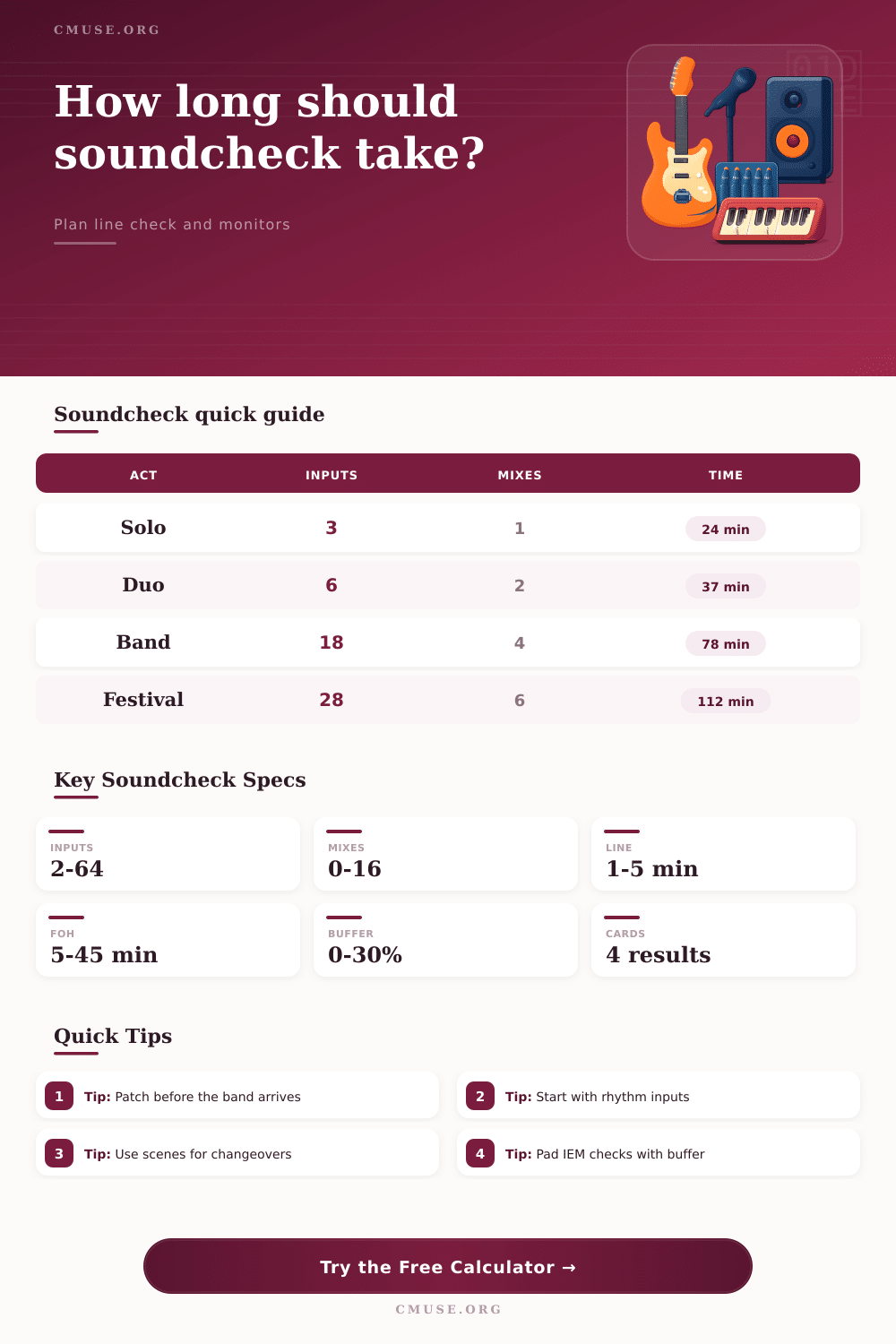
| Preset Scenario | Inputs | Monitor Mixes | Estimated Window |
|---|---|---|---|
| Solo Cafe | 3 | 1 | 20 to 30 minutes |
| DJ Club | 5 | 1 | 25 to 40 minutes |
| Rock Club Quartet | 20 | 4 | 70 to 95 minutes |
| Headline Arena | 48 | 12 | 150 to 220 minutes |
| Workflow Factor | Faster When | Slower When | Calculator Input |
|---|---|---|---|
| Advance quality | Stage plot and input list are current | Channels change at load-in | Crew workflow |
| Line check | Patch is labeled and tested | Many swapped mics or dead lines | Input complexity |
| Monitor check | Musicians know their priority sources | Every player requests a full remix | Minutes per mix |
| FOH tuning | System is already rung out | New room, outdoor wind, or harsh stage bleed | FOH tuning |
Soundcheck planning require careful allocation of time for several reasons. Soundcheck planning impact many aspects of the show. If it is done incorrectly, the soundcheck will impact the load-in, the crew’s morale, the dinner breaks, and the opening act.
You must ensure you allocate enough time for the soundcheck for the task to be completed. A soundcheck is when the band plug into their equipment and test the sound of their instrument. However, the individual involved in the soundcheck often does not notice the hour spent on completing the soundcheck if the soundcheck is successful.
How to Plan a Soundcheck
The input count is one of the first factor to consider when planning a soundcheck. However, the input count do not necessarily represent the time it will take for the soundcheck to happen. For example, a drum kit that has 14 channels does not take twice as long as a kit with 7 channel.
A kit with 14 channels will take more time because each additional microphone require the engineer to decide on the placement of the microphone, the phase of the microphone, and the bleed of the microphone. The calculator will account for this with an input complexity setting that will allow the engineer to adjust for the complexity of the soundcheck. Each channel on a soundcheck will not necessarily take the same amount of time as the other channel when the room is empty and the monitor are off.
Another factor to consider are the monitor mixes. Monitor mixes add to the complexity of the soundcheck and the individual preparing for the soundcheck often underthink them. For example, it may take four minute to set up a wedge monitor for all of the band member, but it will take more time to set up four individual monitor mixes.
Individual monitor mixes may take more time because each musician may want a different monitor mix and each musician will have to communicate with the engineer to ensure that they have the correct monitor mix. The band size input will account for the time it will take for each musician to speak with the engineer to adjust the monitor mix for each band member. If the monitor mixes are ignored, the soundcheck will take up to eat dinner and the opening act will have lost time before they begin to play their song.
Another separate category to consider is the time it will take to FOH tune the stage and to change over soundcheck task. Tuning the FOH for each song will require the band to be in an empty room so the engineer can accurately tune the FOH for the soundcheck. Change over time is the time to change over the gear and make decision on which cable to use for the next act that will arrive to perform.
The crew workflow setting will account for this time for the same reason that the engineer will take different amount of time to change over the gear. An experienced crew will take less time to change over the gear than a crew that is walking into the location for the first time. The buffer percentage is the last task to account for in soundcheck planning.
The buffer percentage will be required to account for time taken by the band to arrive late for soundcheck, time to fix direct box that are faulty, or time to request the band to play a click track for the engineering crew. The engineer will account for the percentage after the soundcheck is completed to determine how long it will take for them to complete the soundcheck. This final number is the number that should of been written on the day sheet to keep track of the time of the soundcheck.
This final number will provide the band and engineer with a realistic expectation for that day’s soundcheck. The calculator will provide an estimate for the soundcheck. However, the calculator will not account for the social aspect of the soundcheck.
For example, some bands may use the soundcheck to rehearse the song that they will play and may want to play three songs during the soundcheck. Other bands may want to complete the soundcheck quickly to eat meal before the show. Additionally, the worship team that is playing may use the monitor mixes in a different manner than the rock band.
Each of these social aspect will have an impact on the soundcheck time. The calculator can only provide an estimate, so the engineer will need to have a conversation with the band member to discuss their preference and the soundcheck. The number for the soundcheck should be run before the band plays their show.
This will allow the engineer to discuss with the production manager or the venue any concern that they have regarding the time for the soundcheck. For example, if the soundcheck estimate is higher than expected, the engineer may have a conversation with the production manager to discuss this before the load-in begin. This will prevent argument between the band and the crew member during the load-in.
Additionally, by planning the soundcheck number early, the engineer can avoid any friction between the band and engineer during the soundcheck process.