Wavelength Temperature Calculator
Convert frequency, air temperature, humidity, pressure, and medium choice into sound speed, wavelength, partial wavelengths, and room-distance checks.
🎯 Real Audio Presets
🎚 Wavelength Inputs
📌 Current Wavelength Spec Grid
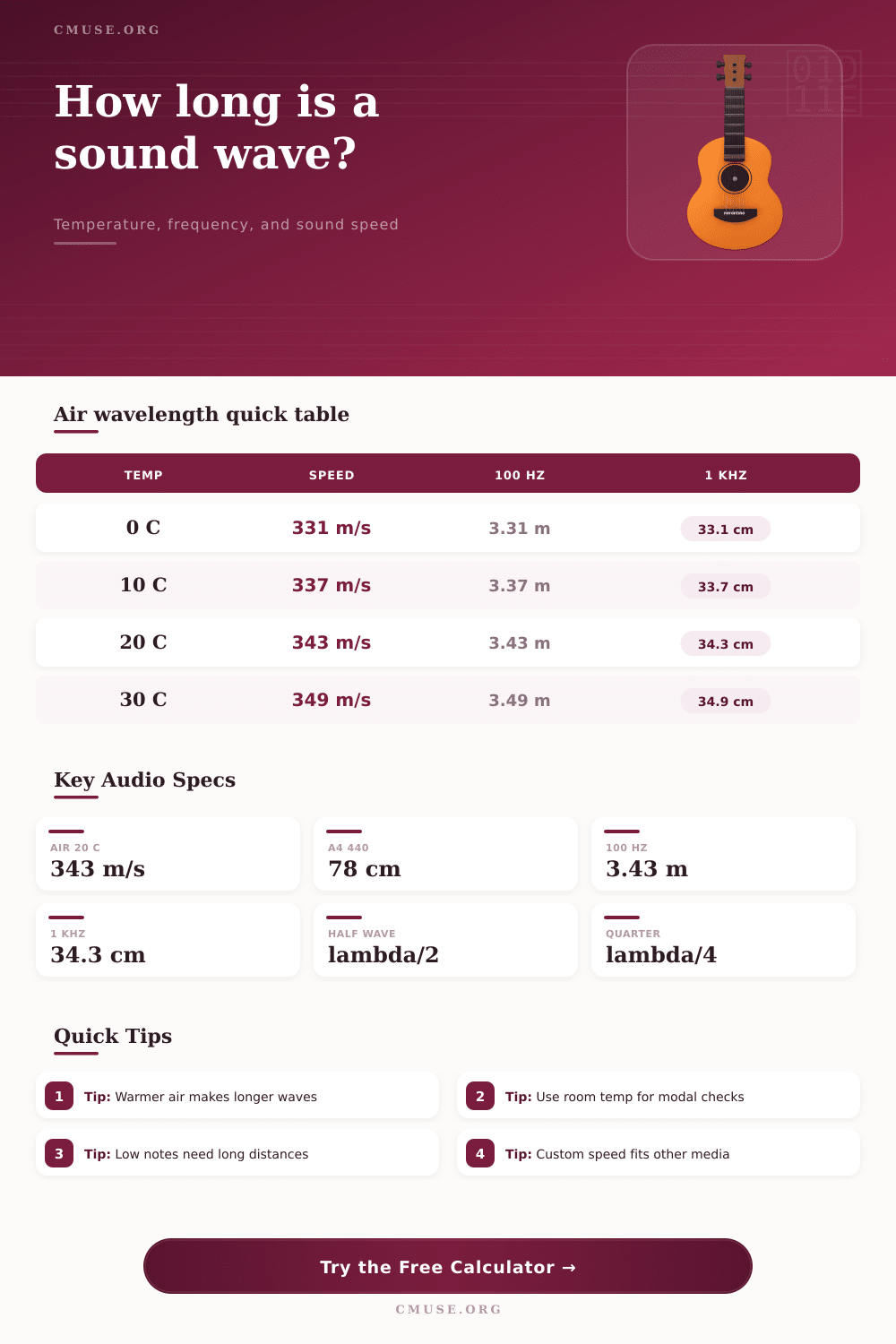
🌡 Air Temperature Reference
| Air Temperature | Sound Speed | 100 Hz Wavelength | 1 kHz Wavelength |
|---|---|---|---|
| 0°C / 32°F | 331.3 m/s / 1087 ft/s | 3.31 m / 10.87 ft | 33.1 cm / 13.0 in |
| 10°C / 50°F | 337.4 m/s / 1107 ft/s | 3.37 m / 11.07 ft | 33.7 cm / 13.3 in |
| 20°C / 68°F | 343.4 m/s / 1127 ft/s | 3.43 m / 11.27 ft | 34.3 cm / 13.5 in |
| 30°C / 86°F | 349.5 m/s / 1147 ft/s | 3.49 m / 11.47 ft | 34.9 cm / 13.8 in |
🎼 Musical Frequency Wavelengths at 20°C
| Reference | Frequency | Full Wavelength | Quarter Wavelength |
|---|---|---|---|
| Low E bass | 41.2 Hz | 8.33 m / 27.3 ft | 2.08 m / 6.83 ft |
| Kick fundamental | 60 Hz | 5.72 m / 18.8 ft | 1.43 m / 4.69 ft |
| A4 tuning note | 440 Hz | 78.0 cm / 30.7 in | 19.5 cm / 7.68 in |
| Presence tone | 3 kHz | 11.4 cm / 4.51 in | 2.86 cm / 1.13 in |
| Air band | 12 kHz | 2.86 cm / 1.13 in | 7.15 mm / 0.28 in |
📊 Medium Comparison Table
| Medium | Approx Sound Speed | 1 kHz Wavelength | Best Calculator Setting |
|---|---|---|---|
| Dry air at 20°C | 343 m/s | 34.3 cm | Air from temperature |
| Warm air at 30°C | 349 m/s | 34.9 cm | Air from temperature |
| Helium at 20°C | 1007 m/s | 1.01 m | Helium preset |
| Fresh water near 20°C | 1482 m/s | 1.48 m | Water reference |
| Measured duct or pipe | Varies | Use entered speed | Custom sound speed |
🎧 Room and Studio Distance Checks
| Distance | Half-Wave Frequency | Quarter-Wave Frequency | Useful Check |
|---|---|---|---|
| 0.5 m / 1.64 ft | 343 Hz | 172 Hz | Desk or speaker offset |
| 1.0 m / 3.28 ft | 172 Hz | 85.9 Hz | Near-wall bass spacing |
| 2.5 m / 8.20 ft | 68.7 Hz | 34.3 Hz | Small room dimension |
| 4.0 m / 13.1 ft | 42.9 Hz | 21.5 Hz | Control room length |
| 8.0 m / 26.2 ft | 21.5 Hz | 10.7 Hz | Stage or hall span |
Sound travels at different speed through the air based off the temperature, humidity, and pressure. Therefore, the length of the sound wave also change. A wavelength temperature calculator can calculate the physical distances of a sound wave based on the temperature, humidity, and air pressure inputs.
A wavelength temperature calculator allow individuals to see the length of the sound wave by entering the physical conditions of an environment in which the sound is traveling. Using this calculator is crucial to understanding how temperature affect the length of the sound wave. The three main input for a wavelength temperature calculator are the temperature, humidity, and air pressure in the environment.
How Temperature, Humidity and Air Pressure Change the Wavelength of Sound
The temperature is the most crucial input because warmer air allow sound to travel faster. Humidity has a second-highest input because adding moisture to the air increase the speed of sound. The third input is air pressure because altering the pressure of the air change the density of the air.
This parameter can also change the medium of sound movement to alternatives to air, such as helium or water. The frequency input is the measurement of the note of sound that will be calculated. It determine the number of cycles of the sound wave that occur in a given period of time.
The wavelength temperature calculator display the length of the sound wave in four different way. The full wavelength measures the distance from one peak of the sound wave to the next. The half-wavelength measurement calculates the distance from one peak to a trough of the sound wave.
This parameter help to identify standing waves that exist between two reflecting surface within the environment. The quarter-wavelength of the sound wave is used to calculate the phase relationship between two sound waves. By understanding how quick a sound wave can reflect off of a surface, sound engineers can avoid sound cancellation at the microphone.
The period of the sound wave calculate the time it take for one complete cycle of the sound wave. These sound wavelength measurements is crucial in understanding how sound behaves within the room where it is played. The wavelength of low frequencies can be many meter in length, which can cause those sound waves to reflect off the walls in the room.
These reflections can cause bumps or dips in the sound that is played within the room. The wavelength of sound waves has to be measured careful. If the wavelength of a sound wave match the distance between two walls, it can create a standing wave that reflect back on itself.
Higher frequencies has shorter wavelengths and are more affected by small objects in the environment. Sound engineers must use the wavelength temperature calculator to understand these relationship in order to make sound-modifying decisions about the room. It is essential to understand that the temperature of the environment will have a direct impact on the length of the sound wave.
This is true of most sound studios, outdoor festival, and live music stages. By changing the temperature of the air by a few degree, the wavelength of the bass frequencies will change. This change in the wavelength of the sound waves will also change the modal frequency of the room.
The modal frequency can make a corner of the room sound boomy or make a null point of the room move into a spot where listeners sits. These engineers can use the wavelength temperature calculator to calculate the same frequency at different temperature within the room. This will allow them to understand how the sound will change as the room change in temperature.
By choosing a different medium of sound travel within the calculator, different medium like helium or water can be used. Helium will increase the speed of sound within the environment. Therefore, sound will travel faster in helium then in air.
The same is true of water; the speed of sound will be increased in water, causing the wavelengths to become more longer than in the air. Engineers can use the wavelength temperature calculator to compare the behavior of a specific frequency in warm air versus in water. The wavelength temperature calculator will allow engineers to make sound decisions about sound system layouts.
If the longest dimension of a room can be entered into the wavelength temperature calculator, engineers can calculate the number of half wavelength that will fit within the longest dimension of the room. If the number of half wavelength is known, axial mode within the room can be identified. Furthermore, if the distance that sound will travel in the room is divided by the quarter wavelength, engineers can find where a sound null or peak will be create in the area.
These calculations are an approximation of the acoustic property of a room but do follow the law of physics. As sound engineers enter new projects into a studio, the wavelength temperature calculator will assist them. A vocal booth that work for an individual at room temperature may not work at a different temperature.
Furthermore, the placement of microphones in relation to the vocalists will work at one frequency but not at another. Engineers should of use a wavelength temperature calculator every time they enter a new project and environment. Using the wavelength temperature calculator will remove the guesswork and provide sound engineers with an understanding of how sound within a specific area will behave.