🔊 Sound Travel Time Calculator
Calculate how long sound takes to travel any distance — in air, water, or solid materials
| Temp (°C) | Temp (°F) | Speed (m/s) | Speed (ft/s) | Speed (mph) | ms per 1 meter |
|---|---|---|---|---|---|
| -20°C | -4°F | 319 | 1047 | 714 | 3.14 ms |
| -10°C | 14°F | 325 | 1066 | 727 | 3.08 ms |
| 0°C | 32°F | 331 | 1086 | 740 | 3.02 ms |
| 10°C | 50°F | 337 | 1106 | 754 | 2.97 ms |
| 15°C | 59°F | 340 | 1115 | 760 | 2.94 ms |
| 20°C | 68°F | 343 | 1125 | 767 | 2.91 ms |
| 25°C | 77°F | 346 | 1135 | 774 | 2.89 ms |
| 30°C | 86°F | 349 | 1145 | 781 | 2.87 ms |
| 35°C | 95°F | 352 | 1155 | 787 | 2.84 ms |
| 40°C | 104°F | 355 | 1164 | 794 | 2.82 ms |
| Distance | Distance (m) | Time (ms) | Time (sec) | Echo Possible? | Real-World Example |
|---|---|---|---|---|---|
| 1 ft / 0.3 m | 0.3 m | 0.87 ms | 0.00087 s | No | Near speaker |
| 3.3 ft / 1 m | 1 m | 2.91 ms | 0.0029 s | No | Studio monitor |
| 10 ft / 3 m | 3 m | 8.75 ms | 0.0088 s | No | Small room |
| 33 ft / 10 m | 10 m | 29.15 ms | 0.029 s | No | PA stack delay |
| 56 ft / 17 m | 17 m | 49.6 ms | 0.050 s | Barely | Echo threshold |
| 100 ft / 30 m | 30 m | 87.5 ms | 0.088 s | Yes | Concert hall |
| 328 ft / 100 m | 100 m | 291.5 ms | 0.29 s | Yes | Stadium |
| 1640 ft / 500 m | 500 m | 1458 ms | 1.46 s | Yes | Open field |
| 1 mile / 1609 m | 1609 m | 4693 ms | 4.69 s | Yes | Thunder rule |
| 1 km / 1000 m | 1000 m | 2915 ms | 2.92 s | Yes | Long distance |
| Application | Typical Distance | Delay Time | Notes |
|---|---|---|---|
| Studio Near-Field Monitor | 1–2 m | 3–6 ms | Negligible latency |
| Stage Monitor to Performer | 1–3 m | 3–9 ms | Minimal correction needed |
| Front-of-House PA | 15–30 m | 44–87 ms | Delay compensation advised |
| Delay Speaker Stack | 30–60 m | 87–175 ms | Must sync to main system |
| Line Array Full Concert | 50–100 m | 146–292 ms | Digital delay correction required |
| Stadium Rear Fill | 100–200 m | 292–583 ms | Significant delay compensation |
| Outdoor Festival Stage | 50–150 m | 146–437 ms | Weather affects timing |
| Recording Room Reflection | 3–8 m | 9–23 ms | Pre-echo / slap-back range |
| Material | Speed (m/s) | Speed (ft/s) | ms per meter | Category |
|---|---|---|---|---|
| Air (0°C) | 331 | 1086 | 3.02 | Gas |
| Air (20°C) | 343 | 1125 | 2.91 | Gas |
| Air (35°C) | 352 | 1155 | 2.84 | Gas |
| Fresh Water (25°C) | 1480 | 4856 | 0.676 | Liquid |
| Sea Water (25°C) | 1531 | 5023 | 0.653 | Liquid |
| Rubber | 100 | 328 | 10.0 | Solid |
| Wood (Oak) | 3850 | 12631 | 0.260 | Solid |
| Concrete | 3200 | 10499 | 0.313 | Solid |
| Glass | 5640 | 18504 | 0.177 | Solid |
| Aluminum | 6420 | 21063 | 0.156 | Solid |
| Steel | 5960 | 19554 | 0.168 | Solid |
| Copper | 4760 | 15617 | 0.210 | Solid |
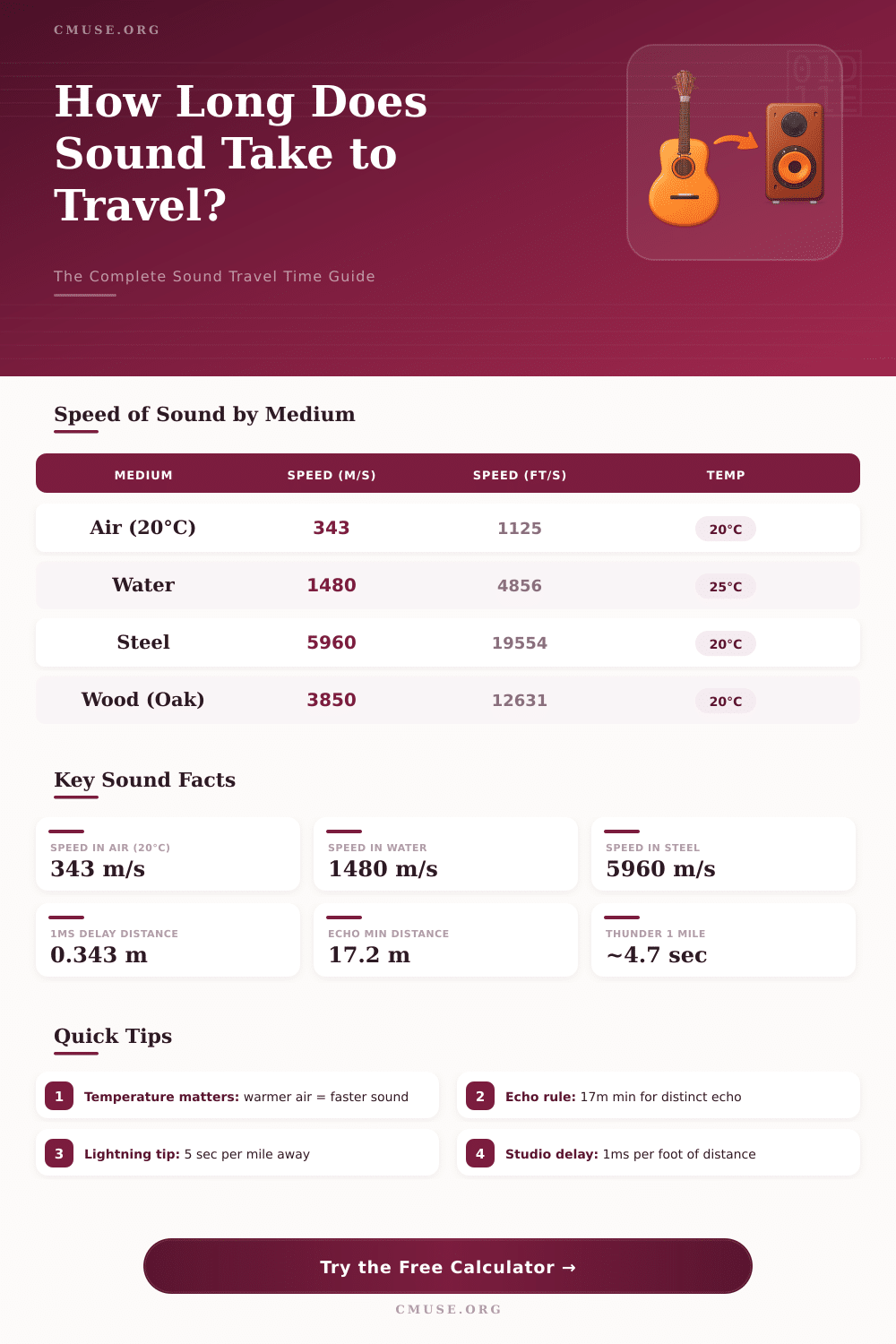
Sound waves move through the air at around 343 metres each second, when the temperature is around room. Here another way think about that: it matches to 1 125 feet each second, or almost 767 miles each hour. In kilometers, sound covers one of them in about 2,9 seconds.
For one mile it takes a bit more time… Around 4,69 seconds.
How fast sound travels and what changes it
Here the practical method, that all use. At about 1 100 feet each second in air, five seconds are enough to cover almost one mile, because the clock marks only above 5 000 feet. Hence the calculation between lightning and thunedr operates like this well in everyday life…
The math always counts.
Now about the conditions, that change causes. In dry air at cool cold of 0 degrees Celsius, sound moves at 331 metres each second. The temperature has a really big role here.
The sound travel time depends on what happens outside. But one thing does not affect it: the frequency. High and low notes travel at same speed, which surprises many folks.
When frequency rises, the wavelength shrinks, but the pace stays same. It also happens with the volume, loud sounds go through air just as quickly as a murmur in normal cases.
In water everything is totally different. Sound waves travel at around 1 500 metres each second in sea water. That is like thirty football fields long, that ends in only one second.
In solids it is even faster, because particles are packed more tightly, so sound has more material too work with.
Here the interesting part, on the other hand. Light waves make sounds seem like standing in place. Light travels millions of times more quickly than sound.
To show: sound covers three and a half football fields each second, which is around 50 percent more quickly than a Boeing 747 flying at around 250 metres each second. And even so, it still is beaten by the light.
If you want to no, how much time sound needs to reach a certain place? Simply divide the distance by the speed of sound. The same logic counts for speakers in home cinema.
Say, your television is 34 metres away in a big room with good sound, it needs 0,1 second to arrive, and your brain will not notice any delay atthat distance.
Here a wild example. If sound could somehow fly from the Earth to the Moon through air without stopping, it would need around 13 days. The Moon is about 384 millions of metres away, so the calculation gives around 1,1 million of seconds.
Low frequencies have a better way to go far than high. High waves bounce off objects more easily, hence bass sounds go further than sharp ones. Those short wavelengths bounce and bend around the place.