Sound Pressure Level Calculator
Estimate listener SPL from a measured source level or from speaker sensitivity, amplifier power, distance loss, source count, air absorption, placement, and room behavior.
🎧Named SPL Presets
📏SPL Inputs
Distance Projection From This Setup
| Distance | Projected SPL | Target Margin | Use Meaning |
|---|
📊SPL Constants and Source Specs
📐Reference Tables
| Distance Ratio | Free-Field Change | Example | Planning Use |
|---|---|---|---|
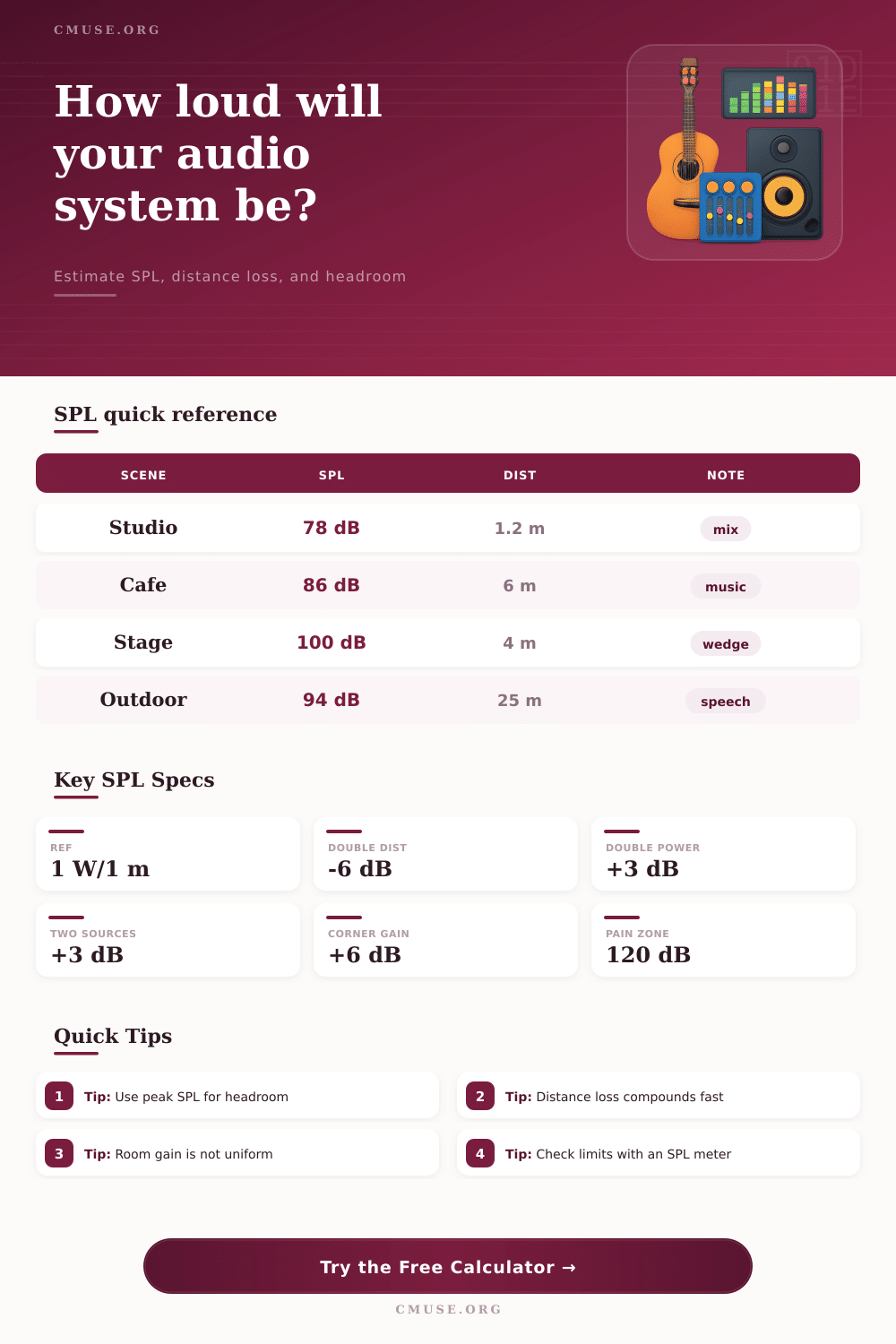
| 0.5x distance | +6 dB | 4 m to 2 m | Closer monitors feel much louder without more power. |
| 1x distance | 0 dB | same point | Reference distance for comparing setups. |
| 2x distance | -6 dB | 2 m to 4 m | Standard inverse-square rule for point sources. |
| 4x distance | -12 dB | 2 m to 8 m | Venue throws need more source level or coverage planning. |
| SPL Range | Common Audio Context | Planning Note | Headroom Thought |
|---|---|---|---|
| 70-80 dB | quiet editing, speech checks | Comfortable for long work sessions. | Leave room for transients. |
| 80-90 dB | mixing, hi-fi listening, cafe music | Useful range for tonal balance checks. | Peaks may be 10-20 dB higher. |
| 90-105 dB | rehearsal, stage fill, small PA | Verify exposure and feedback limits. | Use clean amplifier headroom. |
| 105-120 dB | concert peaks, drums, loud monitoring | Short duration planning only. | Meter the actual position. |
| Adjustment | Approx dB | When It Applies | Caution |
|---|---|---|---|
| Wall loading | +3 dB | Speaker near a broad boundary. | Can change tonal balance. |
| Corner loading | +6 dB | Two or three boundary planes support output. | Bass buildup may dominate. |
| Reflective hall | +2 to +5 dB | Late reflections raise average level. | Clarity may fall as level rises. |
| Dry outdoor throw | -0.01 to -0.05 dB/m | High-frequency energy over distance. | Weather changes the result. |
| Preset Scenario | Primary Inputs | Expected Focus | Best Check |
|---|---|---|---|
| Nearfield Mix | 88 dB sensitivity, 35 W, 1.2 m | Comfortable monitoring with stereo summing. | Calibrate pink noise at the chair. |
| Stage Wedge | 98 dB sensitivity, 250 W, 3 m | Vocal monitoring before feedback. | Check mic gain before adding watts. |
| Cafe PA | 94 dB at 1 m, 8 m throw | Music coverage without overpowering tables. | Measure farthest seat and front row. |
| Outdoor Speech | 99 dB at 1 m, 25 m throw | Free-field projection with air loss. | Walk the audience area with meter. |
Sound pressure level is a measurement of the pressure that a sound wave exerts on air and on you’re ears. Sound pressure level is an important parameter that relates to the setup of monitor speakers in a recording studio and the placement of speakers in a performance venue. Additionally, sound pressure level is a parameter that help to determine the size of a line array for loudspeaters.
Since sound pressure level can change based on a variety of factors, it isnt possible to rely upon a single measurement of sound pressure level. Therefore, it is useful to use a calculator to project sound pressure level from a reference point to the listening position. The various inputs that are required to calculate sound pressure level represent the physical realities of the sound field.
How to Calculate Sound Pressure Level and What Affects It
For example, one of the parameters is the sensitivity of the speaker, which is a measurement of the sound pressure that the speaker driver creates at one watt when the driver is one meter from the listener. Another parameter is amplifier power, which is a factor that impacts the sensitivity of the speaker. The relationship between power and sound pressure level is logarithmic, meaning that increasing the amplifier power will not result in an equivalent increase in sound pressure level of the speaker.
For example, if you double the amplifier power, the sound pressure level will increase by only a small amount. Distance is another input that is a critical factor in the projection of sound pressure level. Sound spreads out in three dimensions.
Therefore, if the distance between the sound source and the listener is doubled, the sound pressure level will drop six decibels. This parameter can be increased to account for the sound reflecting off of the boundaries of the listening room. Sound pressure level will be different if the speaker is placed in the middle of the room compared to against a wall.
Another input is the number of sound sources. For instance, using two identical loudspeakers to play the same material from the same location will not double the sound pressure level. For sound sources that are not coherently stacked, the sound pressure level will increase by three decibels if the number of sound sources is doubled.
Coherently stacked loudspeakers will reach higher sound pressure levels, but only within certain frequency ranges. Additionally, the sound pressure level that is measured in a real room can vary from the modeled sound pressure level due to the complex nature of the room. Atmospheric absorption is another parameter that the sound pressure level calculator can model.
High-frequency sound energy can be lost to the air. Additionally, the farther the sound travels, the more the sound energy is lost due to the air becoming drier and the frequency of the sound increasing. Using a coefficient in the calculation, it is possible to project at what distance the high frequencies will reach.
The first estimate of the loss of high frequencies can be modeled with the sound pressure level calculator. However, the sound pressure level calculator is not a replacement for a site survey of the area in which the sound is to be played. The sound pressure level calculator will provide information regarding the sound pressure level at the listening position.
Additionally, the calculation will reveal the sound pressure level at the sound source, the sound pressure level lost due to distance between the sound source and the listener, and the margin that exists between the sound pressure level and the limit of the venue or the system. These outputs will be meaningful only if the parameters of the calculation are related to the situation to be modeled. Many people make mistakes when calculating sound pressure level.
For instance, people often misread the sensitivity of loudspeakers as the sound pressure level that will be delivered to the listening position at the speaker’s position. Such a calculation dont account for distance between the loudspeaker and the listener. Another mistake is to assume that if the amplifier power is doubled, the sound pressure level will double as well.
However, the relationship between power and sound pressure level is logarithmic. Therefore, doubling the amplifier power results in only a small increase in sound pressure level. Additionally, people often do not account for the interaction of the sound from two loudspeakers.
This can result in sound pressure levels at the listening position that is too low or too high. The sound pressure level calculator allows people to envision these potential problems prior to installing the loudspeakers in their intended positions. There are other variables in the physical world that are not accounted for in the sound pressure level calculation.
For instance, temperature gradients will refract sound. Additionally, the number of people in the room will change the amount of sound that is absorbed by the room. Stage monitors will also interact with the microphones in different ways depending on the angles of the monitors and the equalization settings of the monitors.
These variables are not accounted for in the sound pressure level calculation. Therefore, it is best to use the sound pressure level calculation as a planning tool. Once the loudspeakers are installed in the desired positions, you must measure the sound pressure level at the listening positions with a calibrated meter.
The sound pressure level calculator is a useful tool because it can help people to pose questions regarding the sound system that will be used in the venue. For instance, if a sound pressure level of X decibels is required at a seat in the venue, the sound pressure level calculator can help to answer the question: can the current equipment reach that sound pressure level? The sound pressure level calculation will help to provide the answer.
If the equipment cannot reach the sound pressure level, then it will be known that different equipment will be required. Additionally, the calculation simplifies the task of calculating sound pressure level because it eliminates the need for the user to memorize the mathematical equations that can be used to calculate sound pressure level. You should of used a calculator more often to make things easier.
It is actualy alot more efficient.