SEL Calculator
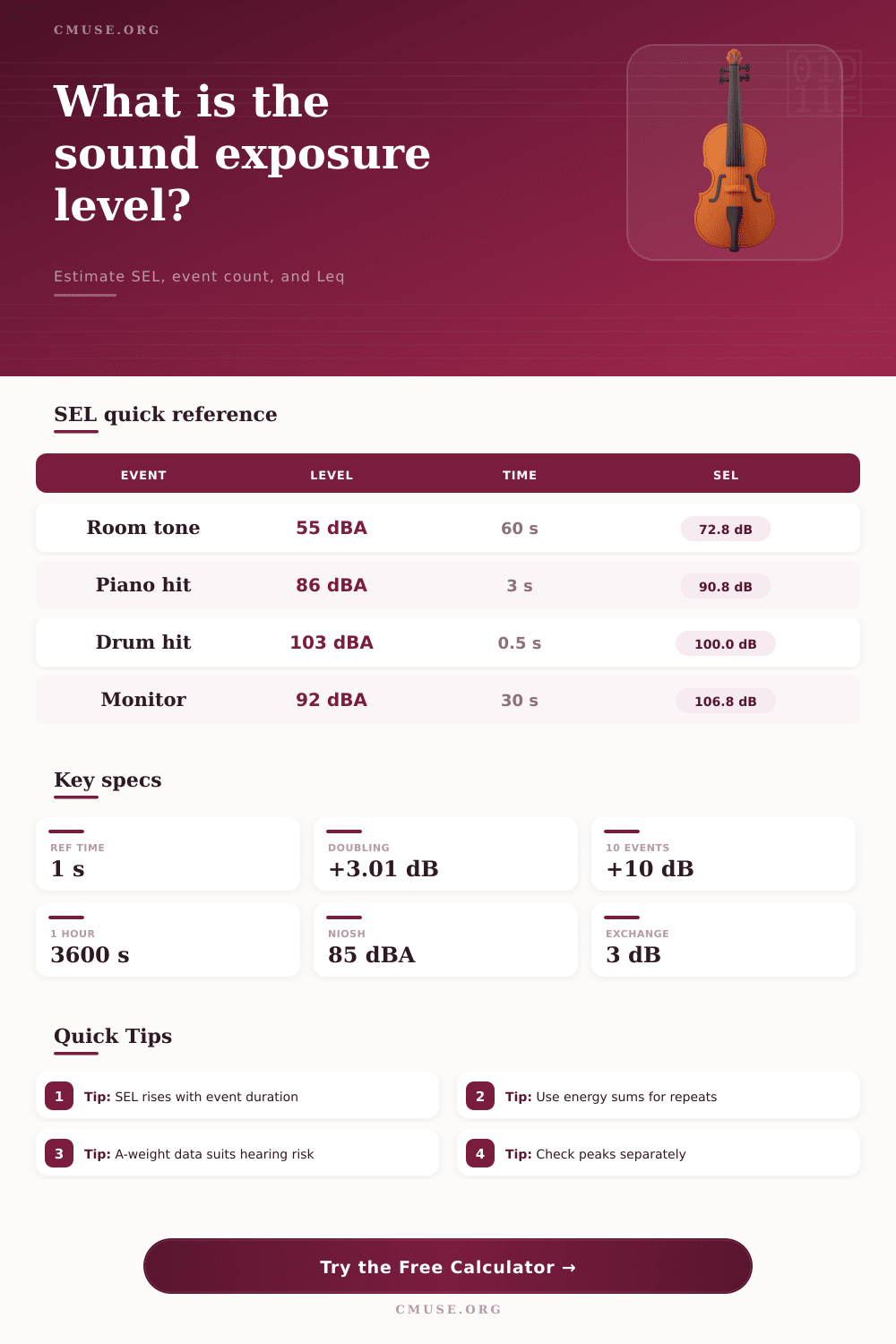
Convert measured level, event duration, and repetitions into sound exposure level, cumulative SEL, and equivalent listening exposure.
🎵Fast Music And Audio Presets
🔊Sound Exposure Inputs
📐Core SEL Reference Grid
📊SEL Formula Table
| Calculation | Formula | Use It For | Audio Example |
|---|---|---|---|
| Single event SEL | SEL = LAeq,T + 10 log10(T/1 s) | One take, one hit, one cue | Snare hit or vocal phrase |
| Repeated event CSEL | CSEL = SEL + 10 log10(N) | Identical repeated sounds | Drum strokes or claps |
| Energy sum | 10 log10(sum 10^(SELi/10)) | Different events together | Piano chord plus monitor check |
| Equivalent level | Leq = CSEL - 10 log10(window s) | Convert SEL into time average | One-hour room exposure |
| Event duration | T = 10^((SEL - LAeq)/10) | Back-solve sound length | Metered transient audit |
🎧Common Audio Event Benchmarks
| Scenario | Typical LAeq | Duration | Approx SEL |
|---|---|---|---|
| Quiet control room tone | 45 to 55 dBA | 60 s | 63 to 73 dB |
| Vocal booth phrase | 78 to 88 dBA | 12 s | 89 to 99 dB |
| Grand piano chord | 82 to 92 dBA | 3 s | 87 to 97 dB |
| Close snare transient | 100 to 112 dBA | 0.2 s | 93 to 105 dB |
| Stage monitor check | 90 to 100 dBA | 30 s | 105 to 115 dB |
| DJ booth cueing | 95 to 105 dBA | 180 s | 117 to 128 dB |
🧮Event Count Addition Table
| Identical Events | Add To One SEL | Meaning | Example |
|---|---|---|---|
| 1 | +0.0 dB | Single event only | One cymbal crash |
| 2 | +3.0 dB | Double the energy | Two matched takes |
| 4 | +6.0 dB | Four times energy | Four snare accents |
| 10 | +10.0 dB | Ten times energy | Ten claps |
| 100 | +20.0 dB | Hundredfold energy | Practice repetitions |
| 1000 | +30.0 dB | Thousandfold energy | Long beat pattern |
🕒Equivalent Exposure Window Table
| Window | Seconds | Subtract From CSEL | Best Use |
|---|---|---|---|
| 1 minute | 60 | 17.8 dB | Short soundcheck |
| 5 minutes | 300 | 24.8 dB | Line check block |
| 15 minutes | 900 | 29.5 dB | Rehearsal excerpt |
| 1 hour | 3600 | 35.6 dB | Studio session |
| 8 hours | 28800 | 44.6 dB | Workday comparison |
💡Practical SEL Notes
- Use A-weighted measurements for hearing exposure comparisons and C/Z weighting for broader sound-system diagnostics.
- Peak SPL is a separate safety metric; SEL does not replace peak or limiter checks.
Sound exposure level, also known as SEL, are a measurement of the total acoustic energy of a sound event. This metric account for the intensity of the sound and the duration of that sound. Sound exposure level differs from sound pressure level measurements in that sound pressure level measurements reveal the average intensity of a sound event.
However, sound exposure level measurements reveal the total energy of a sound event as if it last for one second. By using sound exposure level, a person are able to compare two different sound events of different lengths to one another. The duration of a sound event is a critical element in the calculation of the sound exposure level of that sound event.
What Is Sound Exposure Level?
The longer a sound event continue, the more total acoustic energy that a listener will recieve in their ears. Thus, if the duration of a sound event double, the sound exposure level will also double in strength. Many people make the mistake of adding the decibel measurement of sound levels together, but a person should sum sound energy level to find the total sound energy of a sound event.
A person will encounter various sound events within a recording studio or on a stage setting. To find the total sound exposure that an individual was exposed to while in a recording or performance studio, it is also necessary to sum the sound exposure of each sound event. For instance, if a person records a vocal passage that lasts for twelve second or a piano passage of chords that last for a different length of time, it is necessary to find the sound exposure level of each sound separately.
After finding each individual sound exposure level, they can be summed to find the total sound energy exposure of the session. Furthermore, it is also necessary to consider the total elapsed time of the sound session. This time will impact the equivalent continuous sound level over a period of time, such as one hour.
In addition to calculating the sound exposure levels of various sound event, a person should also consider the measurement uncertainty and the choice of weightings for those sound measurements. It is common for sound engineer and mixing technicians to add a buffer of two decibels to the sound exposure level measurement to account for the possibility of uncertainty in sound measurements created by the placement of the microphone and the acoustics of the room. Additionally, various weightings can be utilized to calculate sound energy; A-weighting is the most common of these choice because it mimics the way that human hearing perceives sound level.
Other weightings, such as C-weighting or Z-weighting are used if the goal is to weight the sound measurements towards low-frequency sound. Finally, various safety organization will use different exchange rates in their sound energy calculations. Thus, it is also necessary for a person to be aware of whether they are calculating sound energy according to the rules establish by NIOSH or OSHA.
There are a few mistake that a person may make when calculating the sound exposure level of a sound event. One of the most common mistake is to forget that sound energy exposure level are standardized to one-second sound duration. Thus, a short sound event can have a high sound energy level, but a longer sound event with a lower intensity will have a lower sound energy level.
The second mistake that a person may make is to forget the difference between the time that a sound is actually playing versus the total elapsed time of the session. While total elapsed time will impact the average sound level that is played during a session, it will not impact the total acoustic energy that is emitted into the ears of the listener. Finally, people also may not consider that sound energy levels do not measure instantaneous sound level; peak sound energy levels must be calculated separate from sound energy measurements to ensure that loud sound during a session dont harm the ears of the listener.
Sound exposure levels are important in the recording industry and for anyone that perform music because loud noise are harmful to the ears. The ears are unable to recover from loud sound in the same way that other equipment can recover. Thus, even short sound session may emit high amount of acoustic energy into the ears.
By measuring the sound energy level of each performance or recording session, ears can be managed to contain the acoustic energy that enters the ears throughout the day. Therefore, sound energy levels allow a person to understand the total exposure to loud noise and to make decision regarding the necessary reduction in the level of noise in the environment.