Songwriter Split Sheet Calculator
Draft a composition split sheet by separating lyric contribution, music contribution, producer writer share, publisher share, administration share, and each participant allocation before the song leaves the room.
Load a named writing-room scenario, then revise the lyric, music, producer, publisher, and admin fields. This is a planning calculator for composition splits, not a legal contract.
Enter contribution weights for lyric and music separately. Producer writer weights are used only when the reserved producer pool is above zero.
| Participant | Role | Affiliation | Lyric weight % | Music weight % | Producer weight % | Publisher split % |
|---|---|---|---|---|---|---|
Split Sheet Breakdown
| Participant | Role | Composition | Writer side | Publisher side | Royalty example |
|---|
Composition total
Common side split
Admin range
Master rights
| Pattern | Typical use | Lyric pool | Music pool | Producer writer share |
|---|---|---|---|---|
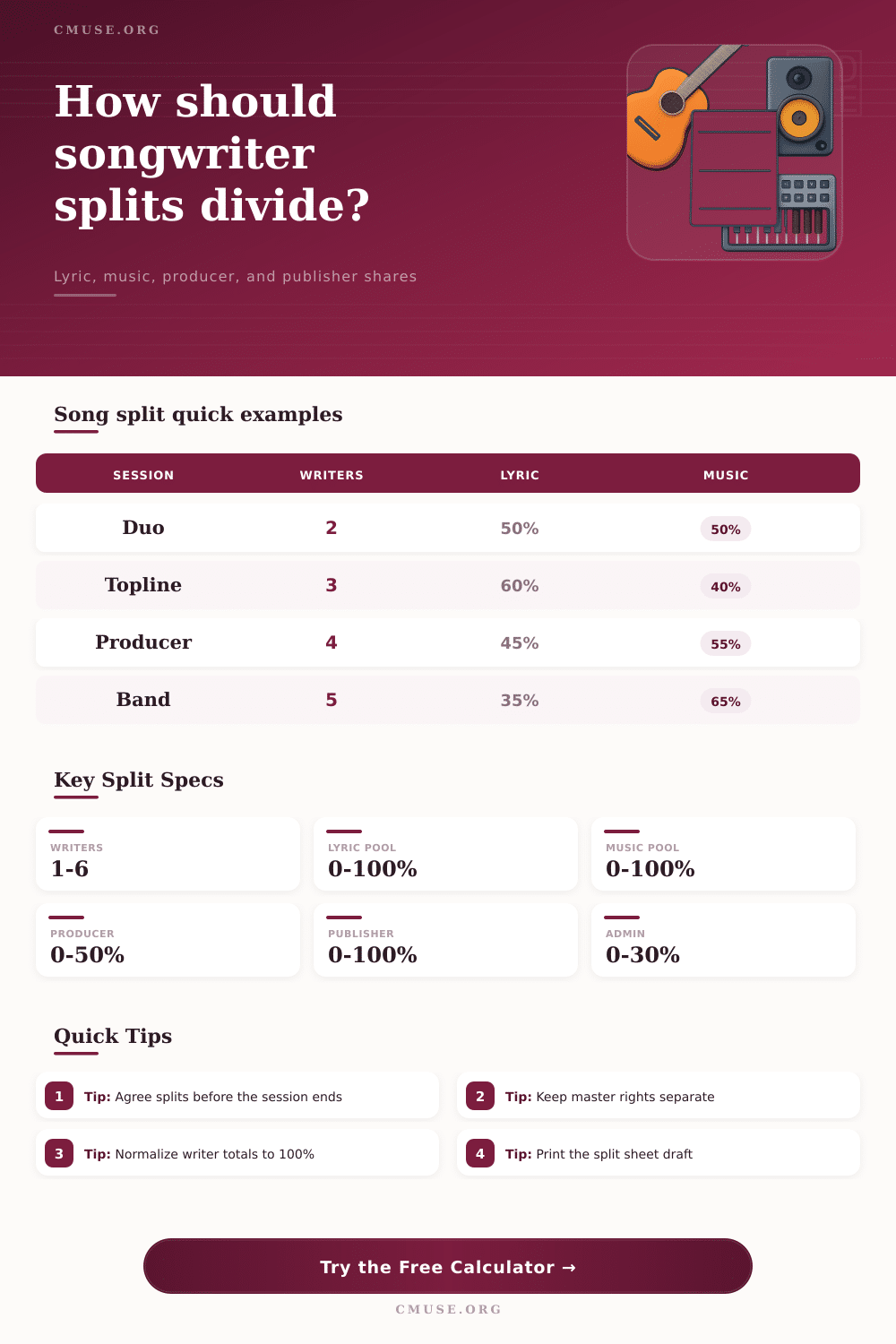
| Equal room | Everyone shaped the complete song together. | 50% | 50% | 0% unless agreed |
| Topline and track | Vocal melody and lyrics are written over an existing instrumental. | 60% | 40% | Often inside music pool |
| Producer writer | Producer contributes beat, chords, hook structure, or melody. | 45% | 55% | 5% to 25% |
| Band arrangement | Band members build parts that materially change the song. | 35% | 65% | Usually none |
| Sample or interpolation | Prior composition receives a carved-out share. | Varies | Varies | Set by clearance |
| Publishing setup | Writer side | Publisher side | Admin effect | Registration note |
|---|---|---|---|---|
| Self-published writer | Writer keeps writer share. | Writer controls publisher share. | 0% if no admin deal. | List writer and self-publisher consistently. |
| Traditional publisher | Writer share remains with writer. | Publisher controls its contracted share. | Not usually called admin. | Confirm publishing entity and PRO IPI. |
| Admin publisher | Writer owns composition share. | Admin collects publisher income. | Often 10% to 25% of publisher side. | Useful for collection without assignment. |
| Co-publishing | Writer share plus negotiated publisher interest. | Publisher share may be shared. | Admin may apply to controlled portion. | Model only the shares in the agreement. |
| Catalog participant | Prior writer share may be fixed. | Publisher share follows clearance. | Depends on clearance language. | Sample and interpolation terms can override drafts. |
| Preset | Participants | Lyric/Music | Producer pool | Publisher/Admin |
|---|
| Field | Why it matters | Calculator use | Common check |
|---|---|---|---|
| Legal name | Identifies each songwriter clearly. | Participant label. | Match PRO and publisher records. |
| IPI or CAE number | Helps societies route royalties. | Affiliation field can hold a reference. | Do not guess missing numbers. |
| Composition share | Sets ownership of the song. | Calculated from lyric, music, and producer weights. | Total should equal 100%. |
| Publisher share | Separates writer and publisher sides. | Creates publisher-side allocation. | Confirm admin or publisher entity. |
| Master ownership | Covers the recording, not the work. | Excluded from math. | Use a separate master agreement. |
Songwriting occurs in layers and many peoples contribute to a song. One person may contribute a chord progression, another person may contribute a drum loop, but a third person may contribute a bridge to a song. Because songwriting involve so many different parts to a completed song, songwriting involves many different contributors to that song.
Thus, when a songwriting session is over, there are many contributors to that song, but it is difficult to assign percentages to each contributor to that song. To understand the percentage of contribution to songwriting, the lyric contributions have to be separated from the contributions made to the music of the song. Such contributions are not always equally.
How to Split Songwriting Credits
For instance, the person who produces the song and creates an instrumental may feel that they deserves a higher percentage of the song’s profits compared than the topliner who contributes a memorable melody and hook to the song. The separate calculations of the weight of each contributors contribution can be calculated with the song split calculator to determine the percentage of profits of each contributor. The most common split among contributor to songs is a fifty-fifty split.
However, what one group of songwriter may deem as a fifty-fifty split may not be the same split for another group of songwriter. For instance, a band who create their own songs may have a split that is different from a group wherein one artist contribute a vocal to a beat that another artist created. Each split can be tested in the split calculator to determine what split is most appropriately for the songwriter.
Some producers will want the writers credit to the song for the beat that they created, but others may want the producer to be compensate for the song on the master side of the song. Such a percentage can be created in the reserved producer pool wherein the percentage is removed from the total percentage of the song splits that is to be distributed to each contributor. The percentages distributed to the writers side of the song may include the percentage of publishing rights and the administration of those publishing rights.
Publishers may traditionally take half of the publishing rights to allocate to other companies to distribute and promote the song and the writers effort, but an administration deal may take only fifteen or twenty percent of the profits of the song. These percentages do not change the split of the total percentage of profits of the song, but they do change the amount of money that each contributor can earn from the song. The split calculator separates the gross percentage of profits from the net percentage to show the difference between the two.
By working with the percentages in advance, any songwriter can determine if any splits of profits are potentially unbalanced. If two songwriters feel that they contributed to the same portion of a song, the split calculator can reveal whether that portion of a song has such a high percentage of profits assign to it that it may become a point of contention between those two writers. Thus, while the split calculator does not solve the issue of who contributed what to the song, it does raise the issue so that it can be discussed while the songwriters still remember the session in which they contribute to the song.
The tables below the split calculator include common splits of profits among songwriter. For instance, a Nashville three-way split may give equal profits to three writers, but a film cue team may provide a higher percentage of profits to the music writer to the composer since the film itself dictate the music that is to be created. A sample interpolation split may provide a percentage of profits to the writer of the song who create the beat that has become popular and widely used before other contributors to the song are compensate for their efforts.
These splits are not rules or regulation of the songwriting split calculator, but they are common splits that the songwriter can reference when determining what split is appropriate for the session in which the song was created. The most difficult part of determining the split of profits for each contributor to a song is the subjective part of the split calculator. No split calculator program can determine who contributed what to a song.
Thus, the split calculator is only a draft of the split that will ultimately become the songs legal contract. Once the splits are determined, every contributor to the song should be asked if the percentages of profits reflect what they believe they contribute to the creation of the song. Any disagreement at this stage can be discussed prior to the work being registered and prior to the percentages of profits becoming difficult to change.
Thus, while the splits do not have to be perfect, they should be clear and each contributor should be satisfied with the clarity of the split.