Song Key Calculator
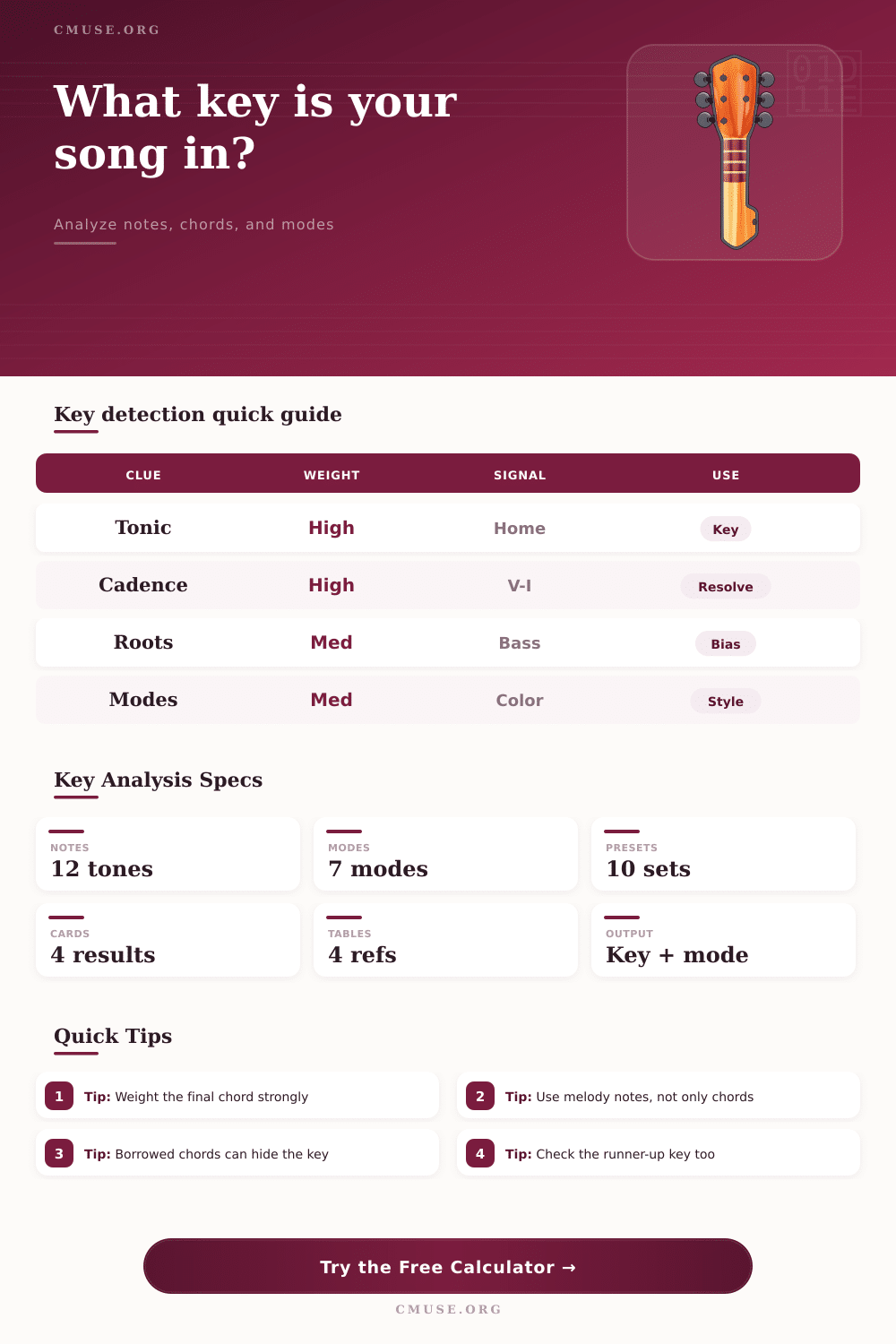
Estimate a song key from selected notes, chord progression, tonic emphasis, root movement, cadence strength, mode color, relative key, and borrowed chord tones.
🎵 Song And Progression Presets
Presets fill note choices, chords, cadence, final root, and scoring weights so you can see how the same pitch set can point to major, minor, or a mode.
♫ Notes And Chords
⚙ Scoring Weights
Key Analysis Result
The detected key will appear here after calculation.
📊 Analysis Spec Grid
🏆 Candidate Score Breakdown
| Rank | Key Candidate | Score | Mode Score | Why It Scored |
|---|---|---|---|---|
| 1 | C major | 0 | 0 | Calculate to compare notes, chords, roots, cadence, and borrowed tones. |
📘 Mode Signature Reference
| Mode | Formula | Signature Color | Common Chord Clue |
|---|---|---|---|
| Ionian / Major | 1 2 3 4 5 6 7 | Stable bright major | I, IV, V, vi |
| Aeolian / Minor | 1 2 b3 4 5 b6 b7 | Natural minor center | i, bVI, bVII |
| Dorian | 1 2 b3 4 5 6 b7 | Minor with raised 6 | i to IV vamp |
| Phrygian | 1 b2 b3 4 5 b6 b7 | Dark b2 pull | i to bII |
| Lydian | 1 2 3 #4 5 6 7 | Bright raised 4 | I to II or #iv |
| Mixolydian | 1 2 3 4 5 6 b7 | Major with b7 | I to bVII |
🔀 Cadence And Root Bias Table
| Cadence | Root Motion | Key Signal | Calculator Treatment |
|---|---|---|---|
| Authentic | V to I | Strong tonic lock | Highest cadence bonus |
| Plagal | IV to I | Warm finality | Medium cadence bonus |
| Modal | bVII to I | Mixolydian or rock color | Mode and cadence bonus |
| Jazz turnaround | ii to V to I | Major or minor resolution | Root chain bonus |
| Minor landing | bVI to bVII to i | Aeolian pull | Minor mode bonus |
🎹 Borrowed Chord Reference
| Borrowed Sound | Major Key Example | Outside Notes | Likely Source |
|---|---|---|---|
| Minor iv | C to Fm | Ab | Parallel minor |
| bVII major | C to Bb | Bb | Mixolydian or minor |
| bVI major | C to Ab | Ab, Eb | Parallel minor |
| bII major | C to Db | Db, Ab | Phrygian color |
| Major IV in minor | Am to D | F# | Dorian color |
📝 Example Progression Table
| Progression Type | Example | Likely Key | What To Check |
|---|---|---|---|
| Axis pop | C G Am F | C major / A minor | Final chord and melody home note |
| Minor loop | Am F C G | A minor / C major | Opening and landing chord weight |
| Blues | A7 D7 E7 | A mixolydian / blues | b7 notes and dominant roots |
| Dorian vamp | Dm G | D Dorian | Major IV chord in a minor center |
| Lydian color | C D C | C Lydian | Raised 4 from the II chord |
When songwriter encounter a song in the session, they must ask the question of what key the song is in. It can be dificult to determine what key a song is in due to the ways in which music can deviate from the standard musical rules. The chords may suggest that the song is in C, but if the melody is based on the A notes, and there are borrowed chord used in the song, the song may sound like it is in a minor key.
The key calculator can perform the mathematical calculations necessary to determine the key of the song the songwriter write. The key calculator makes it more easy for the songwriter to determine the key of their song without having to use the manual process of guessing the key of their song. For a tonal center to become solid within a song, there must be specific element included within that song.
How a Key Calculator Helps Songwriters
These elements includes the root notes used again and again throughout the song, cadences within the song, and the melody notes that land on the same pitch. If these three elements are all used within a composition, the listener will easily recognize the tonal center of that song. If any of these elements are not used, the tonal center will be more ambiguous to the listener.
The key calculator places more importance on the presence of these elements than the total number of notes played in a composition. A single chord that contains the root note will be weighted more highly than a series of melody notes that contain the root note. Thus, the key calculator’s use of these elements allows it to more accurately determine the key of the song that the songwriter write.
The complexities of modes can make it difficult to identify the key of a composition. Modes change the perception of the notes that are used within a song. For instance, a Dorian mode contains the same notes as a natural minor mode but includes a raised sixth note that prevents the song from feeling like it is in a natural minor key.
A Mixolydian mode contains the same notes as a major key but includes a bVII chord within that mode. Using these definitions of the different modes, the key calculator can test all seven mode against the song that a songwriter write to determine in what mode their composition favors. Borrowed chords present a challenge for many songwriter.
Using borrowed chords from the relative minor of a song may add color to a progression but does not mean that the song has changed keys. For instance, using an F minor chord within a key of C does not mean that the song has changed keys because that chord is borrowed from the parallel minor key. A songwriter may use borrowed chords as a decorative element or as a structural element within their song.
The key calculator can highlight any outside tones within a composition to help the songwriter decide whether borrowed chords are used as a decorative element or a structural element within their song. The complexities of relative keys can make it difficult to determine the key of a song. Relative keys contain the same notes but have different tonic.
For instance, C and A contains the same notes but differ in their tonic notes. If a melody does not land on the tonic notes of the chords used in the song, then the home note of the melody and the final chord of the song will determine the relative key of the song. If the melody resolves to the A note while the song use chords in the C key, the listener will understand that the song is in the key of A minor.
The key calculator can identify the relative key of a song to assist the songwriter in understanding the key of their composition without having to perform mental math to determine that relative key. Many songs dont adhere to the rules of music theory. The key calculator has preset progressions so that a songwriter can understand how songs that do not adhere to the rules of music theory can still have an identifiable key.
For instance, a song that contains a I-V-vi-IV progression may be in a major key or a relative minor key depending on the melody of the song. A twelve-bar blues progression will contain dominant seventh chord that are outside the major key progression but still have an identifiable key for the listener to understand. Another use of the key calculator is for songwriters who want to change the key of their song.
If the key calculator identifies that two keys are close in ranking, a songwriter has a choice of which key to use. They could choose to use the relative minor key to create a darker song, or they could choose the major key to create a brighter song for listeners. By using the key calculator, songwriters can make these decisions visible to them in numbers instead of having to rely on their musical intuition to make these choices.
However, the key calculator cannot identify the emotion a songwriter was feeling when writing the song. Additionally, the key calculator cannot take into account the songwriter’s production and performance decisions. For instance, a songwriter may write a song that contains a progression of chords that suggests a key of C major.
However, if the vocalist avoids the root note of the chords, the listener may feel that the progression is unsettled. While a key calculator can provide a songwriter with a map of their song’s musical structure, the songwriter should of make a decision of how to use that map.