Slash Chord Calculator
Spell a slash chord, identify whether the bass is an inversion tone or an outside color, and generate practical piano or guitar voicing notes.
Preset use: Load a familiar inversion, walkdown, pedal bass, or pop-gospel color, then adjust the root, chord type, slash bass, key context, and voicing range.
Calculation Breakdown
| Bass Relation | Interval From Root | Common Name | Typical Sound |
|---|---|---|---|
| Root | Unison or octave | Root position | Stable, direct, grounded chord identity |
| Third | Minor 3rd or major 3rd | First inversion | Smoother bass motion, less final than root position |
| Fifth | Perfect 5th or diminished 5th | Second inversion | Suspended or cadential, often needs resolution |
| Seventh | Minor 7th or major 7th | Third inversion | Colorful pull, common in dominant and jazz harmony |
| Non-chord | 2nd, 4th, 6th, chromatic tone | Pedal, passing, or hybrid slash chord | Modern color, bass-line design, or suspended harmony |
| Quality | Formula From Root | C Example | Useful Slash Bass Notes |
|---|---|---|---|
| Major triad | 1, 3, 5 | C, E, G | 3rd for first inversion, 5th for second inversion |
| Minor triad | 1, b3, 5 | C, Eb, G | b3 for first inversion, 5th for second inversion |
| Dominant 7 | 1, 3, 5, b7 | C, E, G, Bb | b7 for bluesy third inversion or stepwise bass |
| Major 7 | 1, 3, 5, 7 | C, E, G, B | 7th creates a soft leading-tone bass color |
| Sus4 | 1, 4, 5 | C, F, G | 4th or 5th can make a suspended bass shape |
| Add9 | 1, 3, 5, 9 | C, E, G, D | 9th in bass reads as a compound color |
| Type | What To Check | Example | Best Musical Use |
|---|---|---|---|
| True inversion | Bass note is already in the chord tones | C/E or G/B | Connecting chords with smooth bass-line motion |
| Third inversion seventh chord | Bass note is the seventh of a seventh chord | G7/F | Dominant pull, blues, jazz, and gospel movement |
| Pedal bass slash chord | Same bass holds under changing upper chords | F/G to C/G | Suspense, worship pads, cinematic builds |
| Passing bass chord | Bass fills a step between two chord roots | D/F# to G | Pop, folk, musical theater, and ballad walk-ups |
| Hybrid color | Bass is outside the chord and reshapes the harmony | C/D or Bb/C | Modern dominant sus colors and modal harmony |
| Slash Chord | Chord Tones Above Bass | Bass Function | Common Context |
|---|---|---|---|
| C/E | C, E, G over E | Major 3rd, first inversion | Moving from F to G or C to F smoothly |
| G/B | G, B, D over B | Major 3rd, first inversion | Strong approach into C or Am in C major |
| D/F# | D, F#, A over F# | Major 3rd, first inversion | Classic walk-up into G in folk and pop |
| Am/G | A, C, E over G | Minor 7th color | Natural minor walkdown and singer-songwriter harmony |
| C/Bb | C, E, G over Bb | Flat 7 color | Dominant-like blues or rock color without spelling C7 |
| G7/F | G, B, D, F over F | Flat 7, third inversion | Dominant resolution toward C or C/E |
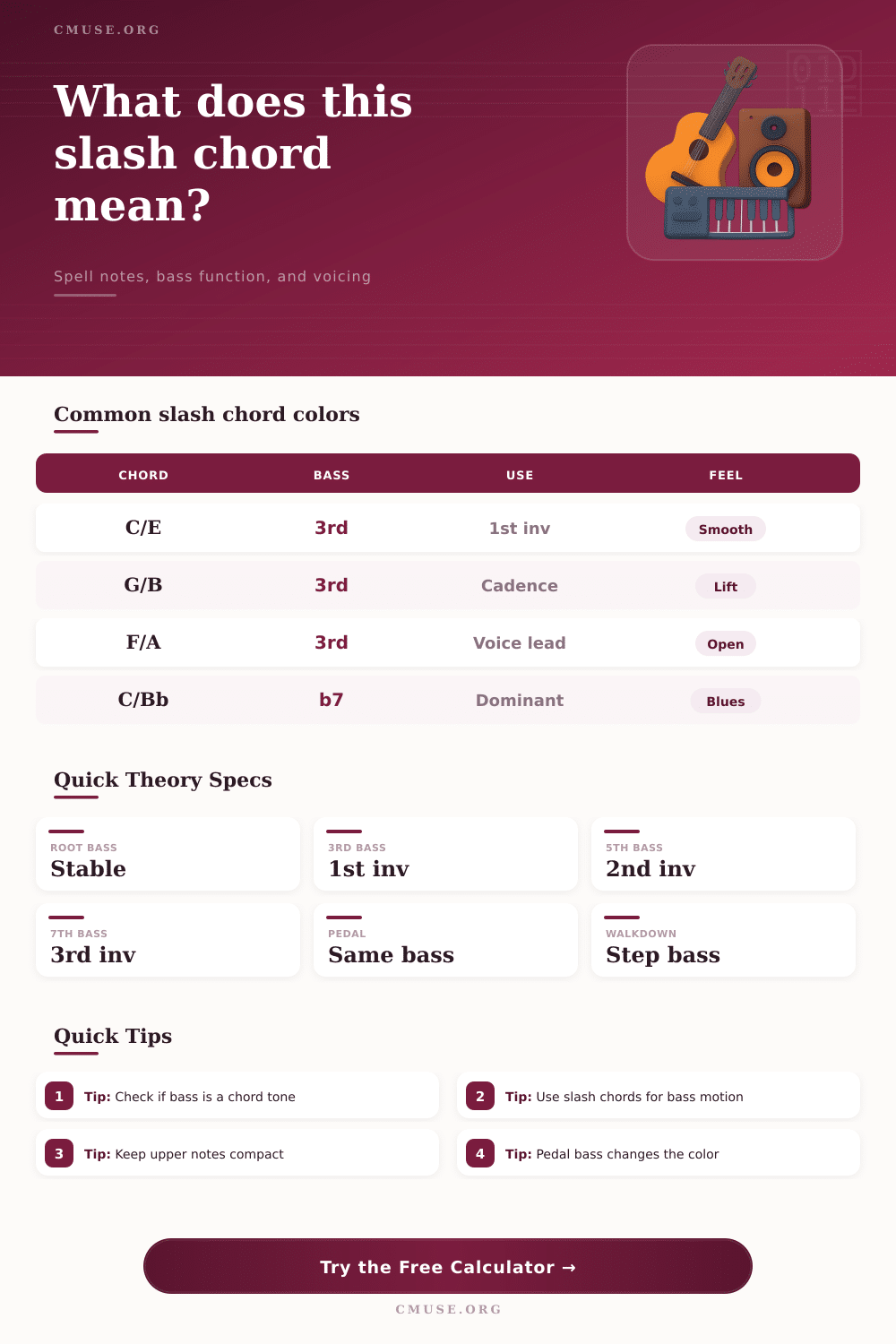
A slash chord is a musical symbol that indicate a specific relationship between an upper chord and a bass note. The slash chord symbol indicates both the identities of the upper chord and the identity of the bass note for that chord. For instance, a C/E slash chord indicate that the chord is a C major chord, but with the third of that chord (E) as a bass note for that chord.
This type of chord alters the way that listeners hear that chord, as well as how that chord may relate to the following chord within the song that contain those slash chords. The calculator provided on this website allow for the selection of the root for a chord, the quality of the chord, the bass note for a slash chord, and the key for the chord. Based on these variable, the calculator provides information regarding the full spelling of the chord, the interval between the root and the slash bass note, and the voicing that may be used for that chord.
How to Use the Slash Chord Calculator
The interval is a particularly important selection for songwriters, as the interval will indicate whether the slash chord is functioning as a first inversion chord, a third inversion chord, or some other type of non-chord tone (such as a pedal note or passing bass chord). Thus, the songwriter does not have to guess at the category of that slash chord. Many songwriters utilize slash chords to create movement within the bass line of the song without changing the upper chord tone of the song.
For instance, a move from an F chord to a G chord within the key of C major will feature an abrupt movement of the bass between the fourth and fifth of the scale. However, changing the bass chord to the third of each of those chord will create a three-note walk from F to G. The calculator allows songwriters to make such a change to a chord by making it deliberate and certain of the interval of that chord. Another common use of slash chords is to utilize a flat seventh in the bass of the chord.
For instance, using a C chord with a Bb in the bass will create a bluesy chord that a standard C major chord cannot produce. The calculator will display the Bb as a non-chord tone, and will label the slash chord as a hybrid color chord. Such a designation can save songwriters time when charting a song and selecting whether the flat seventh chord should resolve or remain as a color chord.
The voicing of a slash chord will depend upon the data provided by the calculator. For instance, if the slash chord is a first inversion chord, close position chords is common. However, if the slash is functioning as a pedal chord, wider spacing between the chord tones will prevent the sustained note from making the other chord tones sound muddily to the listener.
These suggestions provided by the calculator are examples of the type of analysis that can be performed with the information from the calculator. For guitarists, there are a few constraints in playing slash chords. For instance, the guitarist’s lowest string limit where that guitarist may place the bass note for that chord.
Thus, the guitarist may have to place the slash bass note higher than what is suggest by the calculator. The guitarist will have to make a decision as to whether to drop the fifth of the chord to accommodate for this limitation by the guitar strings. Common slash chords are listed within reference table on this website to assist guitarists with these type of decisions.
For instance, C/E, G/B, and Am/G all share common features that allow them to be used in many different songs. It is common for many songwriters to treat slash chords as inversions of the original chord. However, it is important to make the distinction between these two type of chords.
For instance, if the bass note is the third or the fifth of the original chord, then the slash chord is an inversion of the original chord. However, if the bass note is a second or a fourth of the original chord, then the slash chord is functioning as a pedal chord or a suspended chord. The calculator can help with analysis of a song by indicating to the songwriter which category the slash chord possesses, thus allowing for selection of the correct label for the chord in the analysis.
The slash chord calculator is useful not just in the selection of slash chords for different keys, but also for different musical styles. For instance, a G7/F chord may sound good in the context of gospel music, but may be too heavy for folk music. Additionally, the voicing style for the chord can be selected as close to piano, open piano, guitar, or pad voicings.
The interval and function of the slash chord will remain the same, but the spacing between the chord tones can change. Thus, the separation of these two concepts allows for both music theory and musicians to find a balance between the two concept. Slash chords can be particularly useful for musicians who wish to emphasize the bass line within a song.
Thus, the musician may establish the bass line for the song, and then determine which chords will enhance the sound of the song. The calculator ensures that the ear and the music notation are in agreement with one another.