Single Stroke Rate Calculator
Convert BPM, rhythmic subdivision, sticking mode, accents, bursts, and practice duration into total stroke rate, each-hand speed, timing gap, and clean-stroke volume.
Load a practical rudiment scenario, then adjust tempo, subdivision, accent spacing, burst length, and clean-rep target for your own practice pad, snare, or kit routine.
Rate Breakdown
Total stroke rate
Single-stroke speed comes from the tempo pulse and the number of strokes placed inside each beat.
strokes/sec = BPM / 60 x subdivision
Each-hand demand
Alternating R L singles give each hand half of the total notes. One-hand drills keep the full rate on one side.
hand rate = total rate / active limbs
Timing gap
The smaller the millisecond gap, the tighter your motion and rebound control must be.
milliseconds = 1000 / strokes/sec
Interval practice count
For burst-rest routines, only the active work portion contributes to played-stroke volume.
active strokes = rate x active seconds
| Subdivision | Strokes Per Beat | Rate At 120 BPM | Each Hand Alternating | Common Use |
|---|---|---|---|---|
| Eighths | 2 strokes | 4.0 strokes/sec | 2.0 strokes/sec | Warmups, groove checks, relaxed hand-to-hand motion |
| Triplets | 3 strokes | 6.0 strokes/sec | 3.0 strokes/sec | Shuffle control, rudimental flow, triplet rolls |
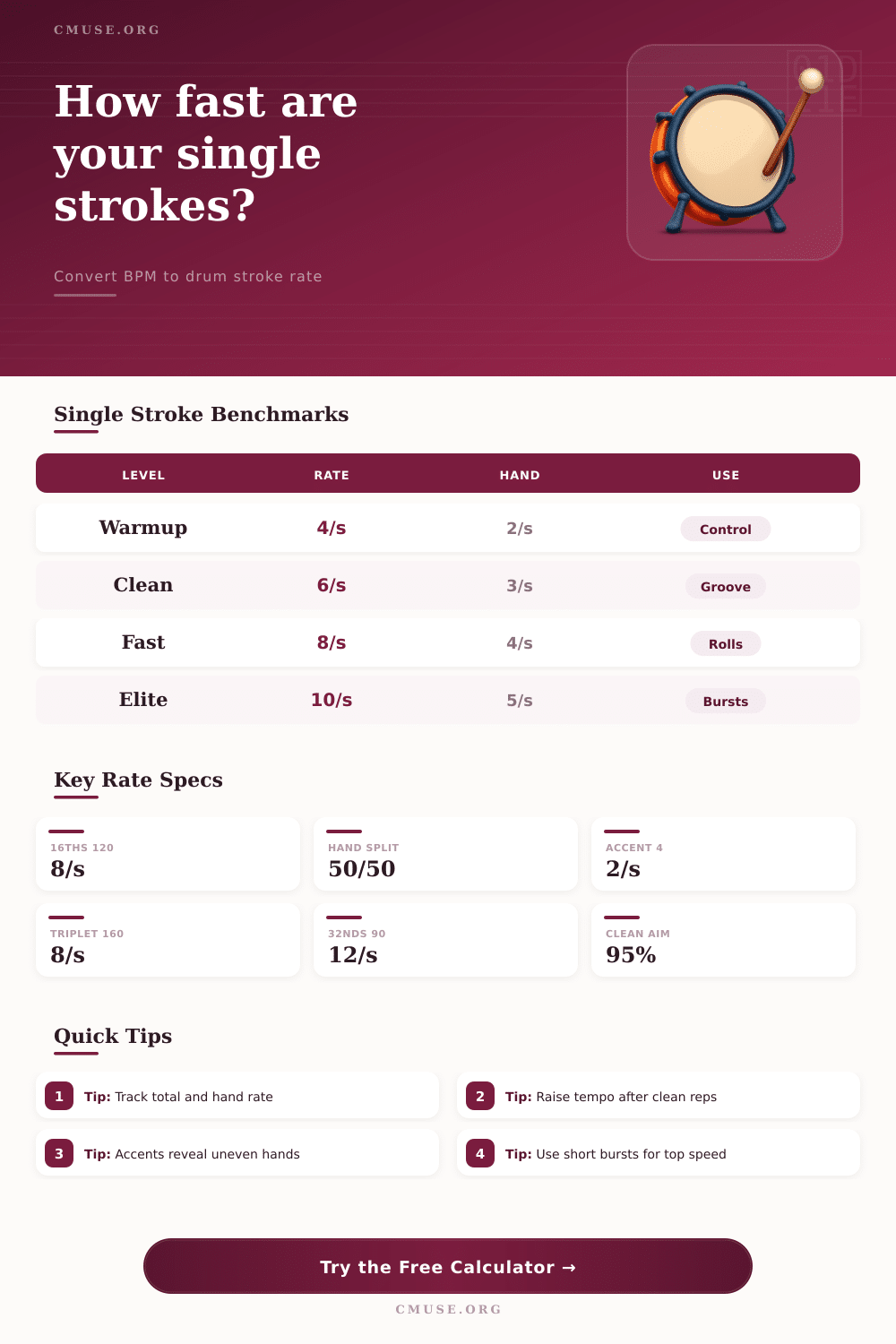
| Sixteenths | 4 strokes | 8.0 strokes/sec | 4.0 strokes/sec | Most single-stroke roll benchmarks and fills |
| Sextuplets | 6 strokes | 12.0 strokes/sec | 6.0 strokes/sec | Fast bursts, hand-to-hand endurance, dense fills |
| 32nds | 8 strokes | 16.0 strokes/sec | 8.0 strokes/sec | Short top-speed bursts and advanced roll checks |
| Tempo | 16th Singles | Triplet Singles | 32nd Singles | Practice Read |
|---|---|---|---|---|
| 80 BPM | 5.33 strokes/sec | 4.00 strokes/sec | 10.67 strokes/sec | Low-stress control and rebound check |
| 100 BPM | 6.67 strokes/sec | 5.00 strokes/sec | 13.33 strokes/sec | Useful clean-roll tempo for many players |
| 120 BPM | 8.00 strokes/sec | 6.00 strokes/sec | 16.00 strokes/sec | Solid benchmark for controlled singles |
| 150 BPM | 10.00 strokes/sec | 7.50 strokes/sec | 20.00 strokes/sec | Advanced roll and fill territory |
| 180 BPM | 12.00 strokes/sec | 9.00 strokes/sec | 24.00 strokes/sec | Usually a burst or highly trained endurance speed |
| Drill Type | Suggested Input | What To Watch | Rate Goal | Best Result Metric |
|---|---|---|---|---|
| Evenness check | 16ths, accent every 4 | Matched accent height and no flam between hands | 6 to 8 strokes/sec | Stroke spacing |
| Endurance roll | 16ths, 5 to 10 minutes | Relaxed forearms and stable volume after minute three | 7 to 10 strokes/sec | Session strokes |
| Top-speed burst | 32nds, 10 to 20 seconds | Rebound quality and recovery after rest | 14 to 22 strokes/sec | Active burst strokes |
| One-hand test | One-hand mode, eighths or 16ths | Left-right gap when each side is tested separately | 3 to 6 strokes/sec | Each-hand rate |
| Setup | Tempo And Subdivision | Total Rate | Each Hand | Notes Per 4/4 Bar |
|---|---|---|---|---|
| Practice pad warmup | 90 BPM 16ths | 6.0 strokes/sec | 3.0 strokes/sec | 16 strokes |
| Rock fill checkpoint | 120 BPM 16ths | 8.0 strokes/sec | 4.0 strokes/sec | 16 strokes |
| Triplet roll phrase | 140 BPM triplets | 7.0 strokes/sec | 3.5 strokes/sec | 12 strokes |
| Blast burst target | 180 BPM 16ths | 12.0 strokes/sec | 6.0 strokes/sec | 16 strokes |
| Advanced 32nd burst | 100 BPM 32nds | 13.3 strokes/sec | 6.7 strokes/sec | 32 strokes |
In other words, few drummers knows how fast they play. Sure, it feels like they’re playing fast, but how many times have you measured how many strokes per second? If there’s any difference between the numbers and the feelings, that’s where we get stuck.
You could be doing single stroke rolls daily, but without an understanding of how the click on the metronome relates to your hand velocity, you could be reinforcing poor technique. Simply input your tempo, then your subdivision, and let the calculator take care of the math for you. No more guesswork about what that click on 120 BPM is going to ask your wrist flexors do.
Use Data to Play Better Drums
It’s pretty basic; there’s some nuance, but here’s the gist: A sixteenth note with a tempo of 120 BPM equals four notes per beat. Two beats per second mean eight strokes per second in total. Sounds doable until you crunch those numbers into how much time you realy have. There are about 125 milliseconds between hits of sticks. That feels like a nanosecond when your stick technique is dialed-in and your rebound control is on point. Otherwise, the margins are awfully thin if your stick height vary from shot-to-shot and your grip is too firm.
The tool then takes it even further breaking out the rate by hands. This shows that you must perform four alternating strokes per second with each hand alone. This makes a difference because matched sticking are a different physical challenge than playing with one hand.
These numbers come to life once put into action. For example, a warm up routine may focus on relaxed motion and steady rhythm, aiming for a clean 4 strokes per second per hand. However, a blast beat burst or rock fill call for a completely different gear. That’s where the accent settings on the tool come into play.
An accent isn’t just a dynamic marking but rather a checkpoint for time. For instance, you establish a grid by accenting each fourth stroke. This force your brain to properly divide up the subdivision. The calculator makes it real by calculating how many strokes you’re working during an active session based off the burst length and rest intervals.
This is important for endurance training. It’s hard to maintain elite speed over extended periods without tension creeping in and fatigue ruining your form. Interval training with a specific amount of work followed by rest help protect your form from fatigue.
Many people chooses speed over cleanliness. As you can see in the rate table above on this page, the rate escalates when subdivided. Switching from sixteenth notes to thirty-second notes immediately doubles the requirement. Now we’re moving so fast that milliseconds is lost. Any delay in the leading hand sounds like chaos. Striving for a high number with sloppy dynamics doesn’t do much good. Rather it’s far more valuable to track your clean accuracy percentage.
How does the calculator work? It calculates what percentage of your total strokes meet your quality standard. It forces you to face the facts. If you miss 30% of your notes, it doesn’t matter that you are playing faster then.
Metrics change the psychology of practice. You don’t feel vaguely that you ought to go faster, but rather you set a target rate and then trace back to discover what’s blocking you. Grip? Stroke height? Rebound control? The tool’s breakdowns will drill down on those variables with visualizations of spacing gaps and per-hand demands.
You begin to realize that speed isn’t about going hard; it’s about going efficient, subject to the limits of our anatomy and physics. In conclusion, it’s about consistency over sporadic bursts of speed. Whether you’re trying to test the boundaries of your one-hand limit or perform matched grip control drills, your desired outcome is the same. You want your hands respond automatically. Data acts as the map; muscle memory is the path. Let the numbers lead you in reps, not your ego… And keep those accents even while spacing tightens. That’s how you transform raw speed into dependable technique.