Single Reflex Bandpass Enclosure Calculator
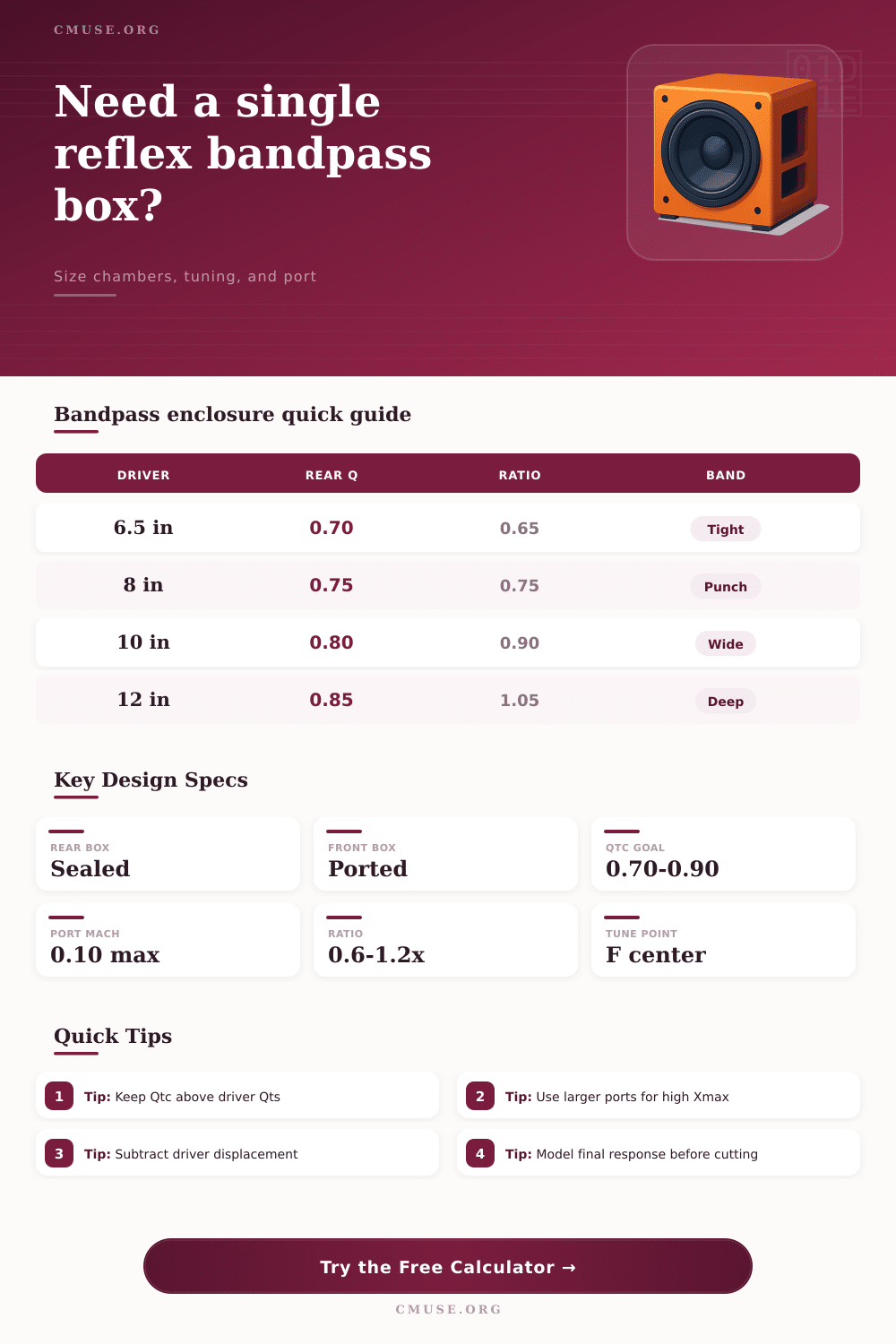
Estimate a fourth-order bandpass box with a sealed rear chamber, reflex front chamber, center tuning, port length, passband width, and port airspeed.
🔊 Bandpass Design Presets
🎛 Driver And Enclosure Inputs
📊 Current Design Snapshot
📐 Bandpass Alignment Reference
| Alignment Style | Typical Rear Qtc | Front / Rear Ratio | Expected Character |
|---|---|---|---|
| Tight control | 0.65 to 0.75 | 0.55 to 0.75 | Compact passband, cleaner transient behavior, lower peak output. |
| Balanced musical | 0.75 to 0.85 | 0.75 to 1.00 | Useful compromise for home, studio, and vehicle sub modules. |
| Wide passband | 0.80 to 0.95 | 0.95 to 1.25 | More upper-bass spread, usually with a larger front chamber and longer vent. |
| Narrow SPL peak | 0.85 to 1.05 | 0.55 to 0.85 | Higher output around tuning, less smooth response outside the target range. |
🌀 Port And Airspeed Reference
| Port Check | Formula Used | Good Range | Design Note |
|---|---|---|---|
| Helmholtz tuning | Fb = c / 2π x sqrt(S / V L) | Set near center | The calculator solves the same relation for physical round-port length. |
| End correction | 0.732 x diameter | Per round port | Short ports can become inaccurate if the correction is larger than the duct. |
| Port Mach | Velocity / 343 m/s | Below 0.10 | Above this range, larger or multiple ports are usually needed. |
| Port area | N x πr² | Larger for Xmax | High-excursion drivers need more vent area even when box volume is small. |
🧮 Common Single Reflex Box Examples
| Example Driver | Rear Net Volume | Front Net Volume | Useful Target |
|---|---|---|---|
| 6.5 inch studio extender | 6 to 10 L | 4 to 8 L | Kick support around 65 to 120 Hz. |
| 8 inch compact sub | 10 to 18 L | 8 to 16 L | Small-room bass with a controlled passband. |
| 10 inch car audio sub | 18 to 32 L | 18 to 34 L | Cabin-gain assisted punch from the upper 30s upward. |
| 12 inch home theater sub | 30 to 55 L | 32 to 65 L | Deep extension with port tuning in the 40 to 55 Hz zone. |
| 15 inch live sound module | 55 to 95 L | 60 to 120 L | High-efficiency thump for 45 to 110 Hz use. |
📝 Specification Comparison Grid
| Design Choice | Smaller Value | Larger Value | Tradeoff To Watch |
|---|---|---|---|
| Rear sealed chamber | Raises Qtc and low cutoff | Lowers Qtc and smooths response | Qtc cannot be lower than driver Qts without an infinite box. |
| Front chamber ratio | Narrower, punchier band | Wider acoustic low-pass behavior | Very large front chambers can reduce the useful output peak. |
| Port diameter | Shorter duct, higher velocity | Lower velocity, longer duct | Long ports may need bends or a slot layout. |
| Front tuning frequency | Lower center, longer port | Higher center, shorter port | The passband follows tuning, so match it to the intended system range. |
A single reflex bandpass enclosures is a type of acoustic enclosure that works as a physical acoustic filter. A single reflex bandpass enclosure force a speaker driver to play within a specific window of frequencies. A single reflex bandpass enclosure provide the high output of a ported enclosure but also provides the controlled roll-off of a sealed enclosure.
Furthermore, because a single reflex bandpass enclosure use a two-chamber system, it is a more complex design than either a sealed or a ported enclosure, and require precision in it’s construction process. The two-chamber system of a single reflex bandpass enclosure consist of a sealed rear chamber and a ported front chamber. The speaker driver is contained within the sealed rear chamber.
How a Single Reflex Bandpass Enclosure Works
The sealed rear chamber act as a spring for the speaker driver. By using this spring action, the rear chamber prevent the bass frequencies from sounding muddy. The speaker driver forces the energy into the front chamber.
The front chamber acts as a megaphone to amplify the speaker sound. If you make the rear chamber too small, you will raise the Qtc and lose the low end of the speaker. If, however, you make the rear chamber too large, the speaker will lose its mechanical grip on the driver.
Finding the right size for both the rear and the front chamber is essential. The alignment style of a single reflex bandpass enclosure allow you to control the behavior of the bass frequencies emanating from the speaker. A tight alignment between the two chambers result in a narrow passband of the enclosure.
A narrow passband is useful for increasing the frequency range of the kick drum from a band playing in a recording studio. A wider passband between the chambers is better for home theater speaker, however. The wider the passband, the more smoother the transition of energy is between the bass and the mid-bass frequencies.
Understanding the tradeoff between the output of the speaker and the bandwidth of the passband is essential in building a speaker with the desired characteristic. You can have a high output at a specific frequency, but not both. Another factor to consider when constructing a single reflex bandpass enclosure is the air speed that travels through the port of the speaker.
High excursion speaker driver will force air through the port at high velocities. If the air velocity becomes too high, the air will begin to turbulence within the port. This turbulence will create a chuffing sound with the air as it exit the speaker.
This chuffing sound is the noise created by the speaker port interacting with the air. If the Mach number of the port approach 0.10, the air velocity is too high for that speaker enclosure. In this case the diameter of the port should be increased or you should add one additional identical port.
The ratio of the volume of the front chamber to the rear chamber is another important factor in the construction of a single reflex bandpass enclosure. This ratio dictates the behavior of the passband of the speaker. Furthermore, this ratio dictate the amplification factor for the enclosure’s center frequency.
A ratio of 1.0 is generally a starting point for the volume of the two chamber. Additionally, increasing this ratio will increase the width of the passband. However, increasing this ratio will decrease the peak energy output of the speaker system.
Reference table of these ratios can be consulted to determine what type of speaker enclosure is desired from the speaker system, either one with a punchy energy output or one with a deep and wide passband. Another factor to consider when designing a single reflex bandpass enclosure is the physical displacement of the object inside the enclosure. Many people will calculate the total volume that the enclosure will possess when complete.
However, they will often forget to account for the displacement of the speaker driver, the port tube, and the bracing for the enclosure. If you do not account for the displacement of the speaker driver, you will create a single reflex bandpass enclosure whose tuning frequency is lower than you calculated. A calculator that allow you to include the displacement of bracing and lining will ensure that your enclosure possess the gross volume that you calculate for it to have optimal performance.
By ensuring that the gross volume is to what you calculated, the speaker system will function according to the calculations made of its various component. You should of checked the displacement of the furnitures too. It is actualy alot of work to get teh volume right.