Single Coil Inductance Calculator
Estimate pickup inductance from turns, coil window area, winding length, magnetic core, wire gauge, DC resistance, cable capacitance, resonant peak and practical pickup voicing.
Calculation Breakdown
Coil Geometry
Electrical Voice
| Magnet / Slug Type | Effective Mu | Inductance Effect | Typical Pickup Voice | Use In Calculator |
|---|---|---|---|---|
| Alnico 2 rods | 1.18 | Low-medium | Soft attack, sweet upper mids | Vintage neck and lower output bridge coils |
| Alnico 3 rods | 1.12 | Low | Clear, open, less push | Early-style low pull single coils |
| Alnico 5 rods | 1.28 | Medium | Bright attack with firm lows | Common Strat, Tele and bass single coils |
| Alnico 8 rods | 1.36 | Medium-high | Strong output, tighter mids | Hot rod and higher drive single coils |
| Ceramic bar with steel poles | 1.90 | High | Focused, louder, more compressed | Budget ceramic pickups and blade designs |
| Steel slugs or rail | 2.45 | Very high | Thick midrange and lower peak | Single-coil rails and steel slug conversions |
| Hybrid steel blade | 2.15 | High | Even string sensing, strong mids | Blade pickups and narrow rail layouts |
| Air core reference | 1.00 | Reference | Weak, experimental reference | Testing formula sensitivity only |
| Gauge | Diameter Approx | Ohms Per 1000 ft | Typical Turns | Pickup Use |
|---|---|---|---|---|
| 41 AWG | 0.071 mm | 1050 | 5500-7600 | Lower resistance, open custom coils |
| 42 AWG | 0.063 mm | 1659 | 6500-9000 | Most vintage Strat, Tele and bass coils |
| 43 AWG | 0.056 mm | 2143 | 7600-11000 | Tele neck, compact bobbins and hotter winds |
| 44 AWG | 0.050 mm | 2593 | 8500-13000 | High turn count in tight coil windows |
| 45 AWG | 0.045 mm | 3348 | 9000-15000 | Very compact high-resistance coils |
| Loaded Resonant Peak | Likely Voice | Common Cause | Adjustment Direction |
|---|---|---|---|
| 6.0 kHz and higher | Very bright, glassy, lower output | Low inductance or low cable capacitance | Add turns, use more cable pF or load lower |
| 4.5 to 6.0 kHz | Classic clear single-coil chime | Moderate turns with Alnico rods | Good target for neck and middle coils |
| 3.2 to 4.5 kHz | Balanced, punchy, bridge friendly | More turns, higher capacitance or stronger core | Useful for hotter bridge winds |
| 2.2 to 3.2 kHz | Thick mids, P90-like weight | High inductance or steel-assisted core | Lower turns or cable pF for more openness |
| Below 2.2 kHz | Dark, compressed, heavy mid focus | Large inductance plus high capacitance | Reduce tone capacitance or load less heavily |
| Preset | Turns | Core | Wire | Design Goal |
|---|---|---|---|---|
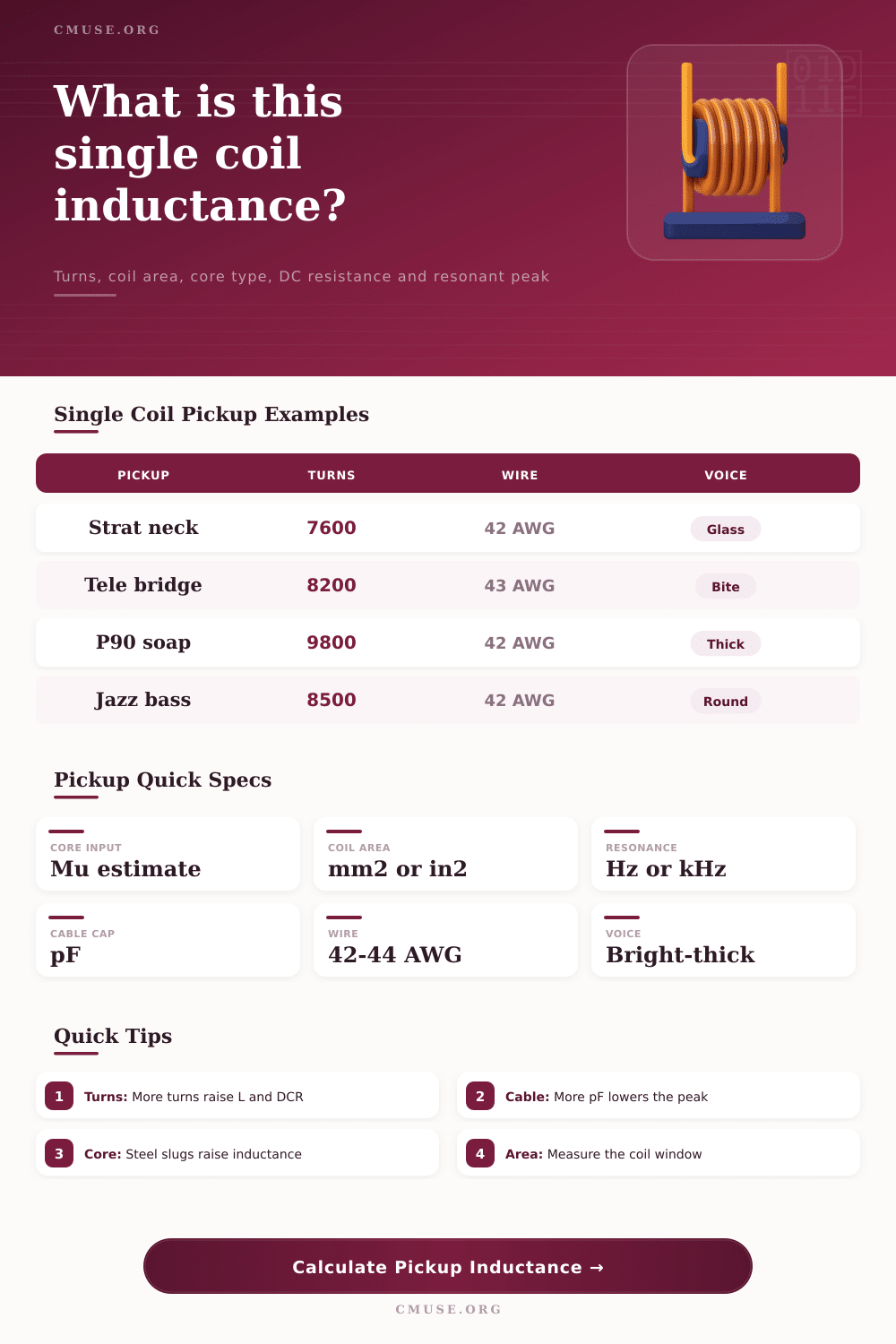
| Strat Neck Glass | 7600 | Alnico 5 rods | 42 AWG | Clear top with familiar vintage output |
| Tele Bridge Bite | 8200 | Alnico 5 rods | 43 AWG | Sharper bridge edge with extra resistance |
| P90 Soapbar Thick | 9800 | Alnico 2 with broad coil | 42 AWG | Higher inductance, wider coil aperture |
| Jazz Bass Round | 8500 | Alnico 5 rods | 42 AWG | Round bass response with usable top |
| Steel Slug Rail | 9000 | Steel rail / slugs | 43 AWG | High inductance and stronger mid focus |
Before you play a single note, the world opens or closes with that very first sound you hear when you plug in your guitar. That instant tonal snapshot are neither magic nor physics; it’s caused by copper wire wrapped around bar of magnetic steel. Before you even pluck a string, the connection settles into place and do battle with resistance of your amp and the capacitance of your cable.
Players most often believe that their tone stem from pickups or even the wood they are made from. But it isn’t. There is something more electrical going on here. And this is where single coil inductance calculator steps in. It takes raw geometry and turns it into audible character. This means no one has to guess what will happen if you wrap some extra wire around a magnet or use a different one.
Why Inductance Changes Your Guitar Tone
What does all that mean? Well, basicly, it’s just how much your pick up resists a change of current, aka inductance. In turn, that means directly how your pick up cuts through the mix. For instance, if something has high inductance it will soften its attack and thicken the low end by pushing resonant peak down. If something has low inductance, then it stays pretty glassy and bright.
Compare the difference between a P90 soapbar pickup and a standard Stratocaster neck pickup. A Strat usually runs about seven thousand turns with moderate inductance resulting in articulate chime. A P90 often pushes ten thousand turns. That raise the inductance enough to drop the peak frequency and add some weight to the mids. And neither is better than the other. They’re aimed at different parts of sound range. It helps you know where your setup sit. It can also help you decide if you want more output or something else.
But it’s not only about the number of turns of wire; it’s also about the core material. Most vintage guys will know exactly what I’m talking about. A good alnico 5 rod offer a solid, crisp starting point. Move to a high-permeability ceramic bar or steel slug and magnetism clamps down on the field tighter. You’ve increased the inductance without adding any extra turns of wire, which moves the voice towards a more compressed, heavy sound. Because the calculator take these material differences into account, it displays them in its permeability factor. In this way, it illustrates how something as simple as changing your core can have the same effect as rewinding completely.
Little things matter a lot when you’re chasing after that special sound while trying not to break the bank with purchases. The length of the cable also has an effect on the high end that we often don’t think about unless we connect it to our pedalboard. Each foot of cable create capacitance. This interacts with the pickup’s inductance to create a low-pass filter. With a short six-foot cable, your resonant peak is left wide open. Those crisp upper harmonics is preserved. When you run twenty feet of cheap coax out to the back of the stage, that peak gets pulled down into the mud. By entering your estimated load in picoFarads (pF), the tool models this drag and shows you just how much brightness you’re losing before signal reaches the first pedal. This sheds some light on what makes a bright pickup sound dark in a live setting. And it could of help you compensate for this by picking a lower-capacitance cable or playing with your tone pot at home.
Another thing to think about is the effect that wire gauge have on the relationship between DC resistance and inductance. The thinner the wire (such as 43 AWG), the smaller the diameter, which gives you more turns per unit of space, increasing both resistance and inductance. The thicker the wire (41 AWG), the lower the resistance, though this also reduce the amount of inductance that can be packed into a given space. Here’s the rub: Inductors with higher resistances is warmer. But when run through an overdriven amplifier, they compress signal at a quicker rate. In contrast, lower resistance coils respond better to picking dynamics while feeling open and lively. It is all a matter of balance.
Sometimes chasing high output come at the cost of some clarity. Capacitive load, electrical resistance, magnetic field strength all play into tone: it’s a balancing act. You can’t optimize for one thing while optimizing for another. Pursue thick lows and you’ll probably sacrifice some high-end. Go after sparkling brightness, and you will have a thin dynamic range that doesn’t hold together well when mixed with other bands.
Your ears determine what works; the calculator gives you the numbers. Experiment with its limits on your existing equipment. Then, take a step back and listen: where does the music liv? Where’s that first note telling the truth? As long as you learn how to ask the question the right way, the answer is always there.