Silence Gap Between Tracks Calculator
Plan silence between songs, CD pregap, live applause tails, crossfade overlap, hidden-track pauses, cue start time, and the final runtime effect of an album sequence.
Preset use: Load a playback scenario, then replace the track list with exact master durations before checking cue starts or CD frame rounding.
Full Timing Breakdown
| Track | Source | Start Cue | Duration | Following Gap | Note |
|---|
| Sequence Type | Common Gap | Where It Appears | Risk To Check |
|---|---|---|---|
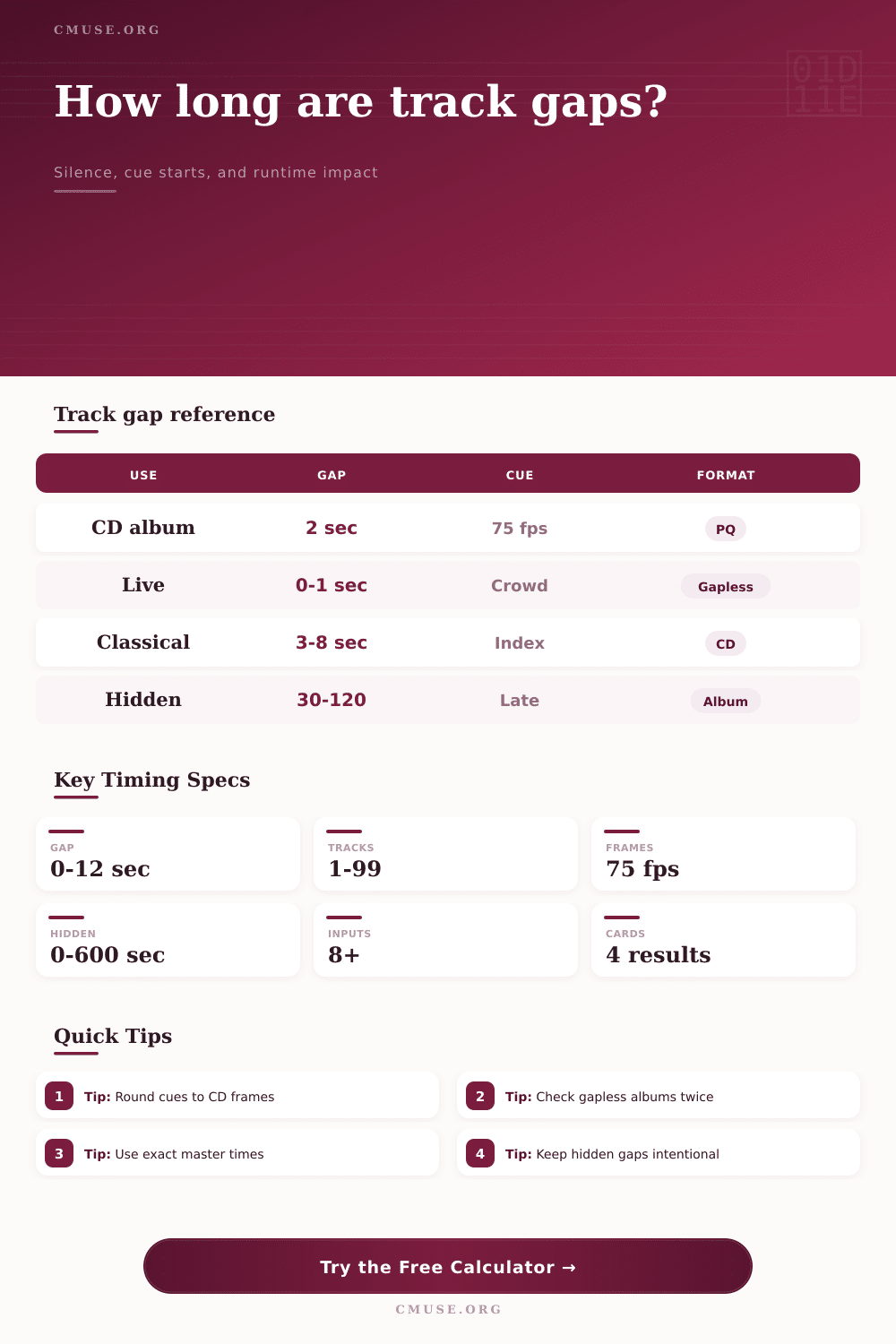
| Modern pop album | 1 to 2 seconds | Between most songs | Too many identical gaps can make pacing feel mechanical. |
| Gapless live album | 0 to 1 second | Applause and audience tails | Splitting tracks at the wrong applause peak can sound clipped. |
| Classical or recital | 3 to 8 seconds | Between movements or works | Longer pauses can push a CD or vinyl side over target. |
| Hidden-track closer | 30 to 120 seconds | Before unlisted material | The hidden pause may become most of the total silence. |
| DJ or ambient flow | 0 seconds | Crossfades or continuous beds | The indexed cue can differ from the musical transition point. |
| Reference | Timing Detail | Calculator Field | Practical Use |
|---|---|---|---|
| CD frame grid | 75 frames per second | Cue rounding mode | Rounds cue starts to a CD-friendly frame boundary. |
| Track 1 pregap | Often 0 to 2 seconds | Pregap before track 1 | Separates lead-in silence from normal transition gaps. |
| Index 00 pause | Counts before index 01 | Pregap and hidden silence | Prevents delivery sheets from hiding real runtime. |
| DDP review | Check PQ starts and ends | Cue start track number | Confirms the exact cue a client or plant will inspect. |
| Crossfade master | Overlap reduces dead air | Crossfade seconds and count | Shows how much silence was removed by overlap. |
| Metric | Formula | Included Timing | Why It Matters |
|---|---|---|---|
| Raw transition silence | Transitions times base gap | Only normal inter-track pauses | Shows the starting silence before live tails or overlaps. |
| Crossfade saved | Overlap times crossfaded transitions | Capped by raw transition silence | Prevents overlap from making impossible negative gaps. |
| Total silence | Pregap plus net gaps plus tails plus hidden pause | All non-song time that remains in the master | Turns subjective pacing into a runtime number. |
| Runtime effect | Total silence divided by final runtime | Music, hidden track, and silence | Shows whether gaps dominate the listening clock. |
| Cue start | Pregap plus prior tracks plus prior gaps | Everything before the selected track | Gives the start time for cue sheets and playback notes. |
| Preset | Tracks | Gap Plan | Special Timing | Best Check |
|---|
Imagine you put on a live album and press play, and suddenly there is a three second void of absolute dead air between two song that were clearly played back to back in venue. It feels like a mistake. However, it is probably just bad metadata. Or, it could be a mastering engineer who thought of silence as a neutral default rather than a deliberate design choice.
But silence isn’t nothing: It’s not only the absence of something; in the world of album sequencing, it’s an instrument with its own kind of weight and rhythm. Sometimes a gap can create tension prior to a dramatic opener getting underway, while other times it provide breathing room for heavy track to settle into.
Why Silence Matters in Music
The key is largely understanding what exactly it is you’re measuring when you plan for these spaces. Because it’s physical media, it consider time not in seconds, but frames. For example, a regular old CD spins at 75 frames per second. This means that if you want a two-second break, you need one hundred and fifty empty frames of data. That level of accuracy become important when thinking about cue points, which need to fall within frame boundaries (otherwise the disc could stumble while switching over). Using page’s calculator, you enter how long you’d like the pause to be, and it figures out exact number of frames necessary, ensuring your exact idea makes its way through technical process intact.
How long is a piece of string? Well, that depends on what’s around it. If you are listening to a pop album, you expect the gaps between tracks to be brief, often only two seconds. Each track fires a hook at you next. Classical music, conversely, requires much more space between movements so that sound can die down gently into the quiet atmosphere of the concert hall. A random break of four or five seconds might work on a rock album, but it would sound harsh and disrespectful on piano sonata.
Is gap between songs something performed by the artist or simply the duration required for CD tray to come back to life? Another variable that usual tools can’t account for is live recordings. Crowd noise isn’t just a static silence, it’s dynamic energy that, without careful editing, will bleed into your subsequent track. Leaving a loud cheer at the end of one song followed by starting the next right away result in a jarring spike of volume that tires the ear. On the other hand, most engineers has to cut the applause short to get songs to fit nicely onto a playlist. That kills energy of the show. What works better is keeping natural end. You should of add a little bit of real silence after it fades out so the listener has a clear separation.
Streaming apps can also screw up extended periods of silence and may not display metadata at all, making hidden tracks a slightly endangered art form. Leaving three minutes of silence followed by a secret song was once a playful fan Easter egg while digging through someone’s physical collections. Today it’s more of a technical crapshoot, which is why some apps just skip right past the empty section altogether. To add one if you desire, check with your particular distributor about how it treats extended non-audio passages first, so you don’t lose the surprise in its entirety.
Eliminating silence is what makes crossfades so different than others. There’s nothing to count when your songs are overlapping. Now we add another element into the mix (pun intended). We must make sure that beginning of one song doesn’t clip onto the ending of the other. To see this spelled out and visualized nicely, see table at the bottom of the page that details various formats’ handling of discrete stops vs continuous play. It will help to show where the balance lies between having tracks cut cleanly apart from each other or blended seamlessly together.
There are also practical limitations in terms of space with vinyl. The amount of time you can play per side is directly related to playing surface available, and every millisecond of silence nibbles away at that. While a lengthy break could be acceptable on a digital track, it means having to back off on the bass levels (or, conversely, truncating playback time) when getting close to inner grooves of your LP. Here, you’re making a choice between fidelity and air; a tradeoff worth making carefully before you send the lacquer out for cutting.
Finally, the sound of nothing is a component of your production too and should be treated as such. Like all other parts, it requires editing and mixing. Rushed transitions or awkward jumps between pieces will only pull listener from the experience. Plan out your spaces deliberately so the music can breathe in its own time without having the listener thinking something’s broken. The quiet times aren’t less then the loud; they’re what give shape to everything around them.