Signal Chain Gain Sum Calculator
Add source level, pedal boosts and cuts, amp input headroom, line/instrument level, clipping risk, and noise risk in one signal-chain pass.
Signal Chain Result
| Source | Typical Level | Classification | Gain Sum Note |
|---|---|---|---|
| Vintage single coil guitar | -22 dBu / -24.2 dBV | Low instrument | Usually tolerates boosts before clipping |
| Passive humbucker guitar | -14 dBu / -16.2 dBV | Instrument | Moderate boost headroom into amps |
| Hot pickup or active bass | -10 to -7 dBu | Hot instrument | Can overload vintage pedal inputs |
| Consumer keyboard output | -7.8 dBu / -10 dBV | Consumer line | Pad before many guitar pedals |
| Pro synth, interface, or rack | +4 dBu / +1.8 dBV | Pro line | Needs trim before instrument inputs |
| Stage | Typical Range | Risk Area | Practical Target |
|---|---|---|---|
| Compressor makeup | 0 to +8 dB | Raises hiss and pickup noise | Match bypass level unless boosting |
| Overdrive output | -6 to +12 dB | Can slam the next pedal | Use +2 to +6 dB for push |
| Graphic or parametric EQ | -12 to +12 dB | Multiple boosts add quickly | Cut first, boost sparingly |
| Clean boost | 0 to +20 dB | Amp input clipping | Use +3 to +6 dB for solos |
| Wet effects makeup | -3 to +6 dB | Loop return overload | Keep trails near unity |
| Measured Result | Safe Zone | Warning Zone | Likely Fix |
|---|---|---|---|
| Input headroom | 6 dB or more | Under 3 dB | Lower boost, add pad, reduce source trim |
| Amp input level | -20 to -6 dBu for instrument | Above 0 dBu into vintage input | Treat as line-hot and trim down |
| Signal-to-noise ratio | 60 dB or more | Under 45 dB | Boost later, reduce noisy gain, fix power |
| Line into pedals | Trimmed near -15 dBu | +4 dBu direct to fuzz | Use reamp, pad, or output trim |
| Scenario | Source | Typical Net Gain | Expected Result |
|---|---|---|---|
| Clean pedal platform guitar | Passive humbucker | +2 to +5 dB | Clear input margin |
| Solo lift after drive | Hot pickup | +8 to +12 dB | Great if amp has +4 dBu headroom |
| Line synth into pedalboard | Pro line | -12 to -18 dB trim | Safer for instrument pedals |
| Ambient loop return | Pedal return | -2 to +4 dB | Watch line input and wet makeup |
When you strike a chord and it sounds distorted harshly, that’s digital clipping. While this can be caused by faulty equipment, more often than not it’s an issue of bad gain staging. Most players regard their signal path as some sort of mysterious box, but if you don’t know how the voltage flow through your amplifiers and pedals, it’s like trying to win at cards without knowing the rules. Learn how it works; it will help you later.
Voltage Gain is measured in terms of voltage potential against some sort of reference standard. Voltage multipliers is stacked when you use multiple effects such as overdrive and compression devices. Since your source signal begins with power, every one of these stage drives it toward the clipping threshold of the following effect. It’s very helpful to see these numbers and understand what they mean; the calculator on this page will do the math for you.
How to Fix Bad Sound with Gain Staging
Noise floor or background hiss is produced by all electronics. The more gain you add to your signal in the beginning of the chain, the louder that hiss will be as well. It may even reach the point where it distracts from what you hear. Adding clean boosters near the end of the chain tend to make more sense since you’re looking for maximum signal strength to the amp and not boosting the silence before hand.
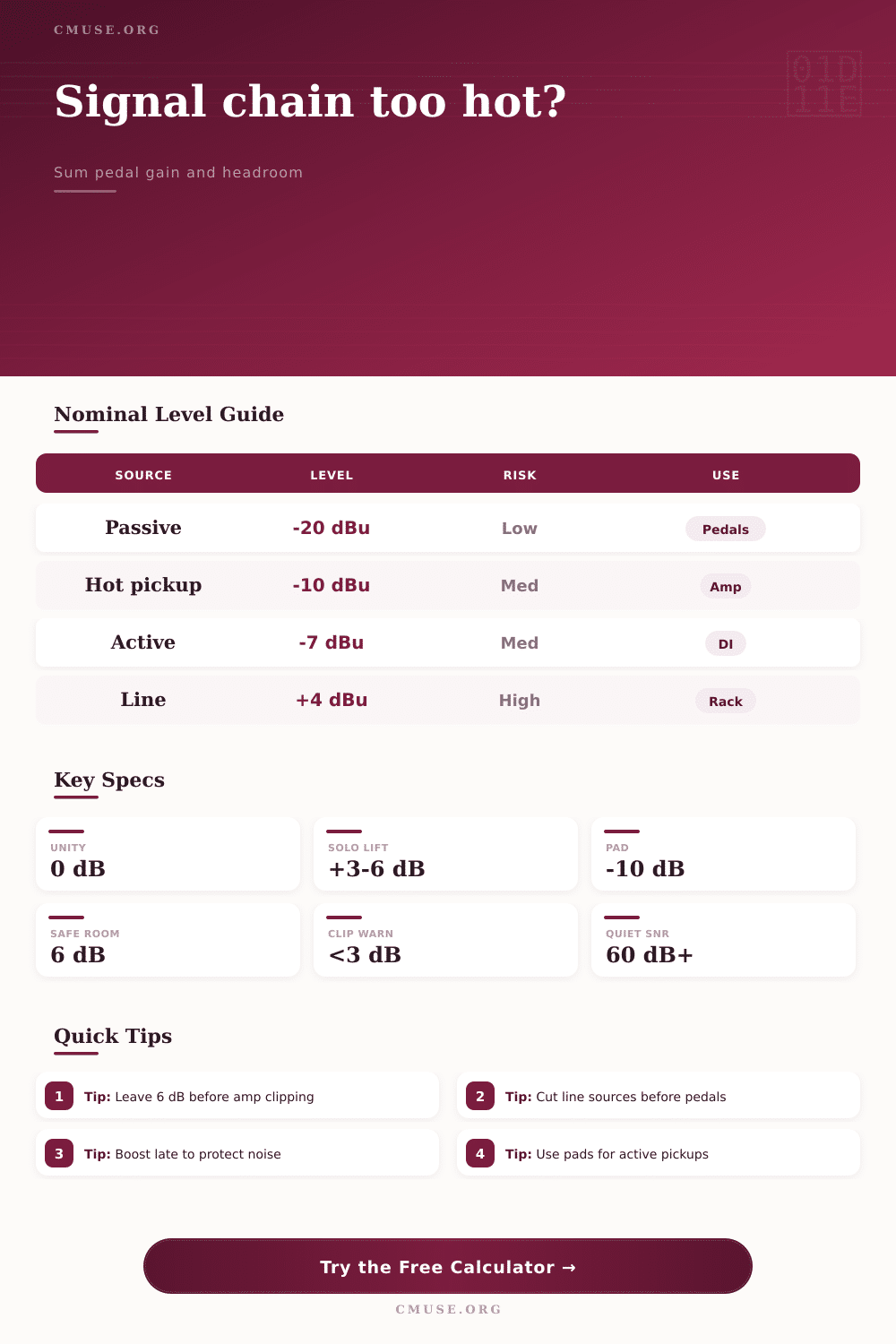
This sample chart shows how different input levels compares to common pedal gains. The problem with vintage amps is that their inputs was made to accept a much lower voltage signal. So while moddern equipment handles hotter signals just fine, those old things has very little headroom and begin to distort naturaly. If you take a hot line-level signal straight into the input on a vintage amp, chances are you’ll be clipping the preamp right away. That’s a mismatch between two different eras of audio engineering. It needs to be trimmed down because the voltage is too high.
It’s surprising how quietly a single-coil pickup can sound. In this case, a clean boost/buffer are a key tool to increase signal strength but not add any harmonic distortion, which can otherwise be lost in the background noise. It’s all about consistency; regardless of how hard you strum or play softly, you want a consistent tone. These tools help maintain evenness of response to your dynamics regardless of style.
How does it apply? How do you know when you’re getting into trouble? You want at least three decibels (dB) of headroom between when the signal starts to clip and the level at which you operate. Six dB is more common and is generally considered a safe amount of headroom. What are these numbers? Think of them as guard rails. The signal gives you a good idea of just how far out you can push without blowing out. When you’re approaching danger, they let you know you shouldn’t of push any harder, they give you defined limits in terms of signal strength.
The key Control is what gain staging is all about. Does your tone get muddy or thick? Knowing what to expect from your rig before plugging in comes from paying attention to signal strength at every stage. From here on out, it’s no longer guesswork; It’s engineering sound. That mindset is what transforms a bunch of random pedals into an instrument that works together coherently. So goodbye harsh digital click and hello good tone.