Sidechain Release Time Calculator
Match compressor release, hold, lookahead, gain-reduction decay, and pump timing to BPM so the duck recovers musically before the next hit.
🎵 Genre And Groove Presets
Presets load BPM, subdivision, release, recovery target, pump feel, hold, lookahead, and gain reduction so you can compare musical release windows quickly.
⚙ Sidechain Inputs
Sidechain Timing Result
Your tempo-synced sidechain release estimate will appear here.
📊 Sidechain Spec Grid
⏱ Tempo-Sync Mapping Table
| Subdivision | Current BPM | 120 BPM | 128 BPM | 140 BPM |
|---|---|---|---|---|
| 1/4 quarter | 484 ms | 500 ms | 469 ms | 429 ms |
| 1/8 eighth | 242 ms | 250 ms | 234 ms | 214 ms |
| Dotted 1/8 | 363 ms | 375 ms | 352 ms | 321 ms |
| 1/16 sixteenth | 121 ms | 125 ms | 117 ms | 107 ms |
| 1/8 triplet | 161 ms | 167 ms | 156 ms | 143 ms |
🎛 Genre And Groove Reference
| Preset | Typical BPM | Subdivision | Recovery Aim | Use Case |
|---|---|---|---|---|
| House Kick Duck | 120-126 | 1/8 | 78-86% | Bass dips that breathe with a four-on-floor kick. |
| Techno Tight Pulse | 128-136 | 1/16 | 70-82% | Fast recovery when the low end must stay driving. |
| Trap 808 Pocket | 130-150 | 1/8 | 65-78% | Kick transient clears space before the 808 returns. |
| Future Bass Swell | 140-155 | Dotted 1/8 | 86-94% | Noticeable lift that blooms after the sidechain hit. |
| Pop Vocal Duck | 90-120 | 1/4 | 82-92% | Music bed returns naturally between vocal phrases. |
📉 Gain-Reduction Decay Table
| Release Curve | Model Factor | Recovery Shape | Best For |
|---|---|---|---|
| Fast exponential | 0.82x | Quick early recovery, less tail. | Techno, DnB, tight bass gates. |
| Natural compressor | 1.00x | Standard one-knob release behavior. | House, pop, general kick ducking. |
| Program dependent | 1.18x | Slower tail after a fast first move. | Bus compression and rhythmic mix-bed ducking. |
| Smooth opto-style | 1.35x | Longer glide with softer pump edges. | Vocals, pads, lo-fi music beds. |
📋 Comparison And Spec Grid
| Timing Goal | Release Range | Hold / Lookahead | Risk If Too Slow | Risk If Too Fast |
|---|---|---|---|---|
| Transparent duck | 40-120 ms | 0-10 ms hold | Masking stays after the hit. | Clicky or nervous level movement. |
| Groove pocket | 100-240 ms | 10-35 ms hold | Bass feels late or swallowed. | Pump ends before the groove breathes. |
| Audible pump | 220-420 ms | 15-60 ms hold | Next kick lands on unrecovered gain. | Lift feels small and unintentional. |
| Music bed duck | 250-700 ms | 0-25 ms hold | Dialogue or vocal sounds over-compressed. | Bed jumps back between words. |
Side chain compression allow a producer to manage the relationship between two differents audio signals. Sidechain compression reduce the volume of one audio signal when another signal reaches a certain threshold. A person must understands the release parameter for a sidechain effect because the release parameter control how quickly the volume return to its original level after the audio signal has been compressed.
If the release parameter is set too short, the audio signal will return to its original volume too quickly for a human listener to notice the sidechain compression effect. However, if the release parameter are set too long, the audio signal will not return to its original volume in time for the next audio transient in the signal, making the mix sound muddy. A sidechain compression calculator allow a person to calculate the appropriate timing for the release parameter based off the BPM of the music and the subdivision settings.
How Sidechain Compression Works
BPM, or beats per minute, allow the calculator to understand the tempo of the music. The subdivision allow a person to select whether the side chain should trigger on quarter note, eighth notes, or dotted notes. The hold parameter allow a person to select for the gain to remain reduced for a small period of time.
This parameter is crucial for preventing the sidechain compression from “swallowing” the initial transient of the audio signal. The lookahead function allow the compressor to anticipate the signal by detecting it before it begin playing. The recovery target is often missed when mixing tracks but is crucial for sidechain compression.
The percentage of gain reduction that a producer targets prior to the next audio transient will drastic affect the sound of the track. An 80% target will allow more room in the low end of the audio signal for bass frequencies as opposed to a 90% target. The sidechain compression calculator will convert this percentage to a release value based on the curve of the compressor that is used in the audio mixing software.
The pump timing target for sidechain compression allow a person to adjust the settings of the audio signal to feel more in sync with the music. For example, some tracks might require a tight side chain setting where the audio signal feel like it is happening ahead of the beat. Other tracks will sound better with a late recovery parameter where the volume of the audio signal swell.
These are two different choice for sidechain compression that can be used in a track depending on the desired feel for that track. The sidechain compression calculator allow a person to see where there settings relate to their chosen pump timing target for sidechain compression. The mixing of audio signals is never a straightforward process.
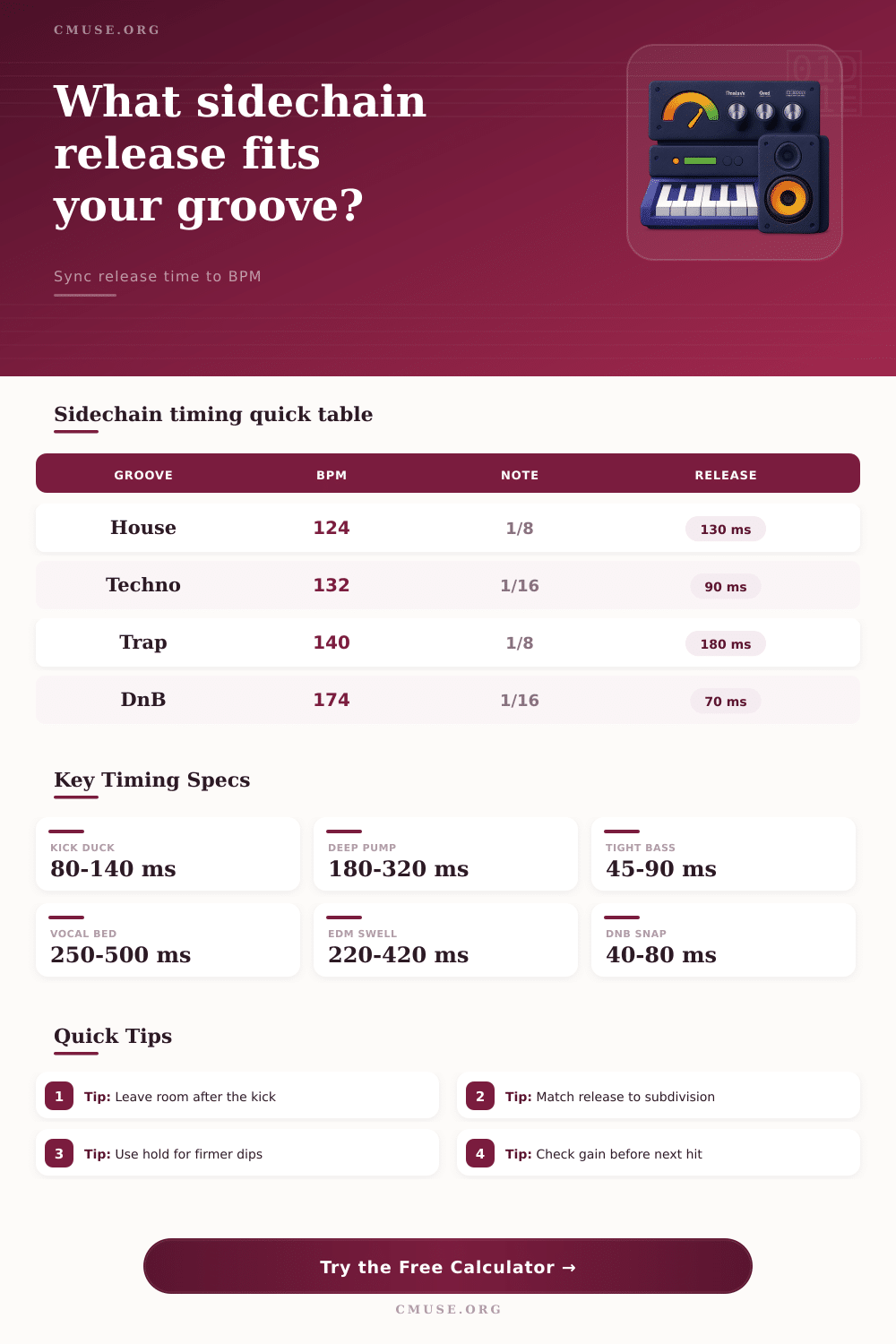
However, the sidechain compression calculator include reference table for different musical genres. For example, house music with a kick drum at 124 BPM will have a different sub division and recovery target then the drum and bass genre at 174 BPM. Audio engineers and producers can use these reference tables as a point of start.
It is common for audio engineers and producers to focus on the release parameter for sidechain compression while ignoring the other parameters. For example, the kick drum will create a good volume dip on the first kick but the second and third kicks will sound weakly because the volume has not yet returned to its original level. In this situation, you can shorten the release parameter to ensure that the volume return to its original level in time with the next kick in the kick drum but the subdivision must be checked to ensure that the groove of the song allow for this volume return.
The subdivision can be altered or a person can use a hold parameter so that the kick drum maintain its volume and the audio signal can recover to that level. Each section of a song might require a different release parameter than the other sections of the same song. For example, the verse vocals will require a different recovery time than the chorus bass line.
The trigger type can also be changed in the sidechain compression calculator to alter the settings for different section of the song. Successful sidechain compression will produce a mix where the kick and bass return to their original volume at the same time. Alternatively, the listener will not notice successful sidechain compression.
Through the process of trial and error, the engineer or producer could of found the best setting for the release parameter, the hold parameter, the sub division parameter, and the recovery target for each track in the song.