Seventh Chord Calculator
Calculate seventh-chord tones, interval formulas, inversions, voicing spans, concert-pitch frequencies, and practical range fit.
🎼 Seventh Chord Presets
🎹 Chord Inputs
📊 Seventh Interval Spec Grid
🎶 Seventh Quality Comparison Grid
| Quality | Formula | Semitones | Common Function |
|---|---|---|---|
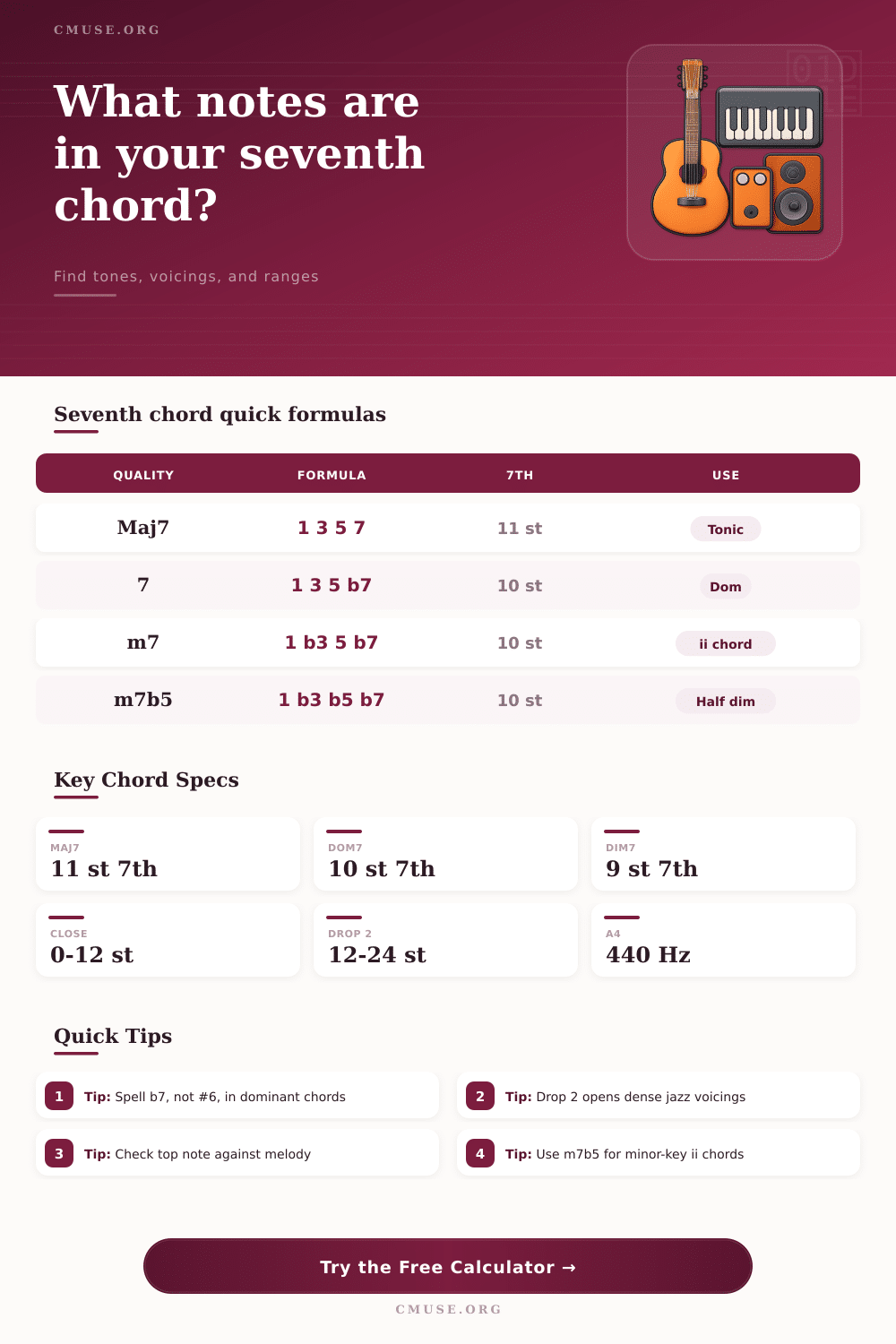
| Major seventh | 1 3 5 7 | 0, 4, 7, 11 | Tonic major, color ending, upper-structure pad |
| Dominant seventh | 1 3 5 b7 | 0, 4, 7, 10 | V7, blues I7 or IV7, secondary dominant |
| Minor seventh | 1 b3 5 b7 | 0, 3, 7, 10 | ii7, vi7, minor vamp, modal color |
| Minor major seventh | 1 b3 5 7 | 0, 3, 7, 11 | Minor tonic, melodic minor color |
| Half-diminished | 1 b3 b5 b7 | 0, 3, 6, 10 | ii in minor, leading color without bb7 |
| Diminished seventh | 1 b3 b5 bb7 | 0, 3, 6, 9 | Leading-tone chord, passing diminished chord |
| Augmented major seventh | 1 3 #5 7 | 0, 4, 8, 11 | Lydian augmented and cinematic tonic color |
| Augmented dominant | 1 3 #5 b7 | 0, 4, 8, 10 | Altered dominant pull, whole-tone color |
| Voicing Type | Construction | Typical Span | Best Use |
|---|---|---|---|
| Close position | Chord tones stacked within one octave before inversion | 9 to 12 st | Keyboard comping, theory spelling, compact pads |
| Drop 2 | Second-highest note from close position lowered one octave | 14 to 22 st | Guitar grips, jazz piano, horn section writing |
| Drop 3 | Third-highest note from close position lowered one octave | 15 to 24 st | Fuller left-hand shapes and guitar voice-leading |
| Open spread | Fifth placed low, inner color tones moved above | 16 to 28 st | Arranging, ballad pads, avoiding muddy clusters |
| Shell voicing | Root, third or fourth, and seventh; fifth omitted | 10 to 22 st | Jazz comping, bass-plus-piano texture, lead sheets |
| Instrument Range | Practical Low | Practical High | Voicing Note |
|---|---|---|---|
| Piano, 88 keys | A0, MIDI 21 | C8, MIDI 108 | Wide range, but dense low thirds can sound muddy |
| Standard guitar | E2, MIDI 40 | E6, MIDI 88 | Drop 2 and shell voicings often fit best |
| Electric bass | E1, MIDI 28 | G4, MIDI 67 | Use roots, sevenths, and shells more than full clusters |
| Four-part vocal pad | C3, MIDI 48 | G5, MIDI 79 | Keep each voice singable and avoid extreme spacing |
| Small horn section | F3, MIDI 53 | C6, MIDI 84 | Open spread and drop 2 keep color tones clear |
| Preset Context | Root | Quality | Primary Result |
|---|---|---|---|
| Major key tonic | C | maj7 | C E G B, bright stable color |
| Blues dominant shell | G | 7 | Root, 3, b7 define the sound |
| Minor ii chord | B | m7b5 | Flat fifth creates pre-dominant tension |
| Passing diminished | C | dim7 | Every note can resolve by half step |
| Suspended dominant | E | 7sus4 | Fourth can resolve down to third |
Seventh chord are essential component of jazz, pop, and classical music. Seventh chords provides more color to the music than plain triad do. Plain triads sound a bit too settle for most listeners.
However, adding the complexity of a seventh chord create an interesting musical phrase. The quality of the seventh chord determine the resolution of the musical phrase. You need to know the exact note of each type of seventh chord when you are arranging music for instrument to play.
How to Use Seventh Chords
The quality of a seventh chord determine the emotional weight of a musical phrase. A major seventh chord produce a bright sound because the seventh note of a major seventh chord are eleven semitones above the root note. The interval between the root note and the seventh note is gentle to the ear and resolve well to the listener.
A dominant seventh chord creates a pull to the next chord in the progression because the flat seventh of a dominant seventh chord are ten semitones above the root note of that chord. Additionally, the third and flat seventh of a dominant seventh chord form a tritone with one another. This tritone create a sense of motion within the music when played.
You can use a calculator to calculate the number of semitones each note are from the root note of the chord. Using a calculator will help you to avoid manually counting the semitones when you are creating musical progression. Inversions will change the sound of a seventh chord.
Using a third of a seventh chord in the bass will soften the sound of the chord and aid in the movement of the chord to the next chord in the progression. Using the seventh of a seventh chord in the bass will create a stronger sense of motion in a musical phrase. Using the seventh in the bass line is useful for show the bass line descending in steps in the musical phrase.
Furthermore, the choice of inversion will change the top note of a seventh chord. The top note of a seventh chord should match the melody note of the song. Voicing style will change how a seventh chord is played and how it sound.
Close position voicings will play a seventh chord in a range of one octave. Close position voicings is good for keyboardists and horn players. Drop-two voicings move the second highest note of a chord down one octave.
Guitarists and jazz pianists use drop-two voicings. Shell voicings will play the root, third, and seventh of a seventh chord. This allow for the bassist or the soloist to play in the middle of a chord.
Each of these voicing style will change the chord’s width and the ability to hear each voice within the chord. Range check are essential for translating the theory of a chord into an arrangement of music for players. The range of a chord will work well for a vocalist but might be too low for another instrument.
For instance, a voicing for the piano might be too high for a bass clarinet. The span result of a voicing will show the distance between the lowest note and the highest note in that voicing. Knowing the distance between the lowest and the highest note will tell you whether the chord sounds muddily or thin.
This is essential when playing with other musicians to ensure that the musician you arrange music for can perform the chord you write. The musical context determine the type of seventh chord to use in a musical phrase. For instance, musicians often use major seventh chord in the tonics of major keys.
Minor seventh chords are used on the second and sixth degree in major keys. Half-diminished seventh chord are used as the ii chord in minor keys before the dominant chord. Common mistake include treating a flat seventh note as a sharp sixth note.
Another mistake is to forget that a diminished seventh chord use a double-flat seventh instead of a major sixth. These choices affect the chord’s lead into the next chord in the musical phrase. Furthermore, they can affect the musicians ability to read the music correct.
A calculator will maintain the spelling of the seventh chord once you have decided on the use of flats and sharps in your chord. This will remove any confusion in the writing session. The frequency numbers of each note is relevant once you set up a reference tuning for your instruments.
The standard frequency played by musicians is 440 hertz for the note A. However, many ensemble play slightly lower or higher frequency than 440 hertz. Knowing the actual frequency of each note will assist you in tuning to a fixed pitch instrument. Seeing the hertz of each note will help you to check the intonation of each musician in the ensemble.
Although the difference in frequency is quite small, the difference is significant in how the music layer upon itself. A calculator will help you to test musical idea. For instance, you can use a calculator to test several inversion of a chord.
You can also use a calculator to test several voicing style. Using the calculator remove the need to perform the arithmetic in the music arrangement. Thus, you can focus on the sound of the chord and the progression of the music created by the seventh chord.
You should of used a calculator more often.