Sequence Transposition Step Calculator
Transpose a motif by chromatic intervals or diatonic scale steps, then preview every repetition, key center, and octave position.
Transposition Results
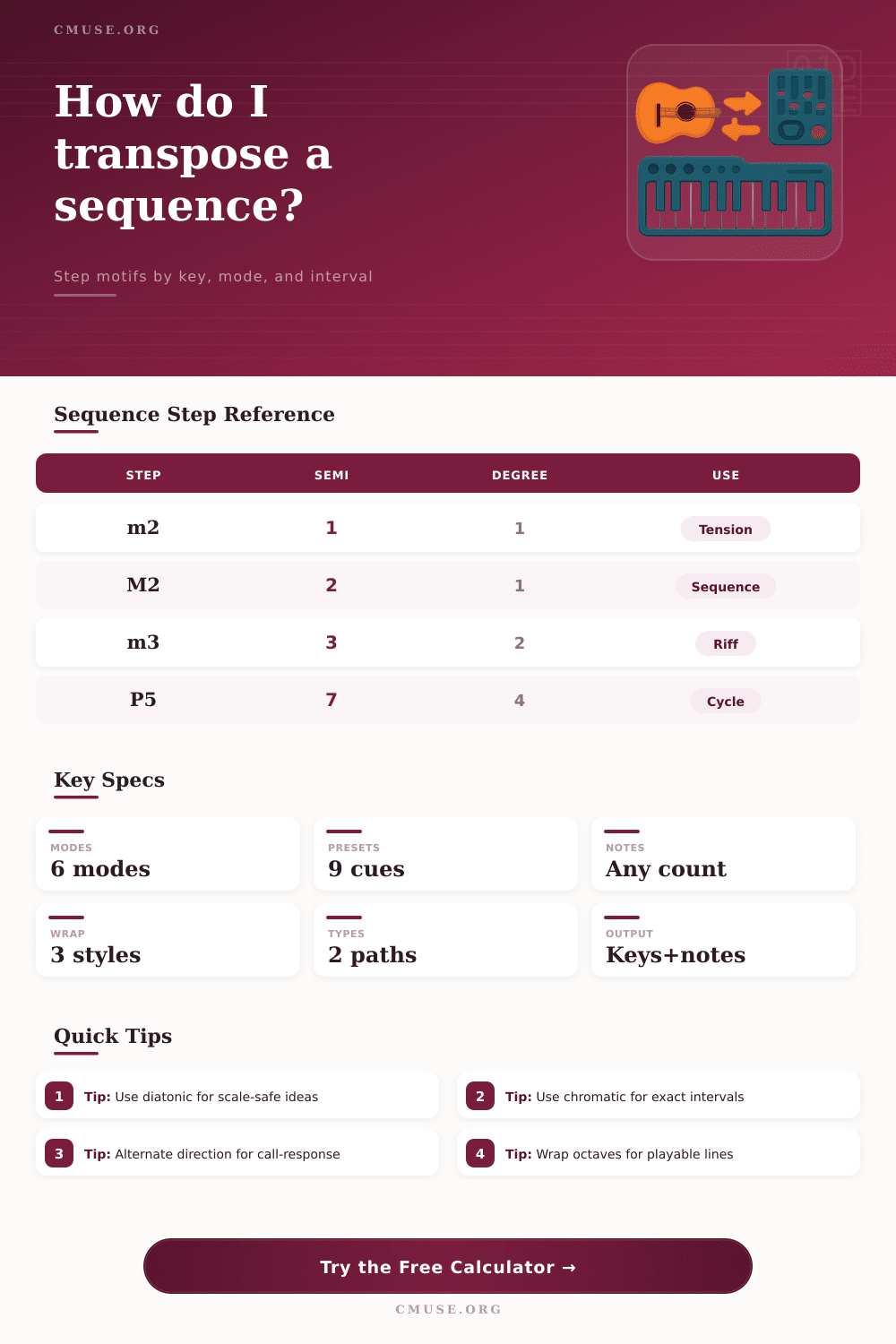
| Interval Step | Chromatic Semitones | Diatonic Degree Move | Common Sequence Use |
|---|---|---|---|
| Minor 2nd | 1 | Next scale degree color | Chromatic tension line |
| Major 2nd | 2 | Step to next degree | Classical and pop sequences |
| Minor 3rd | 3 | Skip by third | Blues, rock, diminished cells |
| Perfect 4th | 5 | Four-note scale reach | Guitar shapes and modulations |
| Perfect 5th | 7 | Five-note scale reach | Circle motion and dominant chains |
| Mode | Scale Formula | Diatonic Sequence Color | Typical Starting Motif |
|---|---|---|---|
| Major / Ionian | 1 2 3 4 5 6 7 | Stable, bright, functional | 1 2 3 5 |
| Natural minor | 1 2 b3 4 5 b6 b7 | Darker and stepwise | 1 b3 4 5 |
| Dorian | 1 2 b3 4 5 6 b7 | Minor with raised 6th lift | 1 2 b3 5 |
| Mixolydian | 1 2 3 4 5 6 b7 | Dominant and open | 5 4 3 1 |
| Harmonic minor | 1 2 b3 4 5 b6 7 | Leading-tone pull | 1 2 b3 7 |
| Wrap Setting | Register Result | Best For | Calculation Effect |
|---|---|---|---|
| Preserve actual register | Notes keep climbing or falling | Piano, strings, orchestration | Uses full semitone offset |
| Wrap into one octave | All tones return to base octave | Lead sheets and compact riffs | Normalizes each pitch class |
| Wrap into two-octave range | Line stays within two octaves | Guitar, voice, synth hooks | Folds notes above the range |
| Alternate direction | Steps mirror around the source | Call-response phrases | Even steps rise, odd steps fall |
| Preset | Starting Key | Step Design | Primary Use |
|---|---|---|---|
| Circle of Fifths Motif | C major | Down P5, chromatic | Dominant chain sketch |
| Jazz ii-V-I Chain | D Dorian | Down P5, diatonic | Practice all tonal centers |
| Bach Up-Second Sequence | C major | Up M2, diatonic | Sequential counterpoint |
| Blues Minor-Third Riff | A minor | Up m3, chromatic | Riff development |
Getting a memorable melody from one key to another can be hard. Put the capo two frets further up the neck. The line now sound wrong, out of place, stretched. This isn’t normaly down to your ear. It’s more likely that you don’t understand what happens to an interval when you change key. You’re moving notes without paying attention to the architecture they rest on.
Staying in key and moving between note is where most ideas stumble. Once you’ve identified your motif, then the calculator will do the maths for you and you don’t have to try and second-guess if a whole step from C Major sounds the same than a whole step from A Minor. It doesn’t sound the same. The size of the step vary according to which note of the scale you’re playing. Your brain hears how one note relate to another. You need to be aware of this important gap, sometimes you want exact semitone shift or strict adherence to the mode.
How to Move Melodies Between Keys
Think of a regular major scale for example. There’s a whole step from second to third, then a half step from the third to the fourth. So when you move a sequence diatonically by a major second, you’re moving a single scale degree upwards. Chromatically speaking it’s simply two semitones exactly. This means the approach soon diverge as each has its own set of rules.
You may have a riff that works tightly in the key of C but becomes awkward in F when you forget the rules of modes. By toggling between these engines, you will be able to hear the immediate difference. The presets make this clearer. A Bach style up-second sequence is basically dependent on diatonic consistency of the melody for the harmonic logic. If you force it into chromatic transposition and remove functional harmony that gives it its classical counterpoint sound, it suddenly begins to resemble a sci-fi laser effect.
In contrast, a bluesy minor third riff can often thrive when moved chromatically, as pulling outside the scale to resolve is part of what creates the tension. The question is are you after textural grit or something with more functional stability?
Another pragmatic element that’s frequently ignored is octave wrapping. If you’re using a circle of fifths progression, for example, it move upwards by perfect fifths that quickly rise through the pitch range. Unless you have your wrap setting on then you’ll find that your line ends up above the reach of a guitar neck or beyond what is possible for a singer. You can use this option on the calculator to fold notes back down into either one or two octaves retaining the harmony but making it playable. It’s not so much theoretical as logistical.
It is not just about direction. Static upwards lines don’t have the same call-and-response feeling that alternate up-and-down sequences do. Mirroring your intervals around a central pitch can give hook a sense of breathing, it moves away from the tonic and back again. It is a simple application of a storytelling principle in pitch space.
The reason most people become stuck is that they treat all the intervals equally; like one big block of sound. They’re not. That’s why the reference tables on the page shows you how different modes change the color of your sequence. In mixolydian you get a dominant open feel but in dorian it’s a brighter minor lift. Selecting the right mode means selecting the emotional vocabulary of your phrase.
In conclusion, then: transposing is simply translating. It means translating a musical idea from one context into another without changing the meaning of what was there. Maybe it is a rock riff that has to be grounded or a film cue that need to rise up with tension. Simple mechanics but the art is deciding which way leads to the right place.
Begin with an easily identifiable theme; set yourself some constraints and let the structure take care of the business. Listen through and rest of the journey will follow.