🎵 Semitone Calculator
Calculate semitones between notes, frequency shifts, pitch intervals & cents deviation
| Note | Octave 3 | Octave 4 | Octave 5 | MIDI # |
|---|---|---|---|---|
| C | 130.81 Hz | 261.63 Hz | 523.25 Hz | 48 / 60 / 72 |
| C# / Db | 138.59 Hz | 277.18 Hz | 554.37 Hz | 49 / 61 / 73 |
| D | 146.83 Hz | 293.66 Hz | 587.33 Hz | 50 / 62 / 74 |
| D# / Eb | 155.56 Hz | 311.13 Hz | 622.25 Hz | 51 / 63 / 75 |
| E | 164.81 Hz | 329.63 Hz | 659.26 Hz | 52 / 64 / 76 |
| F | 174.61 Hz | 349.23 Hz | 698.46 Hz | 53 / 65 / 77 |
| F# / Gb | 185.00 Hz | 369.99 Hz | 739.99 Hz | 54 / 66 / 78 |
| G | 196.00 Hz | 392.00 Hz | 783.99 Hz | 55 / 67 / 79 |
| G# / Ab | 207.65 Hz | 415.30 Hz | 830.61 Hz | 56 / 68 / 80 |
| A | 220.00 Hz | 440.00 Hz | 880.00 Hz | 57 / 69 / 81 |
| A# / Bb | 233.08 Hz | 466.16 Hz | 932.33 Hz | 58 / 70 / 82 |
| B | 246.94 Hz | 493.88 Hz | 987.77 Hz | 59 / 71 / 83 |
| Instrument | Standard Tuning | Lowest Note | Semitone Range |
|---|---|---|---|
| Guitar (6-string) | E2–A2–D3–G3–B3–E4 | E2 (82.41 Hz) | ~24 semitones |
| Bass Guitar (4-string) | E1–A1–D2–G2 | E1 (41.20 Hz) | ~24 semitones |
| Piano (88 keys) | A0 to C8 | A0 (27.50 Hz) | 88 semitones |
| Violin | G3–D4–A4–E5 | G3 (196.00 Hz) | ~37 semitones |
| Cello | C2–G2–D3–A3 | C2 (65.41 Hz) | ~37 semitones |
| Human Voice (soprano) | C4 to C6 | C4 (261.63 Hz) | 24 semitones |
| Human Voice (bass) | E2 to E4 | E2 (82.41 Hz) | 24 semitones |
| Trumpet | F#3 to D6 | F#3 (185.00 Hz) | ~33 semitones |
| Semitones | Frequency Ratio | Cents | Interval Name |
|---|---|---|---|
| 0 | 1.0000 | 0 ¢ | Unison |
| 1 | 1.0595 | 100 ¢ | Minor 2nd (Half Step) |
| 2 | 1.1225 | 200 ¢ | Major 2nd (Whole Step) |
| 3 | 1.1892 | 300 ¢ | Minor 3rd |
| 4 | 1.2599 | 400 ¢ | Major 3rd |
| 5 | 1.3348 | 500 ¢ | Perfect 4th |
| 6 | 1.4142 | 600 ¢ | Tritone (Augmented 4th) |
| 7 | 1.4983 | 700 ¢ | Perfect 5th |
| 8 | 1.5874 | 800 ¢ | Minor 6th |
| 9 | 1.6818 | 900 ¢ | Major 6th |
| 10 | 1.7818 | 1000 ¢ | Minor 7th |
| 11 | 1.8877 | 1100 ¢ | Major 7th |
| 12 | 2.0000 | 1200 ¢ | Octave |
| 24 | 4.0000 | 2400 ¢ | Two Octaves |
In western music, the semitone is the smallest interval that you find. Consider it as the space between two neighboring notes in the chromatic scale. On a piano it simply is the gap between two keys that sit directly one beside the other, for example from C to the black key right next to it.
And from that black key to D? Also a semitone.
What is a semitone and how do musical intervals work
An octave splits into twelve semitones according to the chromatic scale. Like this you have twelve small steps to form one whole octave. On a keyboard, if you count twelve keys one after the other, that gives your full cycle.
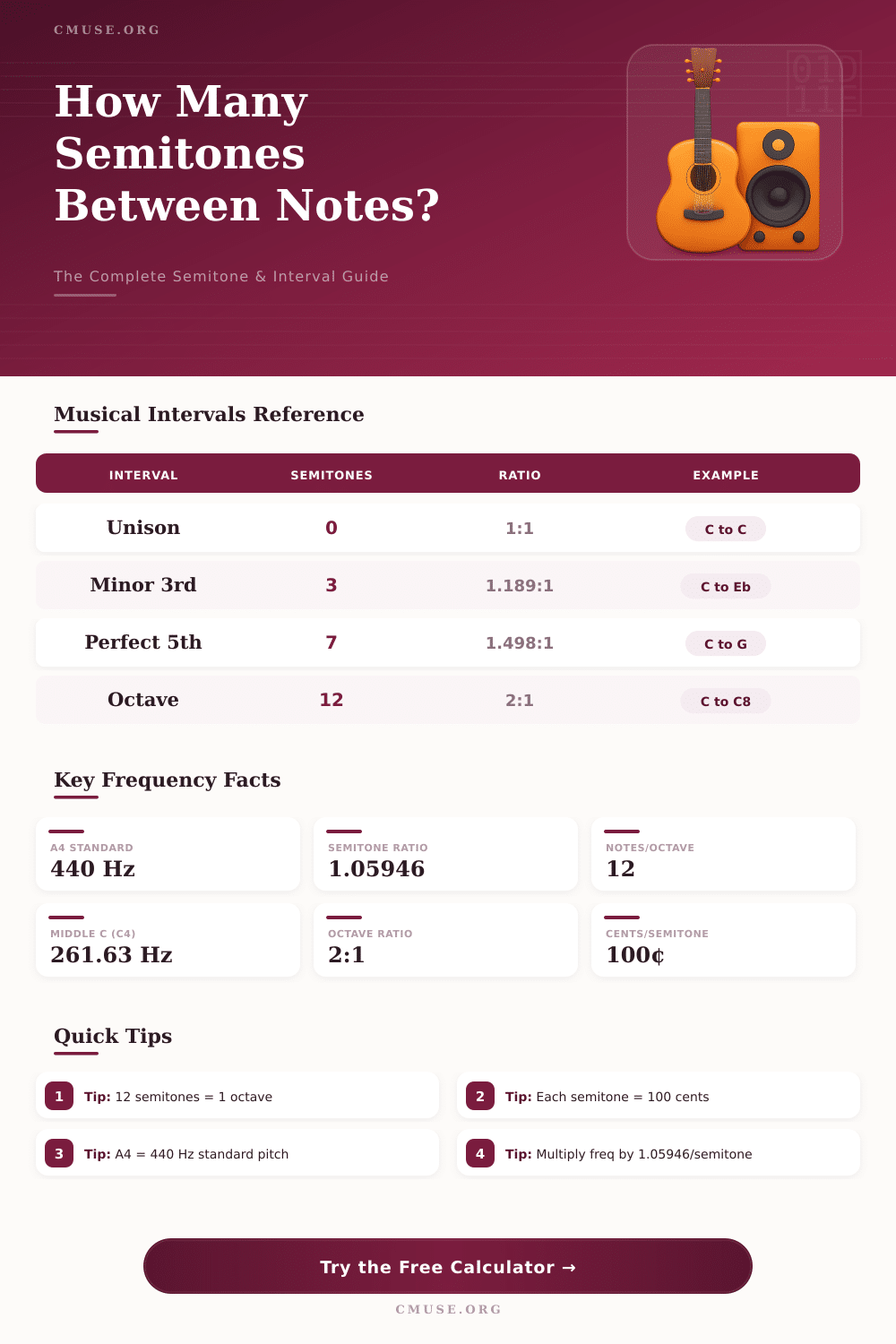
The frequency ratio between two notes that are one semitone apart match to the twelfth root of two.
Here something neat: a semitone always happens between a black key and its neighboring white key on the piano. Even so in each octave there are two places where semitone are between two white keys. They are between E and F, and between B and C. In the major scale, it follows this pattern: whole, whole, half, whole, whole, whole, half.
Two semitones create a whole tone, which musicians also call a major second. And what about a tritone? It covers six semitones (or three whole tones), if you like too consider that.
Funny thing, that interval has three different names depending on the context: augmented fourth, diminished fifth or tritone.
To properly describe intervals, one needs both their number and their quality. The qualities are perfect, major, minor, augmented and diminished. Unisons, fourths, fifths and octaves are perfect intervals.
Seconds, thirds, sixths and sevenths split into major and minor versions. If you lower a major interval by a semitone, it becomes minor. Lower a minor or perfect by a semitone, and you have diminished.
Add a semitone above perfect or major, and you form an augmented interval.
Equal tuning makes each semitone exactly 100 cents, so an octave holds 1200 cents. Each semitone matches a frequency ratio of two to the power one-twelfth. A note that is one semitone above 100 Hz will reach around 106 Hz.
Different parts of the world use different terms. In the United Kingdom one prefers “tone” and “semitone”, while in the United States one says “whole step” and “half step”. Here is the thing, those intervals are not limited to one instrument.
They count for piano, guitar, voice and almost everything that you can play. An interval is simply distance in pitch, nothing more mysterious than miles or centimeters. Lower a perfect fifth by a semitone, and you get a major third.
Add a semitone above a perfect fourth, and you created a minor sixth. Equaltuning spreads everything equally, but that balance can push some intervals, like the major third, a bit sharp at the edges.