Secondary Dominant Chord Calculator
Map applied dominants, verify the target chord, and hear how V/ii, V/V, or V/vi locks into the next harmony.
🎵 Preset Applied Dominants
📊 Calculator Inputs
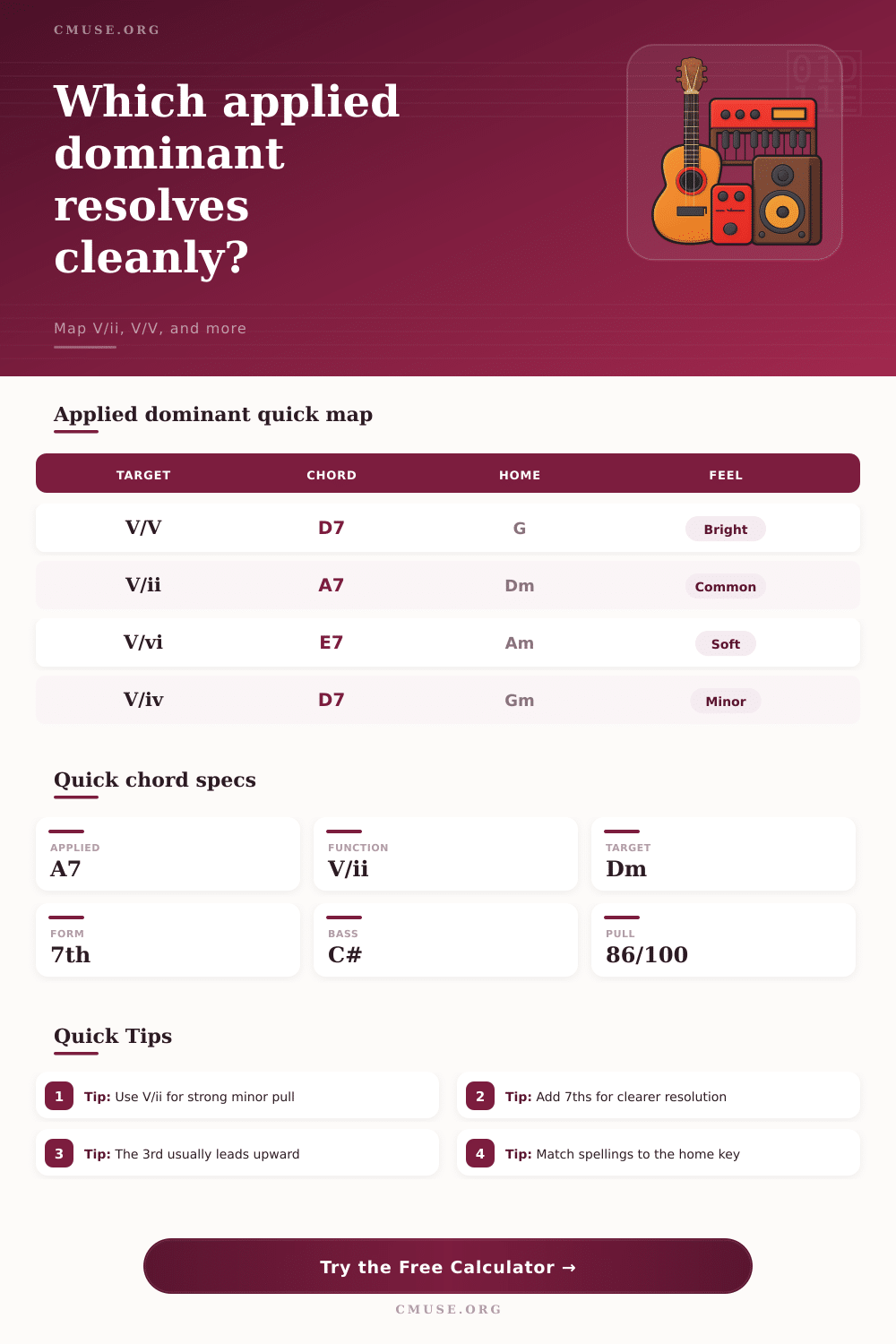
Choose the home key, pick the target function, and the calculator returns the applied dominant, its chord tones, and the most likely resolution path.
📋 Dominant Spec Grid
📖 Reference Tables
| Target | C major | Applied dominant | Result |
|---|
| Target | A minor | Applied dominant | Result |
|---|
| Form | Notes | Use | Pull |
|---|
| Style | Cue | Best fit | Effect |
|---|
A secondary dominant is a musical term that describe a chord that is temporalily used as a dominant chord in a chord progression. This type of chord is used to create tension and direction within a musical composition. A secondary dominant treats a non-tonic chord as if it were the tonic chord of a new key within the musical composition.
When composers use a secondary dominant chord, it add tension to the music. The chord also adds a sense of direction to the music, and it adds color to the music. Songwriters use this chord to increase the impact of a songs verse or chorus.
What is a secondary dominant?
To create a secondary dominant chord, the composer borrows the sound of a V7 or a V chord from the target chords key. For example, if a composer is composing music in the key of C, the V chord will be a G7 chord, which resolve to the tonic chord of C. If a composer uses a secondary dominant, such as a D7 chord, the D7 chord will treat the G chord as if it is the tonic chord of the key of D major. The F# and C notes in the D7 chord will want to resolve to the chord of G. The process by which chord tones move to another chord is called voice leading.
This type of chord movement is important within music theory because it create smooth transitions from one chord to the next. Composers can choose any target chord for the secondary dominant chord, such as the ii or the vi chord. The ii chord in a key is typically a minor chord.
The minor chord typically resolves to the V chord in a key. An A7 chord can be a secondary dominant for the Dm chord. This chord progression is common in pop and jazz music.
A secondary dominant calculator can assist a composer in finding the correct chord. The calculator will determine the root of the chord that is a perfect fifth above the target chord. The calculator can adjust the chord according to the mode in which the music will be played.
The mode can be major, natural minor, or harmonic minor. The composer has to first choose the home key and the mode before they can pick a target chord. This will help the calculator identifies the correct chord and tones to use for the composition.
The form in which the secondary dominant chord is used can alter the chords sound and resolution. A simple triad can be used to create the chord for a specific musical effect. However, including a dominant seventh chord to the triad will make the chord resolution more clearly.
The flat seventh of the dominant seventh chord creates a desire for the chord to resolve to the third of the target chord. A nine note or a flat nine note can be added to the chord for more tension within the song. A composer can use a sus4 chord if they want to add a suspended sound to the song before it resolves to the target chord.
The extensions of the chord will increase its pull to the target chord. Inversions will change the sound of the chord and the function of its bass note. Using root position for the chord will make it hit the home chord directly.
However, using a first inversion will create the chord with the third of the chord in the bass. The first inversion chord can be used to prepare a set of common tones for chords. The output of the calculator will show the applied chords name, its function in the song, the target chord to which it resolve, and a pull score.
The pull score for the chord indicates the strength of the chord. A higher score indicates that the voice leading for the chord is clean and that the chromatic tones do not clash with the tonic chord of the home key. The breakdown of the chord will show each tone and how it resolves to another tone in the chord.
This breakdown can act as a roadmap for the musicians to find the best voicings for the piano or the best shapes for the guitar. Many people make mistakes when using a secondary dominant chord. One of the most common mistakes is ignoring the mode in which the song will be played.
Ignoring the mode of the song can result in the use of incorrect target chords. Many people will also make the mistake of skipping the seventh note of the chord. If the seventh note of a dominant chord is skipped, it will sound like a major chord instead of a dominant chord.
Another mistake that people will make is using voice leading that defeat the purpose of using a secondary dominant chord. For example, if the third of the chord moves down in voice leading, it will fight against the natural pull of the chord to move the third of the chord up. People should always listen to the third of the chord.
This note expresses the emotional content of the chord. In fast musical progressions, a composer should of use root position chords. However, in slow ballads, a composer can use inversions of the chord to create walking bass lines.
A secondary dominant chord can be used to create different musical effects. A chord with a flat nine will create tension within the music. However, if the musical mix contains many instruments, using a b9 secondary dominant can result in a muddy sound for the chord.
A direct resolution of the chord will create a firm pull for the chord to resolve to its target chord. A deceptive resolution can unsettle the listener when composers want to create a specific musical effect. Using a secondary dominant within a song too often will keep the song surprising for the listener.
However, if it is overused, the song may lose its sense of surprise to the listener.